







Question: USING PYTHON The two roots of a quadratic equation example, ax2 + bx+c = 0, can be obtained using the following formula: -b+ vb2-4ac -b-Vb2-4ac
USING PYTHON
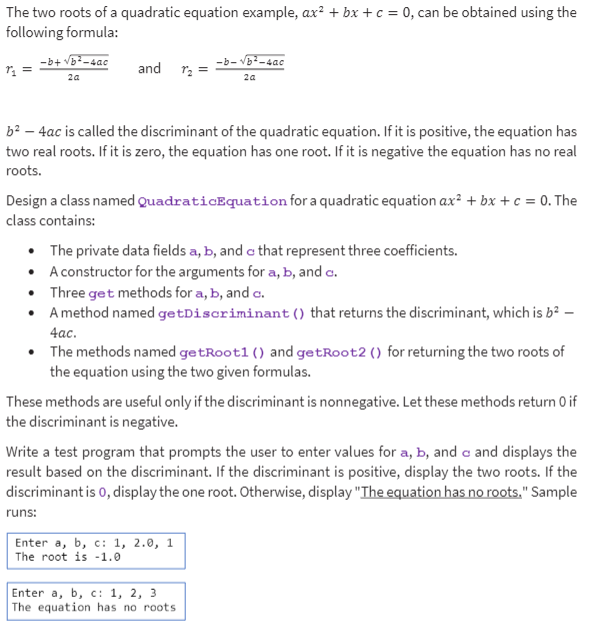
The two roots of a quadratic equation example, ax2 + bx+c = 0, can be obtained using the following formula: -b+ vb2-4ac -b-Vb2-4ac r = and r2 = 20 2a b2 - 4ac is called the discriminant of the quadratic equation. If it is positive, the equation has two real roots. If it is zero, the equation has one root. If it is negative the equation has no real roots. Design a class named QuadraticEquation for a quadratic equation ax2 + bx + c = 0. The class contains: The private data fields a, b, and c that represent three coefficients. A constructor for the arguments for a, b, and c. Three get methods for a, b, and c. A method named getDiscriminant () that returns the discriminant, which is b2 4ac. The methods named getRoot1 () and getRoot2() for returning the two roots of the equation using the two given formulas. These methods are useful only if the discriminant is nonnegative. Let these methods return O if the discriminant is negative. Write a test program that prompts the user to enter values for a, b, and c and displays the result based on the discriminant. If the discriminant is positive, display the two roots. If the discriminant is o, display the one root. Otherwise, display "The equation has no roots." Sample runs: Enter a, b, c: 1, 2.0, 1 The root is -1.0 Enter a, b, c: 1, 2, 3 The equation has no roots
Step by Step Solution
There are 3 Steps involved in it

Get step-by-step solutions from verified subject matter experts
 Study Help