







Question: Using R Suppose we will run an experiment that compares three treatments: A, B, and C. From previous study, we believe the shared variance could
Using R
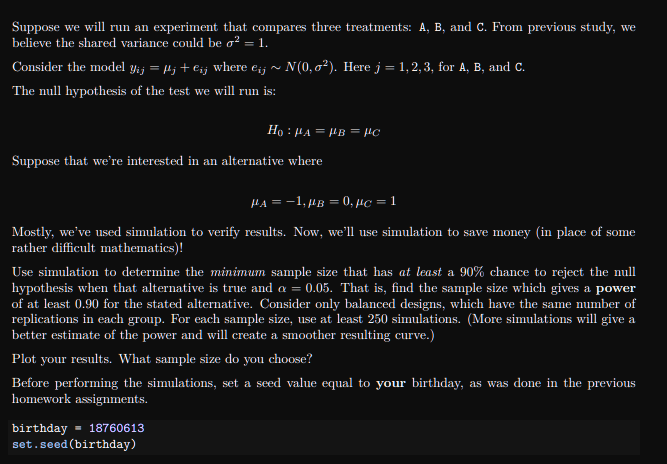
Suppose we will run an experiment that compares three treatments: A, B, and C. From previous study, we believe the shared variance could be o2 = 1. Consider the model yij = 1; + ei; where ei; ~ N(0,0%). Here j = 1, 2, 3, for A, B, and C. The null hypothesis of the test we will run is: H:HA = B = fc Suppose that we're interested in an alternative where A = -1, B = 0,4c =1 Mostly, we've used simulation to verify results. Now, we'll use simulation to save money in place of some rather difficult mathematics)! Use simulation to determine the minimum sample size that has at least a 90% chance to reject the null hypothesis when that alternative is true and a = 0.05. That is, find the sample size which gives a power of at least 0.90 for the stated alternative. Consider only balanced designs, which have the same number of replications in each group. For each sample size, use at least 250 simulations. (More simulations will give a better estimate of the power and will create a smoother resulting curve.) Plot your results. What sample size do you choose? Before performing the simulations, set a seed value equal to your birthday, as was done in the previous homework assignments. birthday = 18760613 set.seed (birthday) Suppose we will run an experiment that compares three treatments: A, B, and C. From previous study, we believe the shared variance could be o2 = 1. Consider the model yij = 1; + ei; where ei; ~ N(0,0%). Here j = 1, 2, 3, for A, B, and C. The null hypothesis of the test we will run is: H:HA = B = fc Suppose that we're interested in an alternative where A = -1, B = 0,4c =1 Mostly, we've used simulation to verify results. Now, we'll use simulation to save money in place of some rather difficult mathematics)! Use simulation to determine the minimum sample size that has at least a 90% chance to reject the null hypothesis when that alternative is true and a = 0.05. That is, find the sample size which gives a power of at least 0.90 for the stated alternative. Consider only balanced designs, which have the same number of replications in each group. For each sample size, use at least 250 simulations. (More simulations will give a better estimate of the power and will create a smoother resulting curve.) Plot your results. What sample size do you choose? Before performing the simulations, set a seed value equal to your birthday, as was done in the previous homework assignments. birthday = 18760613 set.seed (birthday)Step by Step Solution
There are 3 Steps involved in it
1 Expert Approved Answer
Step: 1 Unlock

Question Has Been Solved by an Expert!
Get step-by-step solutions from verified subject matter experts
Step: 2 Unlock
Step: 3 Unlock
 Study Help