







Question: using SageMAth I dont understand what is the question asking to do and neither what comands should I use Let (2) be the number of
using SageMAth
I dont understand what is the question asking to do and neither what comands should I use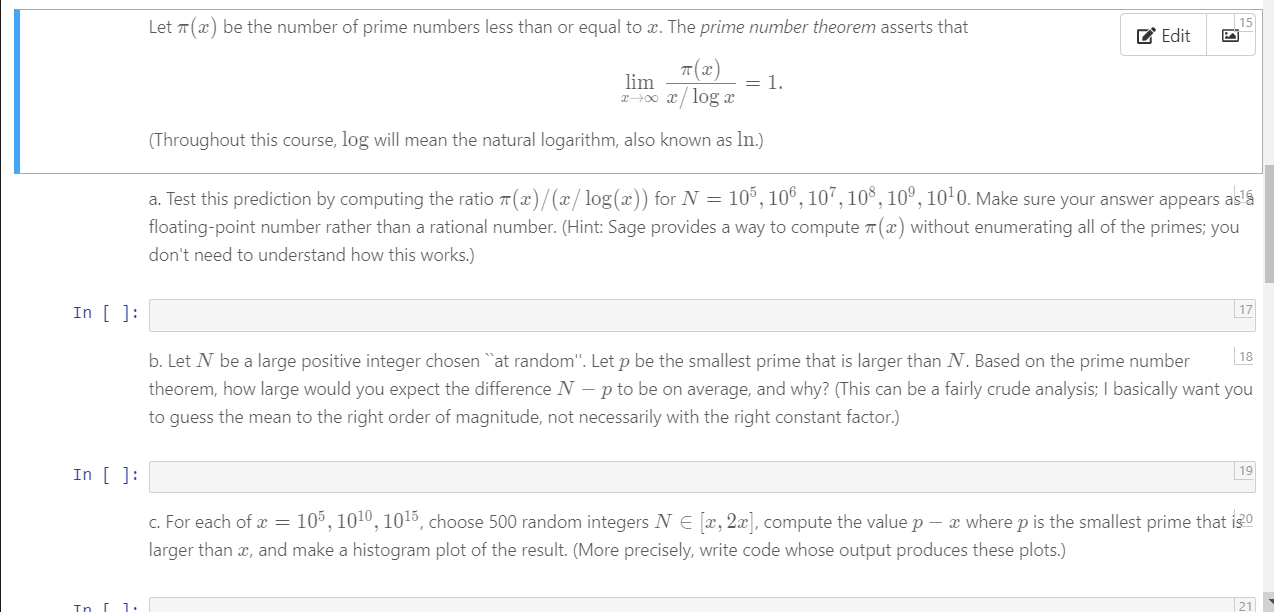
Let (2) be the number of prime numbers less than or equal to z. The prime number theorem asserts that Edit T(2) lim- 2700 2log = 1. (Throughout this course, log will mean the natural logarithm, also known as In.) a. Test this prediction by computing the ratio (2)/(x/log(x)) for N = 105, 106, 107, 108, 109, 10-0. Make sure your answer appears as a floating-point number rather than a rational number. (Hint: Sage provides a way to compute (2) without enumerating all of the primes; you don't need to understand how this works.) In [ ]: b. Let N be a large positive integer chosen at random". Let p be the smallest prime that is larger than N. Based on the prime number 18 theorem, how large would you expect the difference N - p to be on average, and why? (This can be a fairly crude analysis; I basically want you to guess the mean to the right order of magnitude, not necessarily with the right constant factor.) In [ ]: c. For each of x = 105, 1010, 1015, choose 500 random integers N E [X, 2x), compute the value p- x where p is the smallest prime that i30 larger than 2, and make a histogram plot of the result. (More precisely, write code whose output produces these plots.) In ]. Let (2) be the number of prime numbers less than or equal to z. The prime number theorem asserts that Edit T(2) lim- 2700 2log = 1. (Throughout this course, log will mean the natural logarithm, also known as In.) a. Test this prediction by computing the ratio (2)/(x/log(x)) for N = 105, 106, 107, 108, 109, 10-0. Make sure your answer appears as a floating-point number rather than a rational number. (Hint: Sage provides a way to compute (2) without enumerating all of the primes; you don't need to understand how this works.) In [ ]: b. Let N be a large positive integer chosen at random". Let p be the smallest prime that is larger than N. Based on the prime number 18 theorem, how large would you expect the difference N - p to be on average, and why? (This can be a fairly crude analysis; I basically want you to guess the mean to the right order of magnitude, not necessarily with the right constant factor.) In [ ]: c. For each of x = 105, 1010, 1015, choose 500 random integers N E [X, 2x), compute the value p- x where p is the smallest prime that i30 larger than 2, and make a histogram plot of the result. (More precisely, write code whose output produces these plots.) In ]
Step by Step Solution
There are 3 Steps involved in it

Get step-by-step solutions from verified subject matter experts
 Study Help