







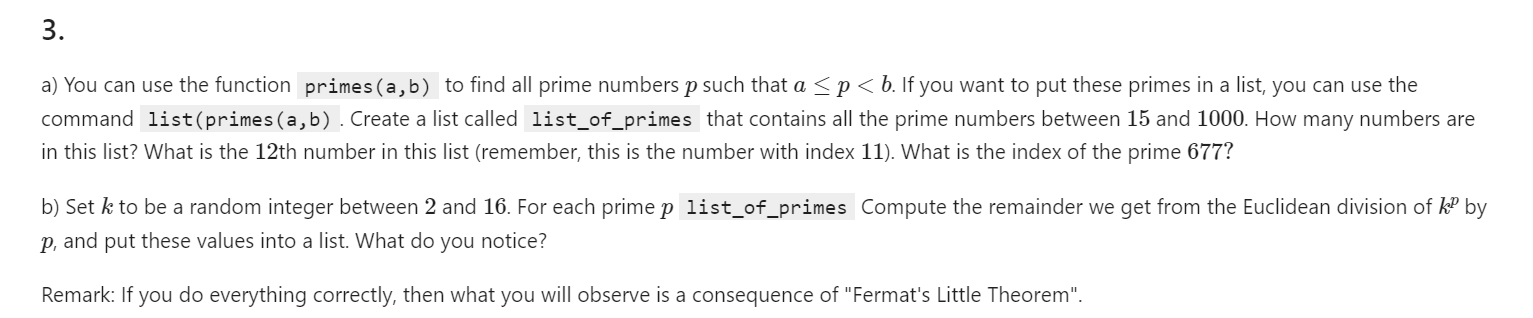
Question: Using sagemaths jupyter notebook language code solve the following: a ) You can use the function primes ( a , b ) to find all
Using sagemath"s jupyter notebook language code solve the following:
a You can use the function primes to find all prime numbers such that you want put these primes a list, you can use the
command list Create a list called rimes that contains all the prime numbers between and How many numbers are
this list? What the number this list this the number with index What the index the prime
Set a random integer between and For each prime rimes Compute the remainder get from the Euclidean division
and put these values into a list. What you notice?
Remark: you everything correctly, then what you will observe a consequence "Fermat's Little Theorem".
Step by Step Solution
There are 3 Steps involved in it
1 Expert Approved Answer
Step: 1 Unlock

Question Has Been Solved by an Expert!
Get step-by-step solutions from verified subject matter experts
Step: 2 Unlock
Step: 3 Unlock
 Study Help