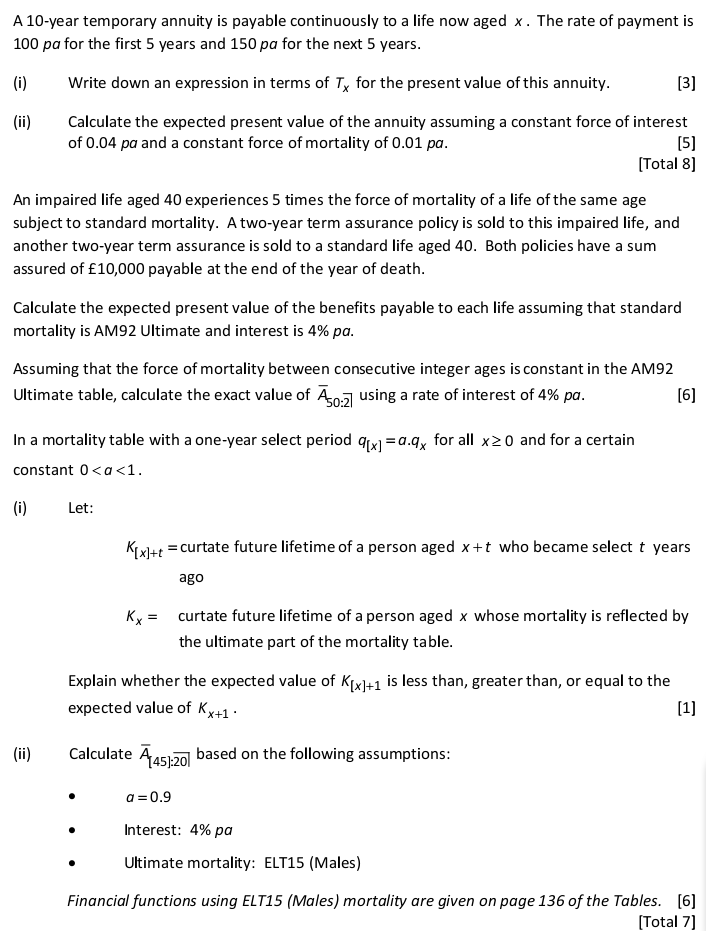
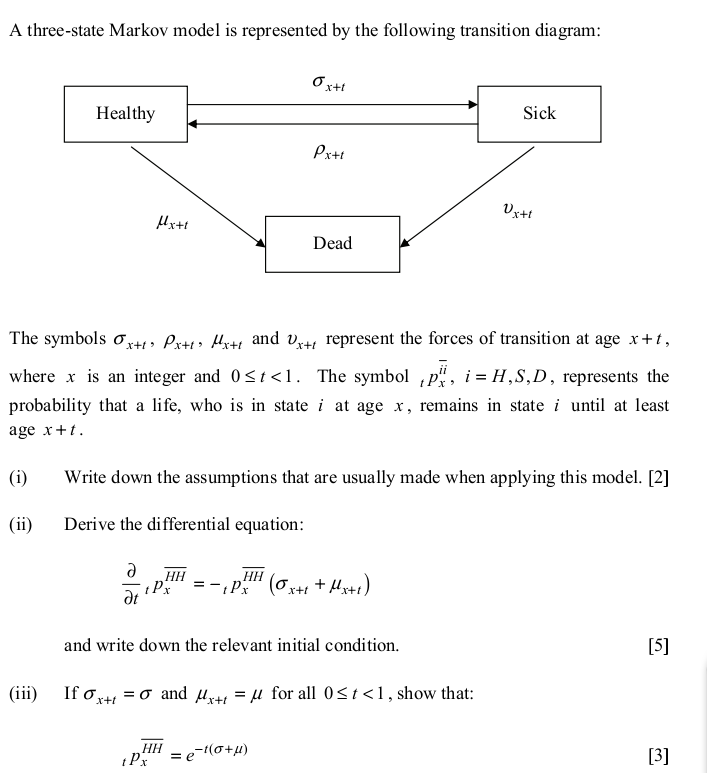
Question: Using step by step from the knowledge of life function answer this question. A three-state Markov model is represented by the following transition diagram: IIwith?

Using step by step from the knowledge of life function answer this question.
Using step by step from the knowledge of lifeUsing step by step from the knowledge of life
A three-state Markov model is represented by the following transition diagram: IIwith? Healthy _- px+f n: The symbols om, x +1: #1 +1. and ox +1 represent the forces of transition at age x+t, where x is an integer and [lite]. The symbol rpil, i=H,S,D, represents the probability that a life, who is in state i at age it, remains in state 1' until at least age x+ t. (i) Write down the assumptions that are usually made when applying this model. [2] {ii} Derive the differential equation: a m E $ max = 'rP'x (51+: +Jux+r) and write down the relevant initial eondition. [5] (iii) If a\"! = or and pm = p for all bite] , show that: HH IF): = e rid-Hf] [3] A 10-year temporary annuity is payable continuously to a life now aged x . The rate of payment is 100 pa for the first 5 years and 150 pa for the next 5 years. (i) Write down an expression in terms of Tx for the present value of this annuity. [3] (ii) Calculate the expected present value of the annuity assuming a constant force of interest of 0.04 pa and a constant force of mortality of 0.01 pa. [5] [Total 8] An impaired life aged 40 experiences 5 times the force of mortality of a life of the same age subject to standard mortality. A two-year term assurance policy is sold to this impaired life, and another two-year term assurance is sold to a standard life aged 40. Both policies have a sum assured of f10,000 payable at the end of the year of death. Calculate the expected present value of the benefits payable to each life assuming that standard mortality is AM92 Ultimate and interest is 4% pa. Assuming that the force of mortality between consecutive integer ages is constant in the AM92 Ultimate table, calculate the exact value of Aso:2 using a rate of interest of 4% pa. [6] In a mortality table with a one-year select period q(x] =0.q, for all x2 0 and for a certain constant 0

Step by Step Solution

There are 3 Steps involved in it

1 Expert Approved Answer
Step: 1 Unlock blur-text-image

Question Has Been Solved by an Expert!

Get step-by-step solutions from verified subject matter experts

Step: 2 Unlock
Step: 3 Unlock

Students Have Also Explored These Related Accounting Questions!