







Question: Using Taylor series and matrices Write a MATLAB program that produces a numerical solution of an ordinary differential equation. This will involve the following steps:
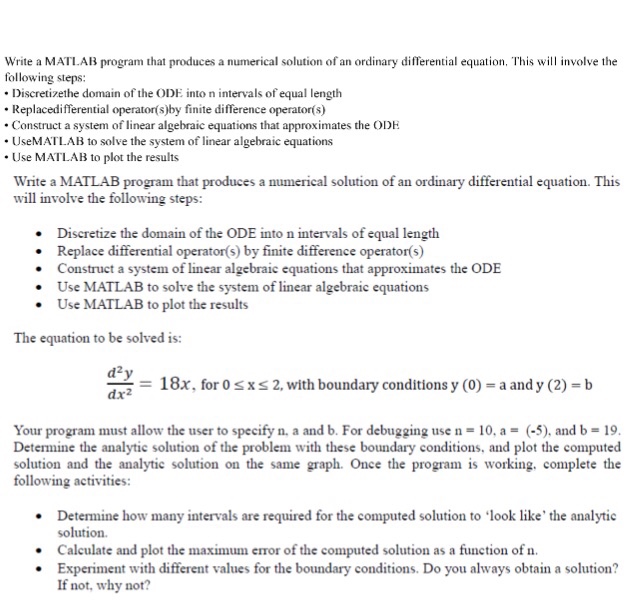
Write a MATI AB program that produces a numerical solution of an ordinary differential equation, This will involve the following steps: Discretizethe domain of the ODE into n intervals of equal length Replacedifferential operator(s)by finite difference operator(s) Construct a system of linear algebraic equations that approximates the ODE UseMATLAB to solve the system of linear algebraic equations Use MATLAB to plot the results Write a M program that produces a numerical solution of an ordinary differential equation. This MATLAB will involve the following steps: Discretize the domain of the ODE into n intervals of equal length. Replace differential operators by finite difference operator(s) Construct a system of linear algebraic equations that approximates the ODE Use MATLAB to solve the system of linear algebraic equations Use MATLAB to plot the results The equation to be solved is: 18x, for o sxs 2, ith boundary conditions y (0) a and y (2-b dx2 Your program must allow the user to specify n. a and b. For debugging use n-10, a (-5), and b- 19. Determine the analytic solution of the problem with these boundary conditions, and plot the computed solution and the analytic solution on the same graph. Once the program is working, complete the following activities: etemine how many intervals are required for the computed solution to "look like' the analytic solution. Calculate and plot the maximum error of the computed solution as a function of n Experiment with different values for the boundary conditions. Do you always obtain a solution? If not, why not
Step by Step Solution
There are 3 Steps involved in it

Get step-by-step solutions from verified subject matter experts
 Study Help