





Question: Using the accept-reject algorithm(see details of algorithm below), generate observations from the binomial distribution as target distribution and the uniform distribution as proposal distribution. Reverse

Using the accept-reject algorithm(see details of algorithm below), generate observations from the binomial distribution as target distribution and the uniform distribution as proposal distribution. Reverse the roles and carry out the same simulation and note the differences. We can use samples and R program to generate output and observations.

More details - Accept-Reject algorithm (also at https://jblevins.orgotes/accept-reject) details are pasted below and in question we need to use sample from binomial distribution for target and sample from uniform distribution as proposal and then explain our observation. Then so same for reverse.
Using the accept-reject algorithm(see details of

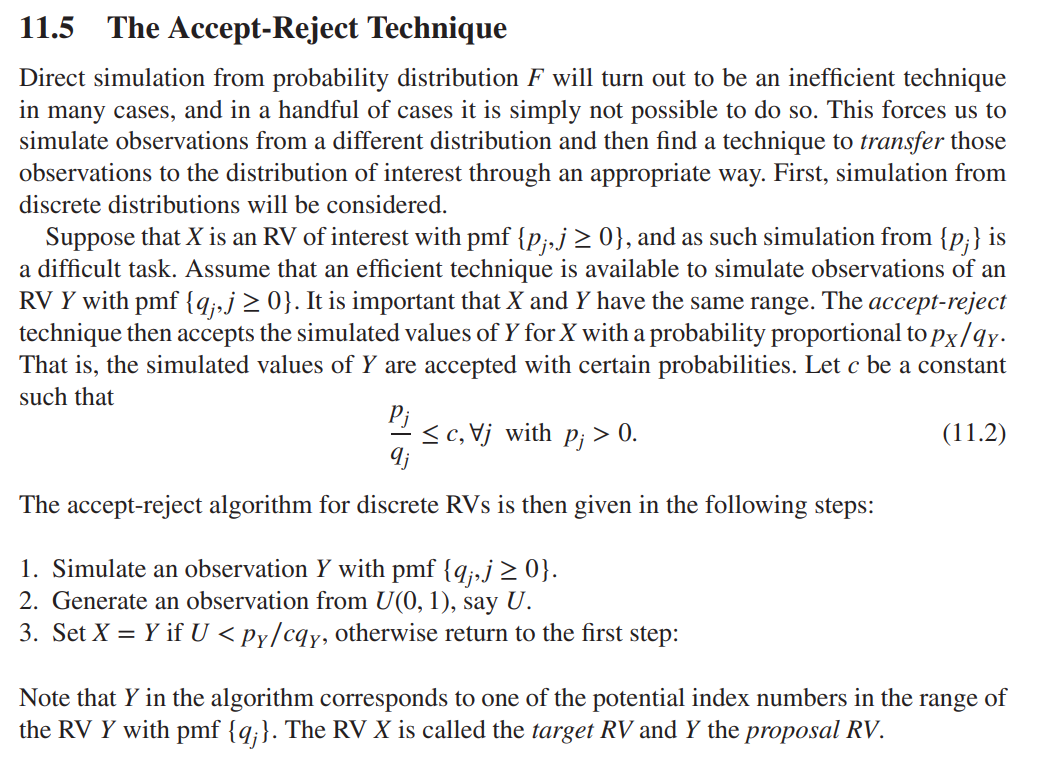
11.5 The Accept-Reject Technique Direct simulation from probability distribution F will turn out to be an inefficient technique in many cases, and in a handful of cases it is simply not possible to do so. This forces us to simulate observations from a different distribution and then find a technique to transfer those observations to the distribution of interest through an appropriate way. First, simulation from discrete distributions will be considered. Suppose that X is an RV of interest with pmf {Pjj 2 0}, and as such simulation from {P;} is a difficult task. Assume that an efficient technique is available to simulate observations of an RV Y with pmf {9jj 2 0}. It is important that X and Y have the same range. The accept-reject technique then accepts the simulated values of Y for X with a probability proportional to Px/qy. That is, the simulated values of Y are accepted with certain probabilities. Let c be a constant such that P; Sc, Vj with P; > 0. (11.2) The accept-reject algorithm for discrete RVs is then given in the following steps: 1. Simulate an observation Y with pmf {9;,j 0}. 2. Generate an observation from U(0,1), say U. 3. Set X = Y if U 0. (11.2) The accept-reject algorithm for discrete RVs is then given in the following steps: 1. Simulate an observation Y with pmf {9;,j 0}. 2. Generate an observation from U(0,1), say U. 3. Set X = Y if U

Step by Step Solution

There are 3 Steps involved in it

1 Expert Approved Answer
Step: 1 Unlock blur-text-image

Question Has Been Solved by an Expert!

Get step-by-step solutions from verified subject matter experts

Step: 2 Unlock
Step: 3 Unlock

Students Have Also Explored These Related General Management Questions!