







Question: Using the below The Five Conflict-Handling Modes answer all the five scenarios - The purpose of this exercise is for students to recognize and explain
Using the below The Five Conflict-Handling Modes answer all the five scenarios -
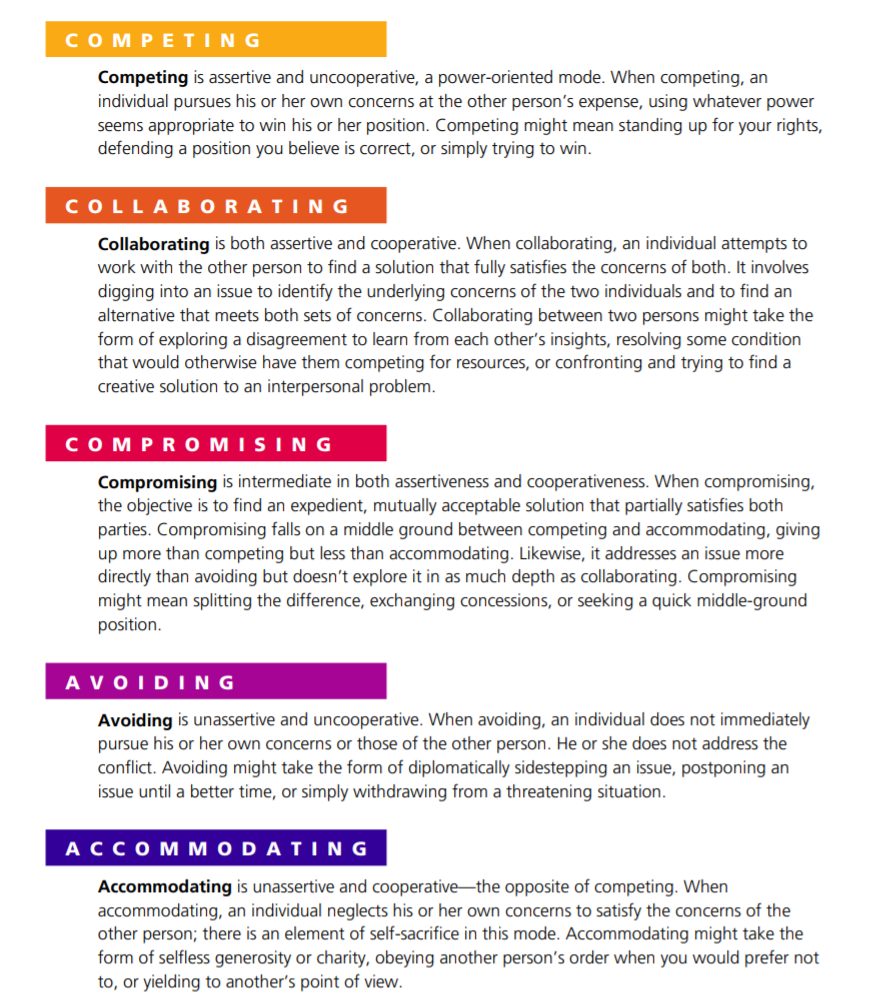
The purpose of this exercise is for students to recognize and explain which Thomas-Kilmann conflict management style should be utilized in the following scenarios. Answer the questions for each scenario and explain in detail which conflict management style should be used. There is one best Kilmann style for each scenario.
Scenarios:
Scenario 1:
You have responded to a situation whereupon you find a man standing in a playground with a knife. All people have been evacuated from the site and you are with several other police officers but being that you arrived first and immediately engaged in conversation with the person from a safe distance, you continue this discussion.
Questions to Consider (QTC): What is the objective of this scenario and explain what the best conflict management style is to use in this case?
Are there any other options within the conflict resolution model that you may consider? 5 marks
Scenario 2:
You have been asked to use a new computer system in your office to organize criminal intelligence gathering for your job as a crime analyst for the police service. You do not personally like the person who designed the system as they are new to the service but you have been instructed by your supervisor to utilize this tool and be part of the implementation team.
QTC: Explain which conflict management style should be used in this case?
How do you proceed? 5 marks
Scenario 3:
As a corrections officer, you have been assigned to work with the inmates (sentenced offenders) to obtain access to a new common room within the facility. There is a high desire amongst inmates to utilize the facility, and you must work with each of the groups who wish access.
QTC: Explain which conflict management style should be used in this scenario?
. Is there any other style of conflict resolution that may be useful? 5 marks
Scenario 4:
As the county peace officer, you have been asked to deal with the amount of dogs that are being dropped off in the county by people from the local First Nations. The dogs are also making their own way into town due to the vast amount of food that can be found. You know very little about the First Nation and you are a bit afraid of dealing with this issue as you have heard that it is dangerous out there and no one cares for their animals. The relationship between the county and the First Nations is almost nonexistent because they can't vote in municipal elections and they are a federal problem. You simply ignore the issue because it is not yours to worry about.
QTC: Explain which conflict resolution style is being used in this case?
What are the consequences of taking no action?
What actions could you take utilizing other styles of conflict resolution?
How could you approach this issue with the community and the First Nation?
5 marks
Scenario 5:
As one of the clerks of the provincial court, you are assigned front counter duties to deal with local people coming in to pay for fines and appear in court. Your supervisor has asked you to do this duty every day for the last month and you continue to do it but you notice that the other four clerks never have to put up with all the complaining that happens from the public when they ask for service. You dont mind the interaction but are wondering why youre the only one being chosen for this duty. You don't say anything because you have been taught to respect your supervisor. Lately, you have been noticing that it is impacting your sleep and last week you were threatened by someone and it scared you.
QTC: Explain which conflict resolution style is being used in this scenario?
What are the consequences for you if you continue to accommodate your supervisor and colleagues?
What conflict resolution style would you use to resolve this issue? 5 marks
COMPETING Competing is assertive and uncooperative, a power-oriented mode. When competing, an individual pursues his or her own concerns at the other person's expense, using whatever power seems appropriate to win his or her position. Competing might mean standing up for your rights, defending a position you believe is correct, or simply trying to win. COLLABORATING Collaborating is both assertive and cooperative. When collaborating, an individual attempts to work with the other person to find a solution that fully satisfies the concerns of both. It involves digging into an issue to identify the underlying concerns of the two individuals and to find an alternative that meets both sets of concerns. Collaborating between two persons might take the form of exploring a disagreement to learn from each other's insights, resolving some condition that would otherwise have them competing for resources, or confronting and trying to find a creative solution to an interpersonal problem. COMPROMISING Compromising is intermediate in both assertiveness and cooperativeness. When compromising, the objective is to find an expedient, mutually acceptable solution that partially satisfies both parties. Compromising falls on a middle ground between competing and accommodating, giving up more than competing but less than accommodating. Likewise, it addresses an issue more directly than avoiding but doesn't explore it in as much depth as collaborating. Compromising might mean splitting the difference, exchanging concessions, or seeking a quick middle-ground position. AVOIDING Avoiding is unassertive and uncooperative. When avoiding, an individual does not immediately pursue his or her own concerns or those of the other person. He or she does not address the conflict. Avoiding might take the form of diplomatically sidestepping an issue, postponing an issue until a better time, or simply withdrawing from a threatening situation. ACCOMMODATING Accommodating is unassertive and cooperativethe opposite of competing. When accommodating, an individual neglects his or her own concerns to satisfy the concerns of the other person; there is an element of self-sacrifice in this mode. Accommodating might take the form of selfless generosity or charity, obeying another person's order when you would prefer not to, or yielding to another's point of view
Step by Step Solution
There are 3 Steps involved in it

Get step-by-step solutions from verified subject matter experts
 Study Help