







Question: Using the case Race Discrimination at Texaco, answer the following questions.Please answer each question completely. a. Discuss the culture and practices at Texaco from a
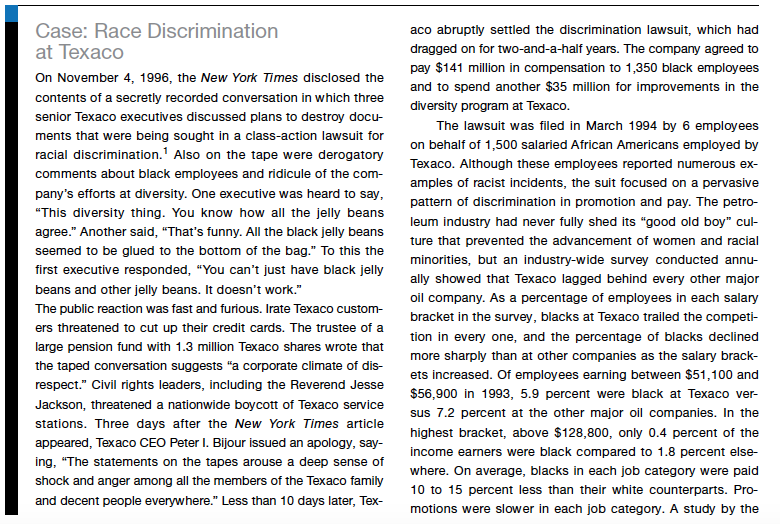
Using the case Race Discrimination at Texaco, answer the following questions.Please answer each question completely.
a. Discuss the culture and practices at Texaco from a "justice" standpoint. In doing so, consider what evidence exists of discriminatory activity and how a justice approach could help deal with the problem.
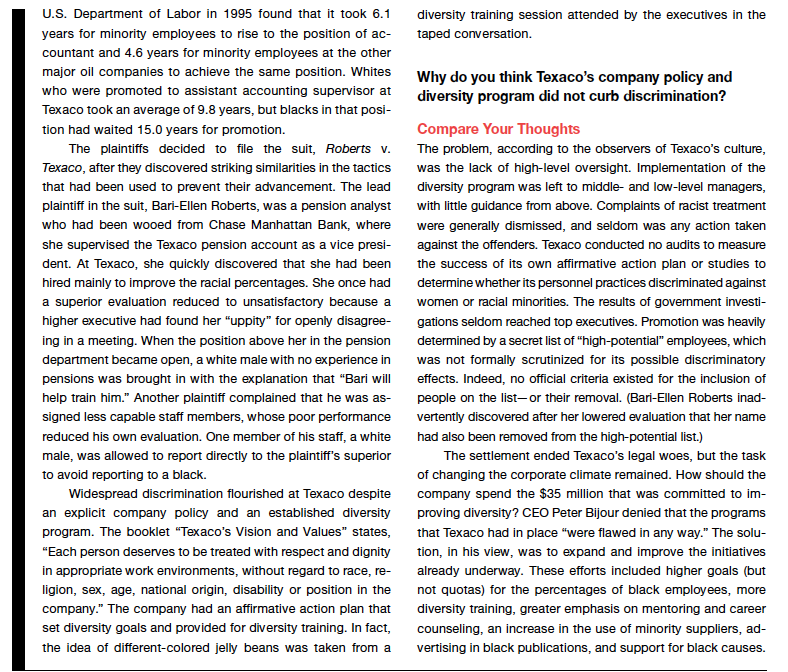
b. Texaco had a discrimination policy and diversity training in place, yet the problem still existed. List as many reasons as you can think as to why the policy and training did not fix the problem in the first place.
c. If you were an executive at Texaco given the job of fixing the problem of discrimination, what steps would you take and why?
U.S. Department of Labor in 1995 found that it took 6.1 diversity training session attended by the executives in the years for minority employees to rise to the position of ac- taped conversation. countant and 4.6 years for minority employees at the other major oil companies to achieve the same position. Whites who were promoted to assistant accounting supervisor at Why do you think Texaco's company policy and Texaco took an average of 9.8 years, but blacks in that posi- tion had waited 15.0 years for promotion. Compare Your Thoughts The plaintiffs decided to file the suit, Roberts v. The problem, according to the observers of Texaco's culture, that had been used to prevent their advancement. The lead diversity program was left to middle- and Iow-level managers, plaintiff in the suit, Bari-Ellen Roberts, was a pension analyst with little guidance from above. Complaints of racist treatment who had been wooed from Chase Manhattan Bank, where were generally dismissed, and seldom was any action taken she supervised the Texaco pension account as a vice presi- against the offenders. Texaco conducted no audits to measure dent. At Texaco, she quickly discovered that she had been the success of its own affirmative action plan or studies to hired mainly to improve the racial percentages. She once had determine whether its personnel practices discriminated against asuperiorevaluationreducedtounsatisfactorybecauseawomenorracialminorities.Theresultsofgovernmentinvesti-higherexecutivehadfoundher"uppity"foropenlydisagree-gationsseldomreachedtopexecutives.Promotionwasheavily ing in a meeting. When the position above her in the pension determined by a secret list of "high-potential" employees, which department became open, a white male with no experience in was not formally scrutinized for its possible discriminatory pensions was brought in with the explanation that "Bari will effects. Indeed, no official criteria existed for the inclusion of help train him." Another plaintiff complained that he was as- people on the list-or their removal. (Bari-Ellen Roberts inadsigned less capable staff members, whose poor performance vertently discovered after her lowered evaluation that her name reduced his own evaluation. One member of his staff, a white had also been removed from the high-potential list.) male, was allowed to report directly to the plaintiff's superior The settlement ended Texaco's legal woes, but the task male, was allowed to report directly to the plaintift's superior The settlement ended Texaco's legal woes, but the task to avoid reporting to a black. Widespread discrimination flourished at Texaco despite company spend the $35 million that was committed to iman explicit company policy and an established diversity proving diversity? CEO Peter Bijour denied that the programs program. The booklet "Texaco's Vision and Values" states, that Texaco had in place "were flawed in any way." The solu"Each person deserves to be treated with respect and dignity tion, in his view, was to expand and improve the initiatives in appropriate work environments, without regard to race, re- already underway. These efforts included higher goals (but ligion, sex, age, national origin, disability or position in the not quotas) for the percentages of black employees, more company." The company had an affirmative action plan that diversity training, greater emphasis on mentoring and career set diversity goals and provided for diversity training. In fact, set diversity goals and provided for diversity training. In fact, counseling, an increase in the use of minority suppliers, ad- the idea of different-colored jelly beans was taken from a vertising in black publications, and support for black causesStep by Step Solution
There are 3 Steps involved in it

Get step-by-step solutions from verified subject matter experts
 Study Help