







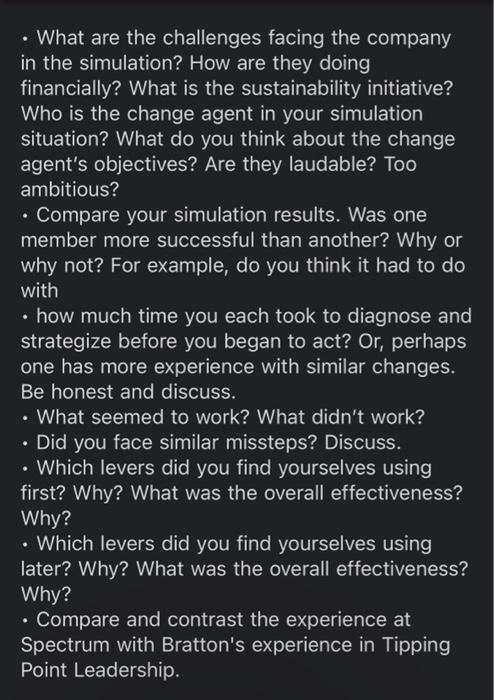
Question: Using the Change Management Simulation: Power and Influence V3 session please answer the questions attached: Scenario 2: Influence With Authority, Low Urgency You are the
Using the Change Management Simulation: Power and Influence V3 session please answer the questions attached:
Scenario 2: Influence With Authority, Low Urgency
You are the CEO and founder of Spectrum Sunglass Company.
While you generally feel good about the state of the business, you are beginning to think about your legacy. You are reading more and more professional articles emphasizing the importance of sustainable development for business and linking the themes of sustainability and innovation, such as Why Sustainability Is Now the Key Driver of Innovation. You are frustrated that you dont have any new sunglass products to offer to the vocal customers who increasingly express concerns about Spectrums environmental impact. Not only does sustainable development make sense to you personally, from both a moral and an economic standpoint, you also see this as an opportunity to differentiate Spectrums products and company from your competitors, which focus primarily on price and design. You have a potential new product design that has received positive focus group feedback as well as some exciting branding deals with Hollywood celebrities in the works. Even still, you are preoccupied with sustainability.
During Spectrum Sunglass Companys annual strategy retreat, you decide to pitch the idea of forming a task force to make the company and its products more environmentally sustainable. Your vision for Spectrum consists of three specific goals:
Eliminate 25 percent of waste by redesigning the manufacturing process.
Reduce the current level of greenhouse gas emissions by 15 percent.
Create a new product line based entirely on environmentally benign materials. You argue that these goals, while aggressive, are achievable within the next two years.
Andrew Chen (general counsel): In my professional opinion, the sustainability project might open up the company to unnecessary legal risks. If we go ahead with this, I advise we narrow the scope somewhat, and that we are very careful with how we publicly announce it.
Daisha Farook (VP of operations): We should first conduct careful due diligence around a product and process change that might increase raw material costs and disrupt existing production flows.
Louise Orysh (benefits administrator): Spectrum is still recovering, and has only recently begun rehiring workers; isnt a dramatic shift in focus to sustainability premature?
You acknowledge your colleagues objections, and as a solution propose that you lead a five-person, interdisciplinary task force to look into the issues. As the task force chair, you will commit to devoting 50 percent of your time to this sustainability initiative while juggling your responsibilities as CEO. The remaining four task force members will devote 75 percent of their time to the project.
You add that, based on your current understanding, the task force will need to pursue the following activities:
Conduct energy audits and set aggressive milestones for improvement on the three goals.
Redesign processes and products to be more environmentally sustainable (and scale up successful experiments quickly).
Analyze environmental life cycles throughout the entire value chain inside the firm and with its suppliers.
Replace fossil-fuel energy sources with renewable energy sources.
Replace petroleum-based materials with biodegradable materials.
Mary Gopinath (VP of human resources): We need to give this initiative serious thought. I for one fully endorse your task force to find a compromise solution.
Eventually, everyone agrees to support your proposal. With your reputation on the line, you realize that success will be measured according to your teams ability to achieve these three goals within the next two years. As the retreat ends and everyone heads to dinner, you start pondering the potentially numerous issues and obstacles you may need to overcome in implementing your sustainability vision.
Your central challenge is to convince your colleagues that a dramatic change in the organizations strategy and products is necessary and that environmental sustainability is one of the keys to the companys future. Fortunately, you have the requisite formal authority and widespread respect throughout the organization to tackle this challenge.
Step by Step Solution
There are 3 Steps involved in it

Get step-by-step solutions from verified subject matter experts
 Study Help