







Question: Using the data in the following table, consider a portfolio that maintains a 70% weight on stock A and a 30% weight on stock B.
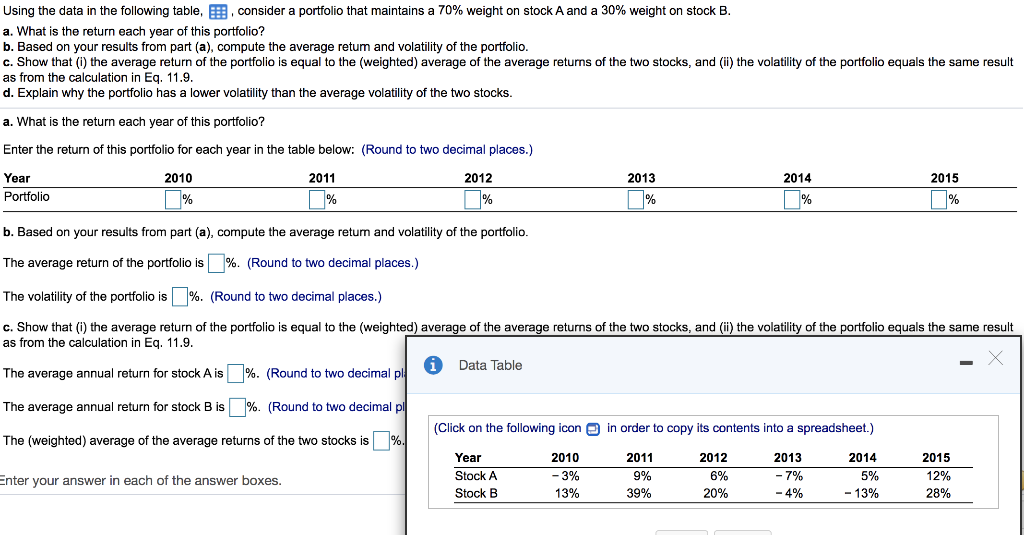
Using the data in the following table, consider a portfolio that maintains a 70% weight on stock A and a 30% weight on stock B. a. What is the return each year of this portfolio? b. Based on your results from part (a), compute the average retum and volatility of the portfolio. c. Show that (i) the average return of the portfolio is equal to the weighted) average of the average returns of the two stocks, and (ii) the volatility of the portfolio equals the same result as from the calculation in Eq. 11.9. d. Explain why the portfolio has a lower volatility than the average volatility of the two stocks. a. What is the return each year of this portfolio? Enter the return of this portfolio for each year in the table below: (Round to two decimal places.) 2013 2014 2015 Year Portfolio 2010 % 2011 % 2012 % b. Based on your results from part (a), compute the average return and volatility of the portfolio. The average return of the portfolio is%. (Round to two decimal places.) The volatility of the portfolio is %. (Round to two decimal places.) c. Show that () the average return of the portfolio is equal to the weighted) average of the average returns of the two stocks, and (i) the volatility of the portfolio equals the same result as from the calculation in Eq. 11.9. The average annual return for stock Ais %. (Round to two decimal pla Data Table The average annual return for stock B is %. (Round to two decimal pl (Click on the following icon in order to copy its contents into a spreadsheet.) The (weighted) average of the average returns of the two stocks is 2011 Year Stock A Stock B Enter your answer in each of the answer boxes. 2010 -3% 13% 2012 6% 20% 2014 5% 9% 39% 2013 -7% - 4% 2015 12% 28% - 13% Using the data in the following table, consider a portfolio that maintains a 70% weight on stock A and a 30% weight on stock B. a. What is the return each year of this portfolio? b. Based on your results from part (a), compute the average retum and volatility of the portfolio. c. Show that (i) the average return of the portfolio is equal to the weighted) average of the average returns of the two stocks, and (ii) the volatility of the portfolio equals the same result as from the calculation in Eq. 11.9. d. Explain why the portfolio has a lower volatility than the average volatility of the two stocks. a. What is the return each year of this portfolio? Enter the return of this portfolio for each year in the table below: (Round to two decimal places.) 2013 2014 2015 Year Portfolio 2010 % 2011 % 2012 % b. Based on your results from part (a), compute the average return and volatility of the portfolio. The average return of the portfolio is%. (Round to two decimal places.) The volatility of the portfolio is %. (Round to two decimal places.) c. Show that () the average return of the portfolio is equal to the weighted) average of the average returns of the two stocks, and (i) the volatility of the portfolio equals the same result as from the calculation in Eq. 11.9. The average annual return for stock Ais %. (Round to two decimal pla Data Table The average annual return for stock B is %. (Round to two decimal pl (Click on the following icon in order to copy its contents into a spreadsheet.) The (weighted) average of the average returns of the two stocks is 2011 Year Stock A Stock B Enter your answer in each of the answer boxes. 2010 -3% 13% 2012 6% 20% 2014 5% 9% 39% 2013 -7% - 4% 2015 12% 28% - 13%
Step by Step Solution
There are 3 Steps involved in it

Get step-by-step solutions from verified subject matter experts
 Study Help