


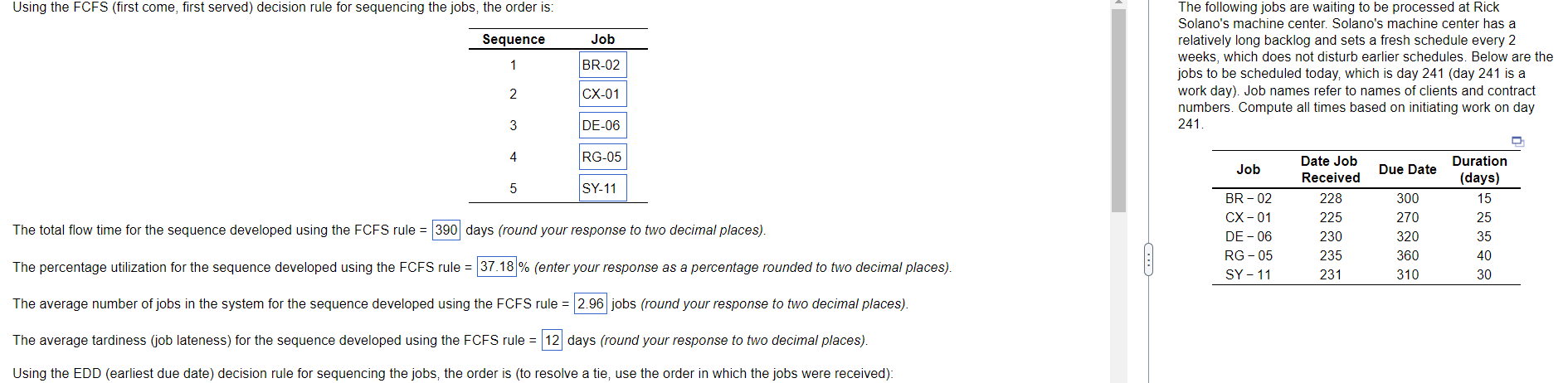
Question: Using the FCFS (first come, first served) decision rule for sequencing the jobs, the order is: Sequence 1 2 3 4 5 Job BR-02 CX-01
Using the FCFS (first come, first served)Using the FCFS (first come, first served)

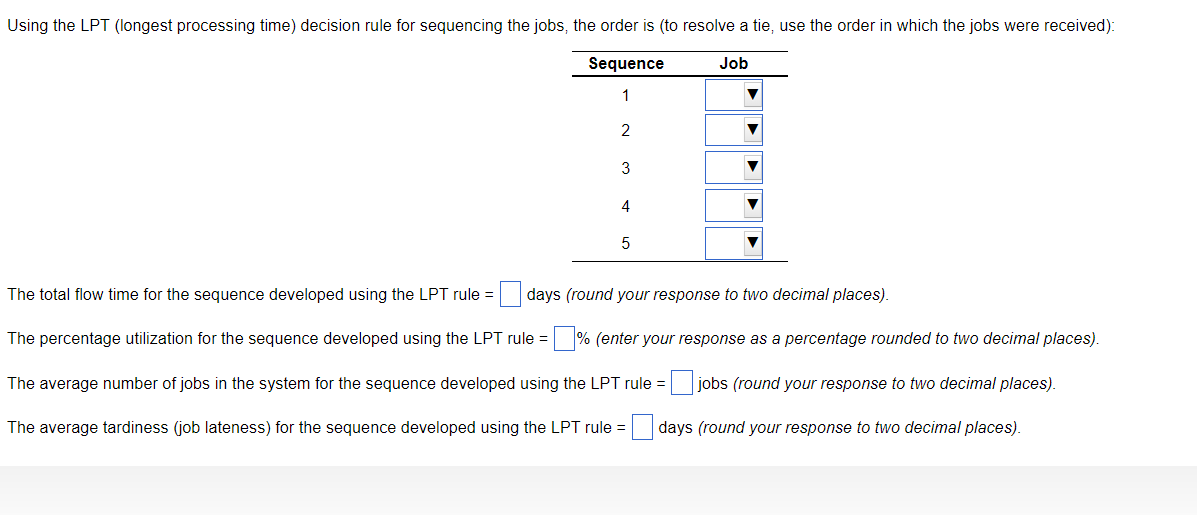
Using the FCFS (first come, first served) decision rule for sequencing the jobs, the order is: Sequence 1 2 3 4 5 Job BR-02 CX-01 DE-06 RG-05 SY-11 The total flow time for the sequence developed using the FCFS rule = 390 days (round your response to two decimal places). The percentage utilization for the sequence developed using the FCFS rule = 37.18% (enter your response as a percentage rounded to two decimal places). The average number of jobs in the system for the sequence developed using the FCFS rule = 2.96 jobs (round your response to two decimal places). The average tardiness (job lateness) for the sequence developed using the FCFS rule = 12 days (round your response to two decimal places). Using the EDD (earliest due date) decision rule for sequencing the jobs, the order is (to resolve a tie, use the order in which the jobs were received): (D) The following jobs are waiting to be processed at Rick Solano's machine center. Solano's machine center has a relatively long backlog and sets a fresh schedule every 2 weeks, which does not disturb earlier schedules. Below are the jobs to be scheduled today, which is day 241 (day 241 is a work day). Job names refer to names of clients and contract numbers. Compute all times based on initiating work on day 241. Job BR-02 CX - 01 DE - 06 RG-05 SY - 11 Date Job Received 228 225 230 235 231 Due Date 300 270 320 360 310 Duration (days) 15 25 35 40 30 Using the LPT (longest processing time) decision rule for sequencing the jobs, the order is (to resolve a tie, use the order in which the jobs were received): Job Sequence 1 2 3 4 5 V The total flow time for the sequence developed using the LPT rule=days (round your response to two decimal places). The percentage utilization for the sequence developed using the LPT rule =% (enter your response as a percentage rounded to two decimal places). The average number of jobs in the system for the sequence developed using the LPT rule = jobs (round your response to two decimal places). The average tardiness (job lateness) for the sequence developed using the LPT rule = days (round your response to two decimal places)

Step by Step Solution

There are 3 Steps involved in it

1 Expert Approved Answer
Step: 1 Unlock blur-text-image

Question Has Been Solved by an Expert!

Get step-by-step solutions from verified subject matter experts

Step: 2 Unlock
Step: 3 Unlock

Students Have Also Explored These Related General Management Questions!