







Question: t 0 20 40 60 80 100 120 140 160 180 200 220 240 260 280 300 320 340 360 x 0 3.05 2.04 0.34
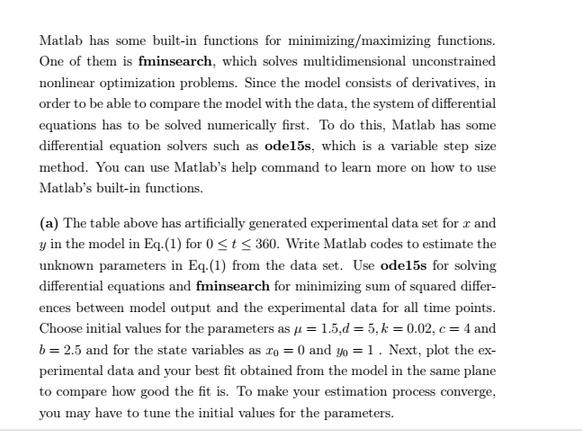
| t | 0 | 20 | 40 | 60 | 80 | 100 | 120 | 140 | 160 | 180 | 200 | 220 | 240 | 260 | 280 | 300 | 320 | 340 | 360 | |
| x | 0 | 3.05 | 2.04 | 0.34 | 0.63 | 0.95 | 1.60 | 2.27 | 1.60 | 0.44 | 0.75 | 1.13 | 1.82 | 2.20 | 0.56 | 0.54 | 0.86 | 1.32 | 2.18 | |
| y | 1 | 0.28 | 0.18 | 0.32 | 0.38 | 0.46 | 0.35 | 0.22 | 0.20 | 0.32 | 0.40 | 0.39 | 0.31 | 0.22 | 0.22 | 0.33 | 0.40 | 0.37 | 0.27 |
| t | 0 | 20 | 40 | 60 | 80 | 100 | 120 | 140 | 160 | 180 | 200 | 220 | 240 | 260 | 280 | 300 | 320 | 340 | 360 | |
| x | 0 | 3.05 | 2.04 | 0.34 | 0.63 | 0.95 | 1.60 | 2.27 | 1.60 | 0.44 | 0.75 | 1.13 | 1.82 | 2.20 | 0.56 | 0.54 | 0.86 | 1.32 | 2.18 | |
| y | 1 | 0.28 | 0.18 | 0.32 | 0.38 | 0.46 | 0.35 | 0.22 | 0.20 | 0.32 | 0.40 | 0.39 | 0.31 | 0.22 | 0.22 | 0.33 | 0.40 | 0.37 | 0.27 |
(b) Use Matlab's lsqcurvefit instead of fminsearch to answer the same question as (a).
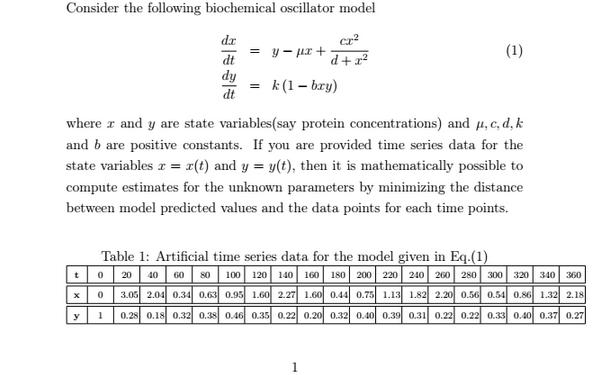
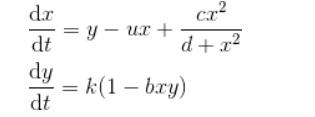
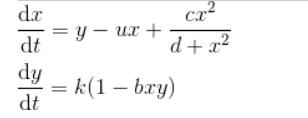
Consider the following biochemical oscillator model dx cx (1) dt d+x == k (1-bay) dt where x and y are state variables(say protein concentrations) and , c, d, k and b are positive constants. If you are provided time series data for the state variables x = x(t) and y = y(t), then it is mathematically possible to compute estimates for the unknown parameters by minimizing the distance between model predicted values and the data points for each time points. Table 1: Artificial time series data for the model given in Eq.(1) |t0| 20 | 40 | 60 80 100 120 140 160 180 200 220 240 200 250 300-320 340 x 360 0 3.05 2.04 0.34 0.63 0.95 1.60 2.27 1.60 0.44 0.75 1.13 1.82 2.20 0.56 0.54 0.86 1.32 2.18 y 1 0.28 0.18 0.32 0.38 0.46 0.35 0.22 0.20 0.32 0.40 0.39 0.31 0.22 0.22 0.33 0.40 0.37 0.27 1
Step by Step Solution
3.46 Rating (156 Votes )
There are 3 Steps involved in it
To estimate the unknown parameters in Eq 1 from the provided data set we can use either fminsearch or lsqcurvefit in MATLAB Heres the MATLAB code for ... View full answer

Get step-by-step solutions from verified subject matter experts
 Study Help