







Question: Using the graphing strategy discussed in class, sketch a graph of the function f(x) = -(2 - 4)9/5 +3(x - 4)4/5. Label any intercepts, relative
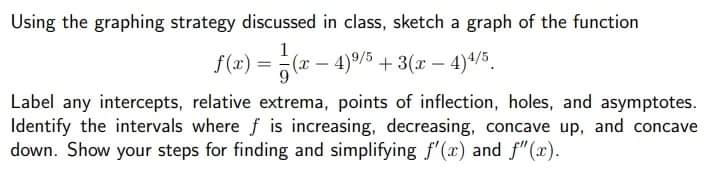
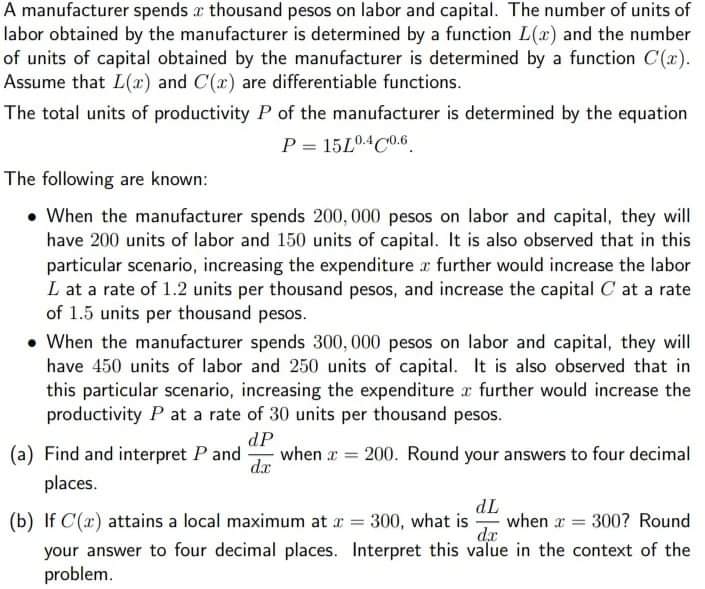
Using the graphing strategy discussed in class, sketch a graph of the function f(x) = -(2 - 4)9/5 +3(x - 4)4/5. Label any intercepts, relative extrema, points of inflection, holes, and asymptotes. Identify the intervals where f is increasing, decreasing, concave up, and concave down. Show your steps for finding and simplifying f'(x) and f"(x).A manufacturer spends a thousand pesos on labor and capital. The number of units of labor obtained by the manufacturer is determined by a function L(x) and the number of units of capital obtained by the manufacturer is determined by a function C(x). Assume that L(a) and C(a) are differentiable functions. The total units of productivity P of the manufacturer is determined by the equation P = 1510.4C0.6 The following are known: . When the manufacturer spends 200, 000 pesos on labor and capital, they will have 200 units of labor and 150 units of capital. It is also observed that in this particular scenario, increasing the expenditure a further would increase the labor L at a rate of 1.2 units per thousand pesos, and increase the capital C at a rate of 1.5 units per thousand pesos. . When the manufacturer spends 300, 000 pesos on labor and capital, they will have 450 units of labor and 250 units of capital. It is also observed that in this particular scenario, increasing the expenditure a further would increase the productivity P at a rate of 30 units per thousand pesos. dP (a) Find and interpret P and - when r = 200. Round your answers to four decimal places. dL (b) If C(x) attains a local maximum at a = 300, what is - when a = 300? Round dx your answer to four decimal places. Interpret this value in the context of the
Step by Step Solution
There are 3 Steps involved in it

Get step-by-step solutions from verified subject matter experts
 Study Help