







Question: Using the horseshoe crab data, fit the logistic regression model for ? = probability of a satellite, using weight as the predictor: a. Report the
Using the horseshoe crab data, fit the logistic regression model for ? = probability of a satellite, using weight as the predictor:
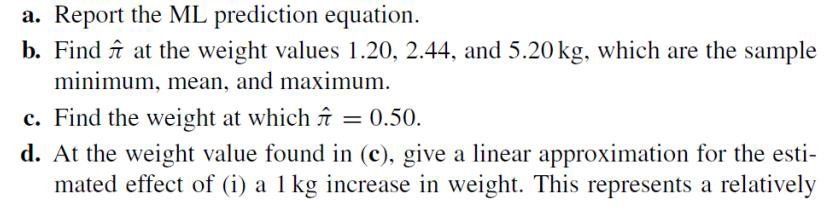
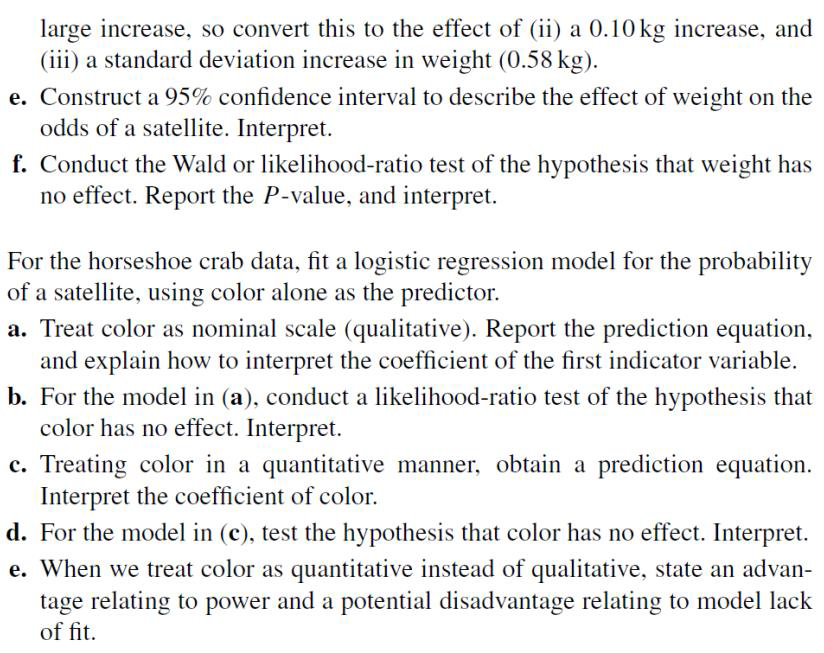
a. Report the ML prediction equation. b. Find if at the weight values 1.20, 2.44, and 5.20 kg, which are the sample minimum, mean, and maximum. c. Find the weight at which a? = 0.50. (I. At the weight value found in (e), give a linear approximation for the esti mated effect of (i) a 1 kg increase in weight. This represents a relatively large increase, so convert this to the effect of (ii) a 0.10 kg increase, and (iii) a standard deviation increase in weight (0.58 kg). e. Construct a 95% confidence interval to describe the effect of weight on the odds of a satellite. Interpret. f. Conduct the Wald or likelihood-ratio test of the hypothesis that weight has no effect. Report the P-value, and interpret. For the horseshoe crab data, fit a logistic regression model for the probability of a satellite, using color alone as the predictor. a. Treat color as nominal scale (qualitative). Report the prediction equation, and explain how to interpret the coefficient of the first indicator variable. b. For the model in (a), conduct a likelihood-ratio test of the hypothesis that color has no effect. Interpret. c. Treating color in a quantitative manner, obtain a prediction equation. Interpret the coefficient of color. d. For the model in (c), test the hypothesis that color has no effect. Interpret. e. When we treat color as quantitative instead of qualitative, state an advan- tage relating to power and a potential disadvantage relating to model lack of fit
Step by Step Solution
There are 3 Steps involved in it

Get step-by-step solutions from verified subject matter experts
 Study Help