Question: USING THE INFORMATION BELOW, CREATE A BPMN MODEL OF THE AS-IS STUDENT ADMISSION PROCESS. Member of academic committee (Peter Capello): You interviewed some representatives for
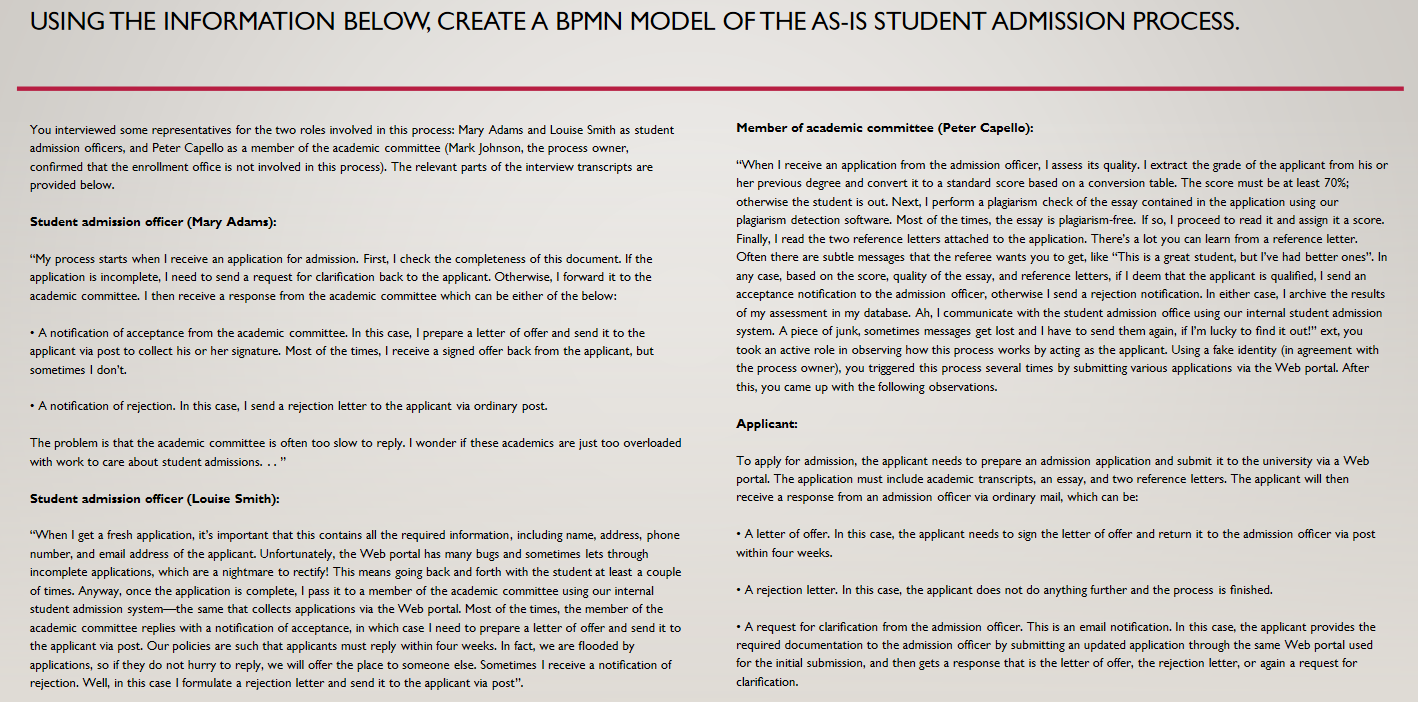
USING THE INFORMATION BELOW, CREATE A BPMN MODEL OF THE AS-IS STUDENT ADMISSION PROCESS. Member of academic committee (Peter Capello): You interviewed some representatives for the two roles involved in this process: Mary Adams and Louise Smith as student admission officers, and Peter Capello as a member of the academic committee (Mark Johnson, the process owner, confirmed that the enrollment office is not involved in this process). The relevant parts of the interview transcripts are provided below. Student admission officer (Mary Adams): "My process starts when I receive an application for admission. First, I check the completeness of this document. If the application is incomplete, I need to send a request for clarification back to the applicant. Otherwise, I forward it to the academic committee. I then receive a response from the academic committee which can be either of the below: "When I receive an application from the admission officer, I assess its quality. I extract the grade of the applicant from his or her previous degree and convert it to a standard score based on a conversion table. The score must be at least 70%; otherwise the student is out. Next, I perform a plagiarism check of the essay contained in the application using our plagiarism detection software. Most of the times, the essay is plagiarism-free. If so, I proceed to read it and assign it a score. Finally, I read the two reference letters attached to the application. There's a lot you can learn from a reference letter. Often there are subtle messages that the referee wants you to get, like "This is a great student, but I've had better ones". In any case, based on the score, quality of the essay, and reference letters, if I deem that the applicant is qualified, I send an acceptance notification to the admission officer, otherwise I send a rejection notification. In either case, I archive the results my assessment in my database. Ah, I communicate with the student admission office using our internal student admission system. A piece of junk, sometimes messages get lost and I have to send them again, if I'm lucky to find it out!" ext, you took an active role in observing how this process works by acting as the applicant. Using a fake identity (in agreement with the process owner), you triggered this process several times by submitting various applications via the Web portal. After this, you came up with the following observations. A notification of acceptance from the academic committee. In this case, I prepare a letter of offer and send it to the applicant via post to collect his or her signature. Most of the times, I receive a signed offer back from the applicant, but sometimes I don't A notification of rejection. In this case, I send a rejection letter to the applicant ordinary post. Applicant: The problem is that the academic committee is often too slow to reply. I wonder if these academics are just too overloaded with work to about student admissions..." via a Web To apply for admission, the cant needs to prepare an admission application and submit it to the univers portal. The application must include academic transcripts, an essay, and two reference letters. The applicant will then receive a response from an admission officer via ordinary mail, which can be: Student admission officer (Louise Smith): A letter of offer. In this case, the applicant needs to sign the letter of offer and return it to the admission officer via post within four weeks. A rejection letter. In this case, the applicant does not do anything further and the process is finished. "When I get a fresh application, it's important that this contains all the required information, including name, address, phone number, and email address of the applicant. Unfortunately, the Web portal has many bugs and sometimes lets through incomplete applications, which are a nightmare to rectify! This means going back a forth with the student at least a couple of times. Anyway, once the application is complete, I pass it to a member of the academic committee using our internal student admission systemthe same that collects applications via the Web portal. Most of the times, the member of the academic committee replies with a notification of acceptance, in which case I need to prepare a letter of offer and send it to the applicant via post. Our policies are such that applicants must reply within four weeks. In fact, we are flooded by applications, so if they do not hurry to reply, we will offer the place to someone else. Sometimes I receive a notification of rejection. Well, in this case I formulate a rejection letter and send it to the applicant via post". A request for clarification from the admission officer. This is an email notification. In this case, the applicant provides the required documentation to the admission officer by submitting an updated application through the same Web portal used for the initial submission, and then gets a response that is the letter of offer, the rejection letter, or again a request for clarification









 Study Help