







Question: Using the schedule from Part 2, estimate the cost for each activity. Determine the total budgeted cost for the project. Prepare a budgeted cost by
- Using the schedule from Part 2, estimate the cost for each activity.
- Determine the total budgeted cost for the project.
- Prepare a budgeted cost by period table (similar to Figure 7.5) and a cumulative budgeted cost (CBC) curve (similar to Figure 7.6) for the project.
PART2
|
| Duration (days) | Precedence | ES | EF | LS | LF | Slack | Critical path? |
| A1 | 3 | - | 0 | 3 | 0 | 3 | 0 | Y |
| A2 | 7 | A1 | 3 | 10 | 3 | 10 | 0 | Y |
| B1 | 7 | A2 | 10 | 17 | 10 | 17 | 0 | Y |
| B2 | 5 | B1 | 17 | 22 | 17 | 22 | 0 | Y |
| B3 | 3 | B2 | 22 | 25 | 22 | 25 | 0 | Y |
| B4 | 45 | B3 | 25 | 70 | 25 | 70 | 0 | Y |
| C1 | 15 | - | 0 | 15 | 45 | 60 | 45 | N |
| C2 | 7 | C1 | 15 | 22 | 60 | 67 | 45 | N |
| C3 | 3 | C2 | 22 | 25 | 67 | 70 | 45 | N |
| D1 | 4 | A2 | 17 | 21 | 27 | 31 | 10 | N |
| D2 | 5 | D1 | 21 | 26 | 31 | 36 | 10 | N |
| D3 | 30 | D2 | 26 | 56 | 36 | 66 | 10 | N |
| D4 | 4 | D3 | 56 | 60 | 66 | 70 | 10 | N |
| E1 | 35 | B4, D4, C3 | 70 | 105 | 70 | 105 | 0 | Y |
| E2 | 5 | E1 | 105 | 110 | 105 | 110 | 0 | Y |
| E3 | 5 | E2 | 110 | 115 | 110 | 115 | 0 | Y |
| E4 | 10 | E3 | 115 | 125 | 115 | 125 | 0 | Y |
| F | 25 | E4 | 125 | 150 | 125 | 150 | 0 | Y |
| G1 | 5 | - | 0 | 5 | 145 | 150 | 145 | N |
| G2 | 15 | G1, F | 150 | 165 | 150 | 165 | 0 | Y |
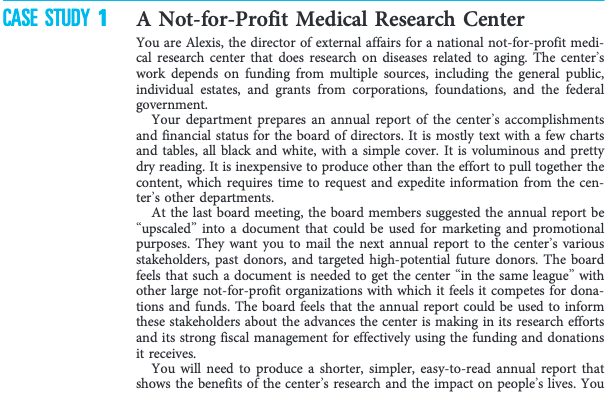
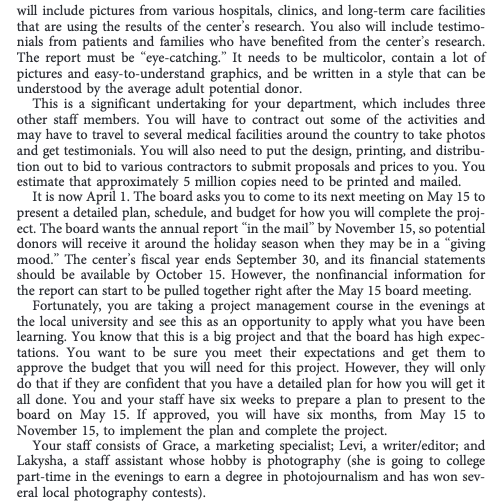
CASE STUDY 1 A Not-for-Profit Medical Research Center You are Alexis, the director of external affairs for a national not-for-profit medi- cal research center that does research on diseases related to aging. The center's work depends on funding from multiple sources, including the general public, individual estates, and grants from corporations, foundations, and the federal government. Your department prepares an annual report of the center's accomplishments and financial status for the board of directors. It is mostly text with a few charts and tables, all black and white, with a simple cover. It is voluminous and pretty dry reading. It is inexpensive to produce other than the effort to pull together the content, which requires time to request and expedite information from the cen- ter's other departments. At the last board meeting, the board members suggested the annual report be "upscaled" into a document that could be used for marketing and promotional purposes. They want you to mail the next annual report to the center's various stakeholders, past donors, and targeted high-potential future donors. The board feels that such a document is needed to get the center in the same league" with other large not-for-profit organizations with which it feels it competes for dona- tions and funds. The board feels that the annual report could be used to inform these stakeholders about the advances the center is making in its research efforts and its strong fiscal management for effectively using the funding and donations it receives. You will need to produce a shorter, simpler, easy-to-read annual report that shows the benefits of the center's research and the impact on people's lives. You will include pictures from various hospitals, clinics, and long-term care facilities that are using the results of the center's research. You also will include testimo- nials from patients and families who have benefited from the center's research. The report must be "eye-catching." It needs to be multicolor, contain a lot of pictures and easy-to-understand graphics, and be written in a style that can be understood by the average adult potential donor. This is a significant undertaking for your department, which includes three other staff members. You will have to contract out some of the activities and may have to travel to several medical facilities around the country to take photos and get testimonials. You will also need to put the design, printing, and distribu- tion out to bid to various contractors to submit proposals and prices to you. You estimate that approximately 5 million copies need to be printed and mailed. It is now April 1. The board asks you to come to its next meeting on May 15 to present a detailed plan, schedule, and budget for how you will complete the proj- ect. The board wants the annual report in the mail" by November 15, so potential donors will receive it around the holiday season when they may be in a "giving mood." The center's fiscal year ends September 30, and its financial statements should be available by October 15. However, the nonfinancial information for the report can start to be pulled together right after the May 15 board meeting. Fortunately, you are taking a project management course in the evenings at the local university and see this as an opportunity to apply what you have been learning. You know that this is a big project and that the board has high expec- tations. You want to be sure you meet their expectations and get them to approve the budget that you will need for this project. However, they will only do that if they are confident that you have a detailed plan for how you will get it all done. You and your staff have six weeks to prepare a plan to present to the board on May 15. If approved, you will have six months, from May 15 to November 15, to implement the plan and complete the project. Your staff consists of Grace, a marketing specialist; Levi, a writer/editor; and Lakysha, a staff assistant whose hobby is photography (she is going to college part-time in the evenings to earn a degree in photojournalism and has won sev- eral local photography contests). CASE STUDY 1 A Not-for-Profit Medical Research Center You are Alexis, the director of external affairs for a national not-for-profit medi- cal research center that does research on diseases related to aging. The center's work depends on funding from multiple sources, including the general public, individual estates, and grants from corporations, foundations, and the federal government. Your department prepares an annual report of the center's accomplishments and financial status for the board of directors. It is mostly text with a few charts and tables, all black and white, with a simple cover. It is voluminous and pretty dry reading. It is inexpensive to produce other than the effort to pull together the content, which requires time to request and expedite information from the cen- ter's other departments. At the last board meeting, the board members suggested the annual report be "upscaled" into a document that could be used for marketing and promotional purposes. They want you to mail the next annual report to the center's various stakeholders, past donors, and targeted high-potential future donors. The board feels that such a document is needed to get the center in the same league" with other large not-for-profit organizations with which it feels it competes for dona- tions and funds. The board feels that the annual report could be used to inform these stakeholders about the advances the center is making in its research efforts and its strong fiscal management for effectively using the funding and donations it receives. You will need to produce a shorter, simpler, easy-to-read annual report that shows the benefits of the center's research and the impact on people's lives. You will include pictures from various hospitals, clinics, and long-term care facilities that are using the results of the center's research. You also will include testimo- nials from patients and families who have benefited from the center's research. The report must be "eye-catching." It needs to be multicolor, contain a lot of pictures and easy-to-understand graphics, and be written in a style that can be understood by the average adult potential donor. This is a significant undertaking for your department, which includes three other staff members. You will have to contract out some of the activities and may have to travel to several medical facilities around the country to take photos and get testimonials. You will also need to put the design, printing, and distribu- tion out to bid to various contractors to submit proposals and prices to you. You estimate that approximately 5 million copies need to be printed and mailed. It is now April 1. The board asks you to come to its next meeting on May 15 to present a detailed plan, schedule, and budget for how you will complete the proj- ect. The board wants the annual report in the mail" by November 15, so potential donors will receive it around the holiday season when they may be in a "giving mood." The center's fiscal year ends September 30, and its financial statements should be available by October 15. However, the nonfinancial information for the report can start to be pulled together right after the May 15 board meeting. Fortunately, you are taking a project management course in the evenings at the local university and see this as an opportunity to apply what you have been learning. You know that this is a big project and that the board has high expec- tations. You want to be sure you meet their expectations and get them to approve the budget that you will need for this project. However, they will only do that if they are confident that you have a detailed plan for how you will get it all done. You and your staff have six weeks to prepare a plan to present to the board on May 15. If approved, you will have six months, from May 15 to November 15, to implement the plan and complete the project. Your staff consists of Grace, a marketing specialist; Levi, a writer/editor; and Lakysha, a staff assistant whose hobby is photography (she is going to college part-time in the evenings to earn a degree in photojournalism and has won sev- eral local photography contests)
Step by Step Solution
There are 3 Steps involved in it
1 Expert Approved Answer
Step: 1 Unlock

Question Has Been Solved by an Expert!
Get step-by-step solutions from verified subject matter experts
Step: 2 Unlock
Step: 3 Unlock
 Study Help