







Question: Using the spreadsheet provided, edit the cells to include the following controls: Annual fee cannot exceed 8% of purchase cost. Training costs cannot exceed $12,000
Using the spreadsheet provided, edit the cells to include the following controls:
- Annual fee cannot exceed 8% of purchase cost.
- Training costs cannot exceed $12,000 in year 0 and $3,000 thereafter.
(Enter the annual training costs in cell B10 and enter initial year 0 training costs in cell D10).
- Annual savings due to efficiency cannot exceed $5,000, but must be zero in year 0.
- Cell C2 (highlighted in yellow to the right of the word Answer) must force entry of either YES or NO no other values can be accepted.
(hint: use cells A30 and A31 as the source for a dropdown list).
- Your name must appear in cell C3, and the cell must ensure that any name entered cannot exceed 30 characters total.
- Cell B8 (annual fee) must NOT permit any alphabetic text.
- The reduction in risk due to the security investment (cell B18) must range between 2% and 8%, inclusive.
- Lock the spreadsheet so that data can only be entered in these cells (all highlighted in yellow in the spreadsheet):
- C2
- C3
- B8
- B10
- B12
- B18
- D10
- A30
- A31
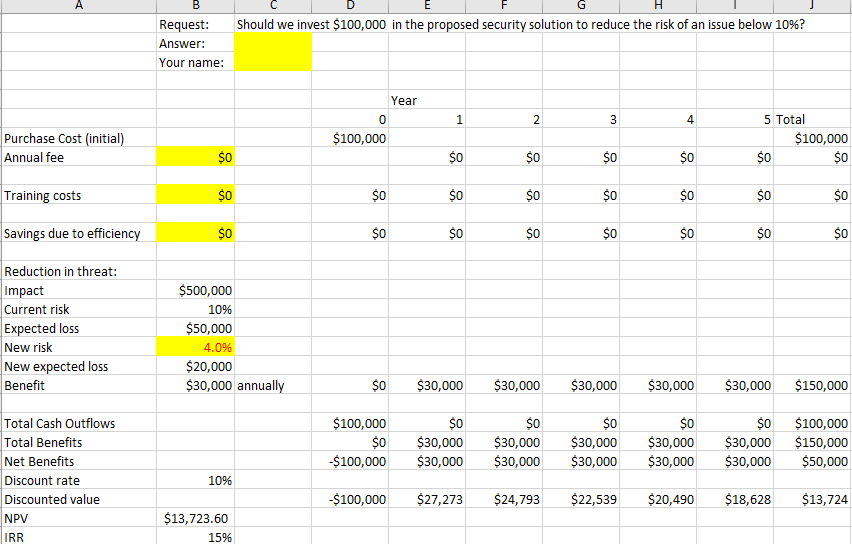
\begin{tabular}{|c|c|c|c|c|c|c|c|c|c|} \hline A & B & C & D & E & F & G & H & 1 & J \\ \hline & Request: & \multicolumn{8}{|c|}{ Should we invest $100,000 in the proposed security solution to reduce the risk of an issue below 10% ? } \\ \hline & Answer: & & & & & & & & \\ \hline & Your name: & & & & & & & & \\ \hline & & & & & & & & & \\ \hline & & & & Year & & & & & \\ \hline & & & 0 & 1 & 2 & 3 & 4 & \multicolumn{2}{|c|}{5 Total } \\ \hline Purchase Cost (initial) & & & $100,000 & & & & & & $100,000 \\ \hline Annual fee & & & & & & so & & & \\ \hline & & & & & & & & & \\ \hline Training costs & \$o & & $0 & & so & so & so & & so \\ \hline & & & & & & & & & \\ \hline Savings due to efficiency & \$o & & & & so & so & so & & $0 \\ \hline & & & & & & & & & \\ \hline Reduction in threat: & & & & & & & & & \\ \hline Impact & $500,000 & & & & & & & & \\ \hline Current risk & 10% & & & & & & & & \\ \hline Expected loss & $50,000 & & & & & & & & \\ \hline New risk & 4.0% & & & & & & & & \\ \hline New expected loss & $20,000 & & & & & & & & \\ \hline Benefit & $30,000 & annually & so & $30,000 & $30,000 & $30,000 & $30,000 & $30,000 & $150,000 \\ \hline & & & & & & & & & \\ \hline Total Cash Outflows & & & $100,000 & so & o & o & so & $0 & $100,000 \\ \hline Total Benefits & & & so & $30,000 & $30,000 & $30,000 & $30,000 & $30,000 & $150,000 \\ \hline Net Benefits & & & $100,000 & $30,000 & $30,000 & $30,000 & $30,000 & $30,000 & $50,000 \\ \hline Discount rate & 10% & & & & & & & & \\ \hline Discounted value & & & $100,000 & $27,273 & $24,793 & $22,539 & $20,490 & $18,628 & $13,724 \\ \hline NPV & $13,723.60 & & & & & & & & \\ \hline IRR & 15% & & & & & & & & \\ \hline \end{tabular}
Step by Step Solution
There are 3 Steps involved in it

Get step-by-step solutions from verified subject matter experts
 Study Help