







Question: using this upper case study and answer for these questions TIMBERLAND: MAKING A DIFFERENCE IN THE WORLD Timberland is no ordinary profit-oriented company. Sure, it
using this upper case study and answer for these questions
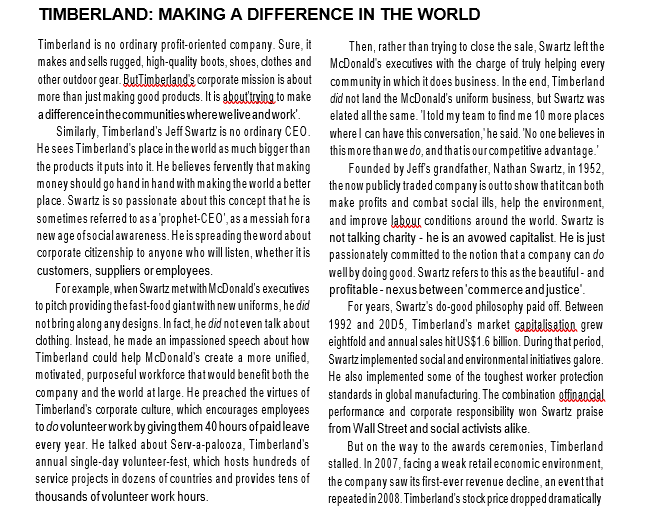
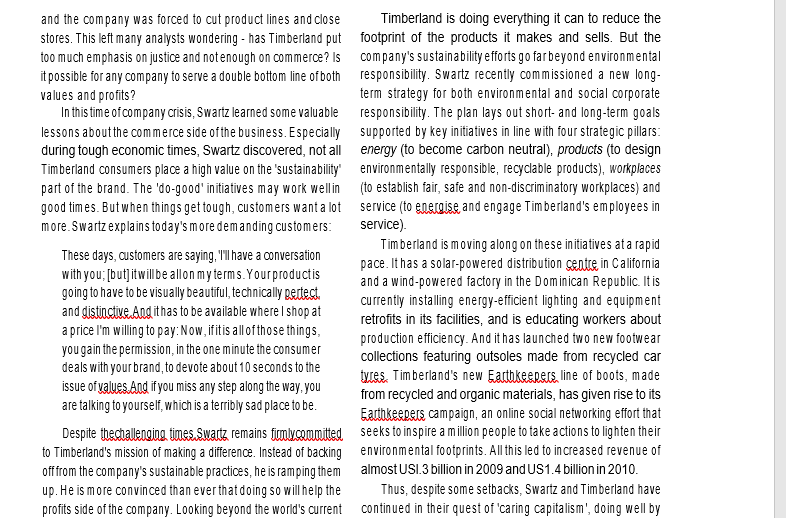
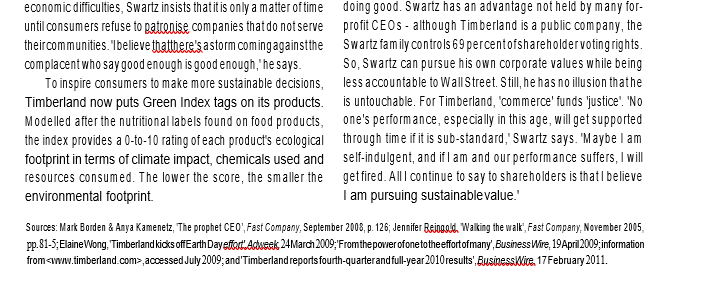
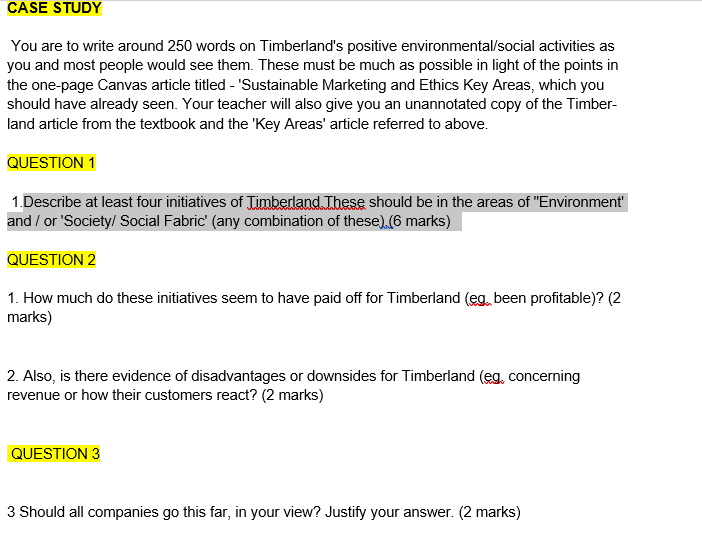
TIMBERLAND: MAKING A DIFFERENCE IN THE WORLD Timberland is no ordinary profit-oriented company. Sure, it Then, rather than trying to dose the sale, Swartz left the makes and sells rugged, high-quality boots, shoes, dothes and McDonald's executives with the charge of truly helping every other outdoor gear. ButTimberland's corporate mission is about community in which it does business. In the end, Timberland more than just making good products. It is abeut'texing to make did not land the McDonald's uniform business, but Swartz was a differenceinthe communities where we live andwork'. elated all the same. 'I told my team to find me 10 more places Similarly, Timberland's Jeff Swartz is no ordinary CEO where I can have this conversation," he said. 'No one believes in He sees Timberland's place in the world as much bigger than this more than we do, and that is our competitive advantage the products it puts into it. He believes fervently that making Founded by Jeff's grandfather, Nathan Swartz, in 1952, money should go hand in hand with making the world a better thenow publicly traded company is out to show thatit can both place. Swartz is so passionate about this concept that he is make profits and combat social ills, help the environment, sometimes referred to as a prophet-CEO', as a messiah fora and improve labeur conditions around the world. Swartz is new age of social awareness. He is spreading the word about not talking charity - he is an avowed capitalist. He is just corporate citizenship to anyone who will listen, whether it is passionately committed to the notion that a company can do customers, suppliers or employees. wellby doing good. Swartz refers to this as the beautiful- and Forexample, when Swartz met with McDonald's executives profitable-nexus between commerce and justice'. to pitch providing the fast-food giant with new uniforms, he did For years, Swartz's do-good philosophy paid off. Between not bring along any designs. In fact, he did not even talk about 1992 and 2005, Timberland's market capitalisation, grew dothing. Instead, he made an impassioned speech about how eightfold and annual sales hit US$1.6 billion. During that period, Timberland could help McDonald's create a more unified, Swartz implemented social and environmental initiatives galore. motivated, purposeful workforce that would benefit both the He also implemented some of the toughest worker protection company and the world at large. He preached the virtues of standards in global manufacturing. The combination offinancial Timberland's corporate culture, which encourages employees performance and corporate responsibility won Swartz praise to dovolunteer work by giving them 40 hours of paid leave from Wall Street and social activists alike. every year. He talked about Serv-a-palooza, Timberland's But on the way to the awards ceremonies, Timberland annual single-day volunteer-fest, which hosts hundreds of stalled. In 2007, facing a weak retail economic environment, service projects in dozens of countries and provides tens of the company saw its first-ever revenue decline, an event that thousands of volunteer work hours. repeated in 2008. Timberland's stock price dropped dramatically and the company was forced to cut product lines and close Timberland is doing everything it can to reduce the stores. This left many analysts wondering - has Timberland put footprint of the products it makes and sells. But the too much emphasis on justice and not enough on commerce? Is company's sustainability efforts go far beyond environmental it possible for any company to serve a double bottom line of both responsibility. Swartz recently commissioned a new long- values and profits ? term strategy for both environmental and social corporate In this time of company crisis, Swartz learned some valuable responsibility. The plan lays out short and long-term goals lessons about the commerce side of the business. Especially supported by key initiatives in line with four strategic pillars: during tough economic times, Swartz discovered, not all energy (to become carbon neutral), products (to design Timberland consumers place a high value on the sustainability" environmentally responsible, recyclable products), workplaces part of the brand. The 'do-good' initiatives may work well in ito establish fair, safe and non-discriminatory workplaces) and good times. But when things get tough, customers want a lot service to energise and engage Timberland's employees in more Swartz explains today's more demanding customers: service) Timberland is moving along on these initiatives at a rapid These days, customers are saying, "I'll have a conversation pace. It has a solar-powered distribution centre in California with you;[but] itwill be allon my terms. Your productis and a wind-powered factory in the Dominican Republic. It is going to have to be visually beautiful, technically pertest currently installing energy-efficient lighting and equipment and distinctive. And it has to be available where I shop at retrofits in its facilities, and is educating workers about a price I'm willing to pay: Now, ifitis allof those things, production efficiency. And it has launched two new footwear you gain the permission, in the one minute the consumer collections featuring outsoles made from recycled car deals with your brand, to devote about 10 seconds to the tyres Timberland's new Earthkeepers, line of boots, made issue of values.And if you miss any step along the way, you from recycled and organic materials, has given rise to its are talking to yourself, which is a terribly sad place to be. Earthkeepers campaign, an online social networking effort that Despite the challenging times.Swartz remains firmlycommitted seeks to inspire a million people to take actions to lighten their to Timberland's mission of making a difference. Instead of backing environmental footprints. All this led to increased revenue of off from the company's sustainable practices, he is ramping them almost US1.3 billion in 2009 and US1.4 billion in 2010. up. He is more convinced than ever that doing so will help the Thus, despite some setbacks, Swartz and Timberland have profits side of the company. Looking beyond the world's current continued in their quest of 'caring capitalism', doing well by economic difficulties, Swartz insists thatit is only a matter of time doing good. Swartz has an advantage not held by many for- until consumers refuse to patrenise companies that do not serve profit CEOs - although Timberland is a public company, the theircommunities. 'I believe thatthere's a storm coming againstthe Swartz family controls 69 percentofshareholdervoting rights. complacent who say good enough is good enough, he says. So, Swartz can pursue his own corporate values while being To inspire consumers to make more sustainable decisions, less accountable to Wall Street. Still, he has no illusion that he Timberland now puts Green Index tags on its products. is untouchable. For Timberland, 'commerce' funds 'justice'. 'No Modelled after the nutritional labels found on food products, one's performance, especially in this age, will get supported the index provides a 0-to-10 rating of each product's ecological through time if it is sub-standard, 'Swartz says. "Maybe I am footprint in terms of climate impact, chemicals used and self-indulgent, and if I am and our performance suffers, I will resources consumed. The lower the score, the smaller the get fired. All continue to say to shareholders is that believe environmental footprint. I am pursuing sustainable value.' Sources: Mark Borden & Anya Kamenetz, The prophet CEO', Fast Company, September 2008, p. 126; Jennifer Beingold, Walking the walk, Fast Company, November 2005, pp. 81-5; Elaine Wong, Timberland kicks offEarth Dayettant'Adweek 24 March 2009;"From the power ofone to the effortofmany', Business Wire, 19April 2009;information from www.timberland.com>, accessed July 2009; and 'Timberland reports fourth-quarter and full-year 2010 results", Businesslice, 17 February 2011. CASE STUDY You are to write around 250 words on Timberland's positive environmental/social activities as you and most people would see them. These must be much as possible in light of the points in the one-page Canvas article titled - 'Sustainable Marketing and Ethics Key Areas, which you should have already seen. Your teacher will also give you an unannotated copy of the Timber- land article from the textbook and the 'Key Areas' article referred to above. QUESTION 1 1. Describe at least four initiatives of Timberland. These should be in the areas of "Environment' and / or 'Society/ Social Fabric' (any combination of these). (6 marks) QUESTION 2 1. How much do these initiatives seem to have paid off for Timberland (eg. been profitable)? (2 marks) 2. Also, is there evidence of disadvantages or downsides for Timberland (eg, concerning revenue or how their customers react? (2 marks) QUESTION 3 3 Should all companies go this far, in your view? Justify your answer. (2 marks)Step by Step Solution
There are 3 Steps involved in it
1 Expert Approved Answer
Step: 1 Unlock

Question Has Been Solved by an Expert!
Get step-by-step solutions from verified subject matter experts
Step: 2 Unlock
Step: 3 Unlock
 Study Help