







Question: Using your graphing calculator or a free app such as GeoGebra or Desmos, work out problem #83 in Section 1.7. Then upload a video of
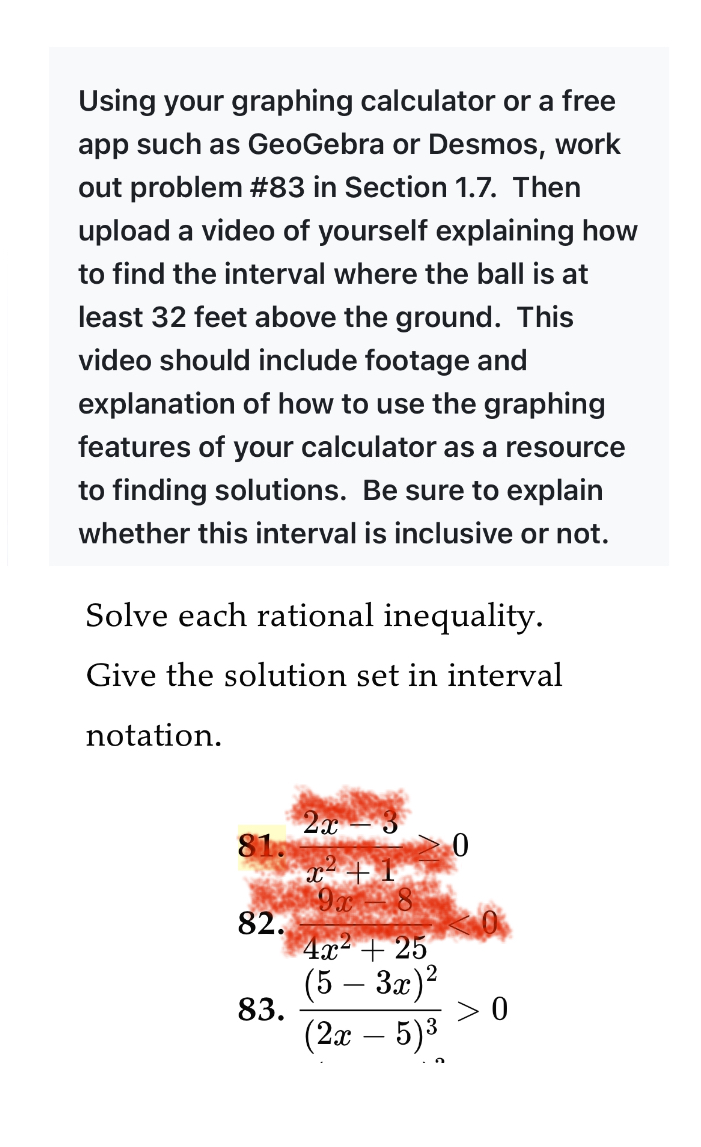
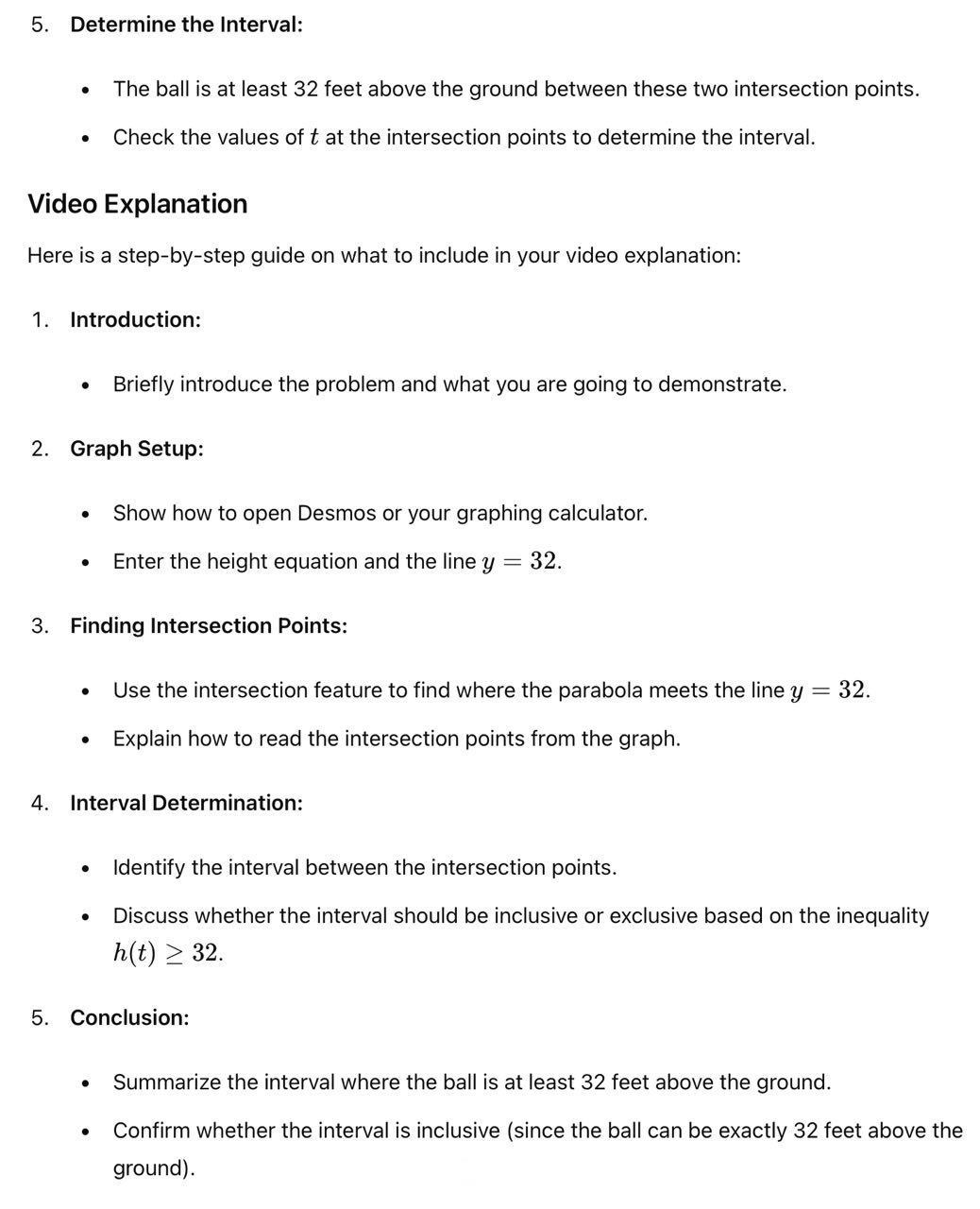
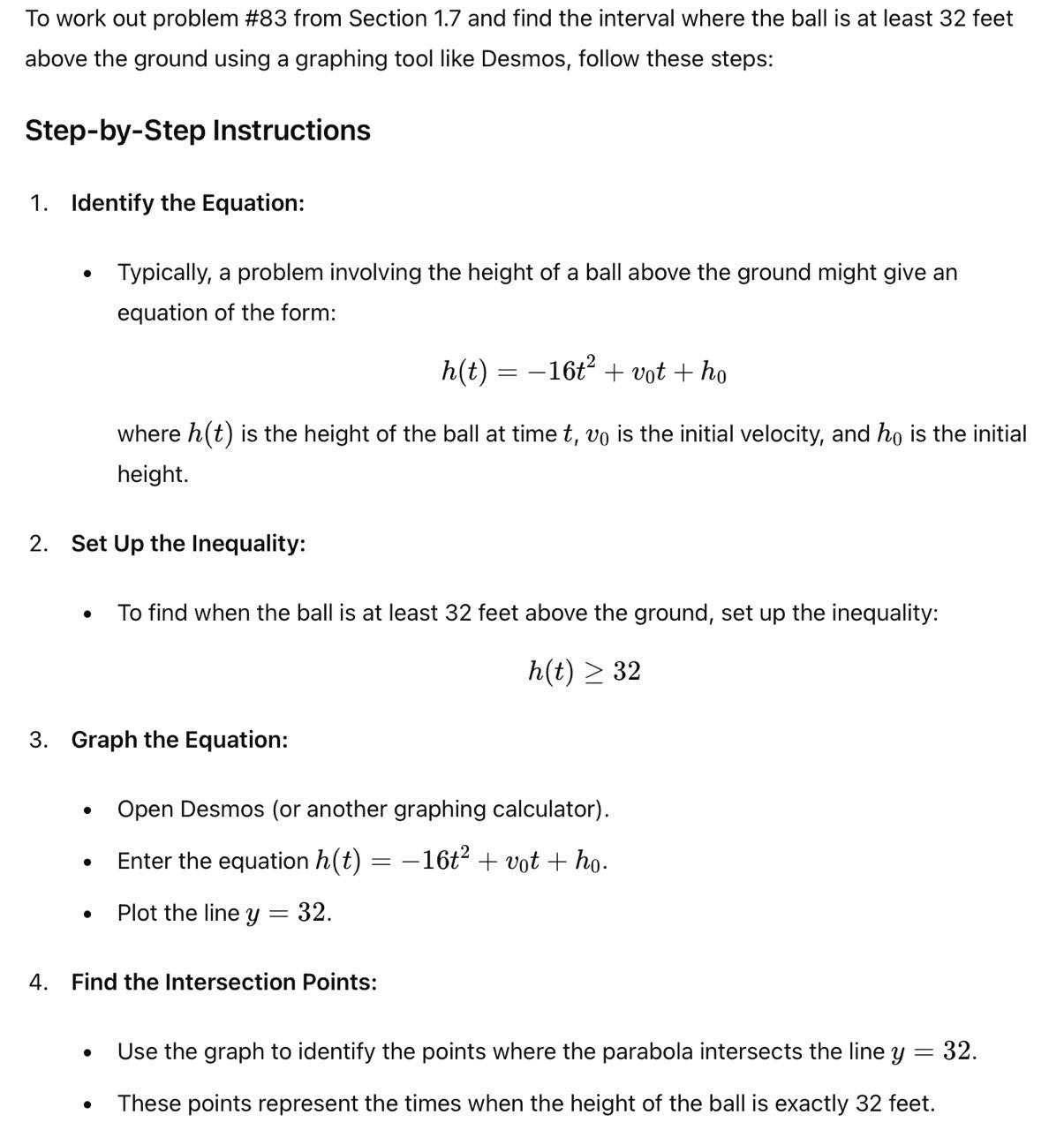
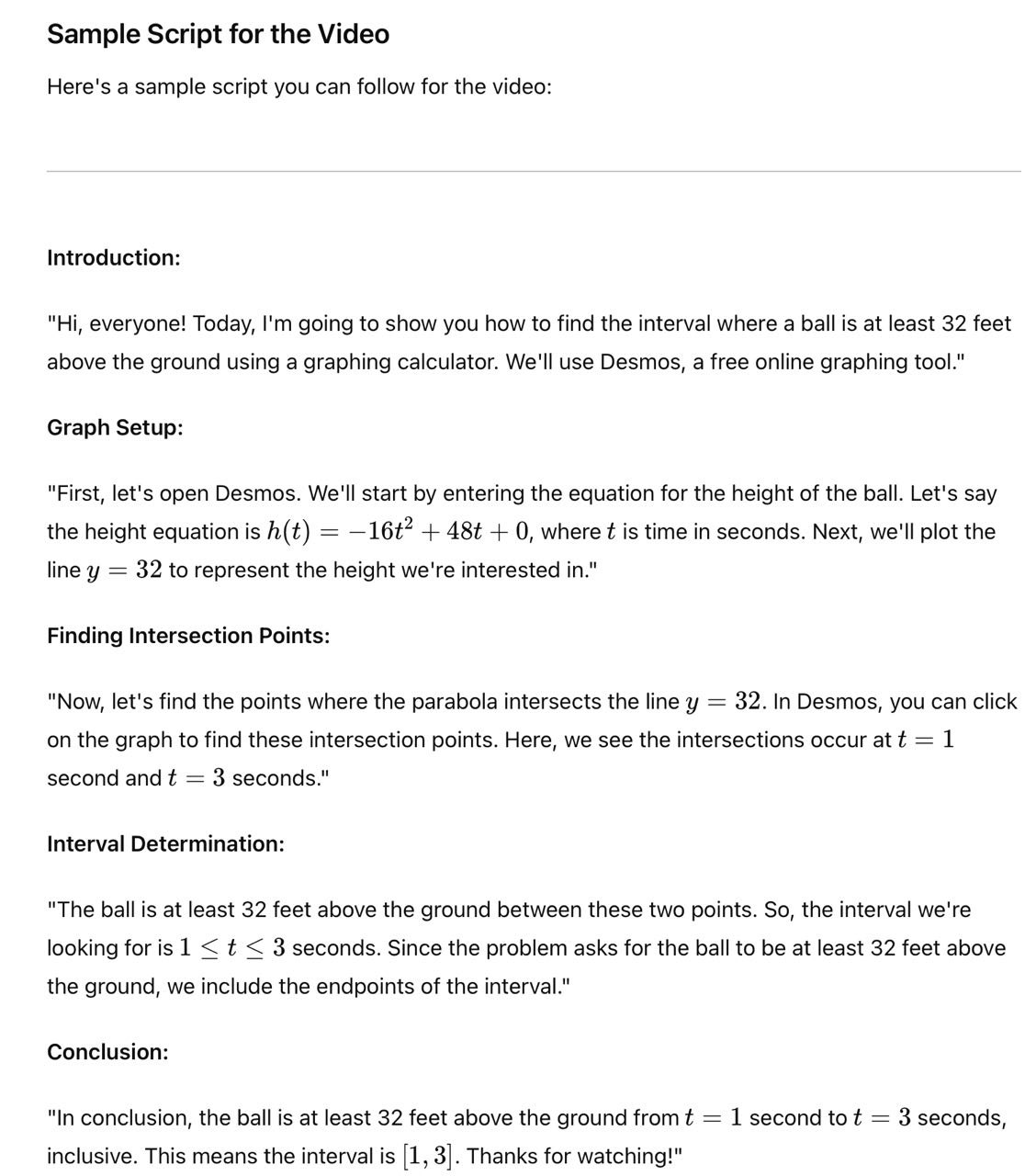
Using your graphing calculator or a free app such as GeoGebra or Desmos, work out problem #83 in Section 1.7. Then upload a video of yourself explaining how to find the interval where the ball is at least 32 feet above the ground. This video should include footage and explanation of how to use the graphing features of your calculator as a resource to finding solutions. Be sure to explain whether this interval is inclusive or not. Solve each rational inequality. Give the solution set in interval notation. 5. Determine the Interval: The ball is at least 32 feet above the ground between these two intersection points. Check the values of t at the intersection points to determine the interval. Video Explanation Here is a step-by-step guide on what to include in your video explanation: 1. Introduction: Briefly introduce the problem and what you are going to demonstrate. 2. Graph Setup: Show how to open Desmos or your graphing calculator. Enter the height equation and the line y = 32. 3. Finding Intersection Points: Use the intersection feature to find where the parabola meets the line y = 32. Explain how to read the intersection points from the graph. 4. Interval Determination: |dentify the interval between the intersection points. Discuss whether the interval should be inclusive or exclusive based on the inequality h(t) > 32. 5. Conclusion: Summarize the interval where the ball is at least 32 feet above the ground. Confirm whether the interval is inclusive (since the ball can be exactly 32 feet above the ground). To work out problem #83 from Section 1.7 and find the interval where the ball is at least 32 feet above the ground using a graphing tool like Desmos, follow these steps: Step-by-Step Instructions 1. Identify the Equation: e Typically, a problem involving the height of a ball above the ground might give an equation of the form: h(t) = 16 + vot + ho where h(t) is the height of the ball at time , v is the initial velocity, and hy is the initial height. 2. Set Up the Inequality: To find when the ball is at least 32 feet above the ground, set up the inequality: h(t) > 32 3. Graph the Equation: Open Desmos (or another graphing calculator). Enter the equation h(t) = 16t% + vgt + hy. o Plottheliney = 32. 4. Find the Intersection Points: Use the graph to identify the points where the parabola intersects the line y = 32. These points represent the times when the height of the ball is exactly 32 feet. Sample Script for the Video Here's a sample script you can follow for the video: Introduction: "Hi, everyone! Today, I'm going to show you how to find the interval where a ball is at least 32 feet above the ground using a graphing calculator. We'll use Desmos, a free online graphing tool." Graph Setup: "First, let's open Desmos. We'll start by entering the equation for the height of the ball. Let's say the height equation is h(t) = 16t2 + 48t + 0, where t is time in seconds. Next, we'll plot the line y = 32 to represent the height we're interested in." Finding Intersection Points: "Now, let's find the points where the parabola intersects the line y = 32. In Desmos, you can click on the graph to find these intersection points. Here, we see the intersections occuratt = 1 second and t = 3 seconds." Interval Determination: "The ball is at least 32 feet above the ground between these two points. So, the interval we're looking foris 1
Step by Step Solution
There are 3 Steps involved in it

Get step-by-step solutions from verified subject matter experts
 Study Help