





Question: Ut + Up = 0, = te (0,0), x (0,1) in classical sense. Here we impose the following initial condition u(x,0) =U(x), = x (0,1),
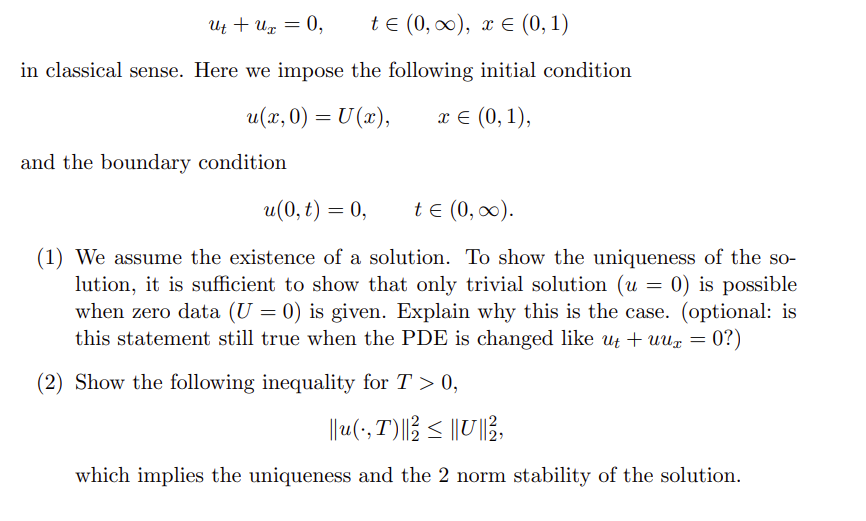
Ut + Up = 0, = te (0,0), x (0,1) in classical

Ut + Up = 0, = te (0,0), x (0,1) in classical sense. Here we impose the following initial condition u(x,0) =U(x), = x (0,1), and the boundary condition u(0,t) = 0, te (0,0). (1) We assume the existence of a solution. To show the uniqueness of the so- lution, it is sufficient to show that only trivial solution (u = 0) is possible when zero data (U = 0) is given. Explain why this is the case. (optional: is this statement still true when the PDE is changed like ut + uur = 0?) ? = (2) Show the following inequality for T >0, || u(,T)||

Step by Step Solution

There are 3 Steps involved in it

1 Expert Approved Answer
Step: 1 Unlock blur-text-image

Question Has Been Solved by an Expert!

Get step-by-step solutions from verified subject matter experts

Step: 2 Unlock
Step: 3 Unlock

Students Have Also Explored These Related General Management Questions!