







Question: V Part A Somewhat surprisingly, the most volcanically active body in the solar system isn't a planet, but a moon: lo, which orbits Jupiter. On
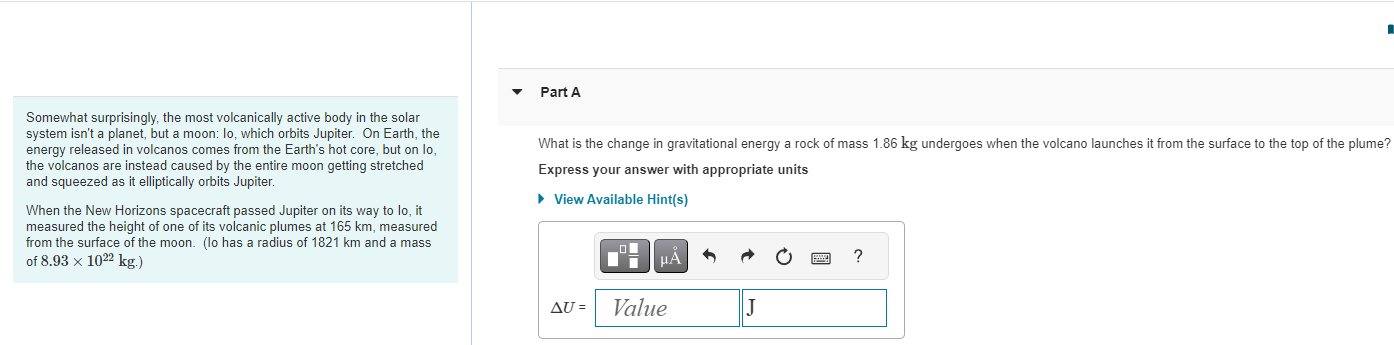
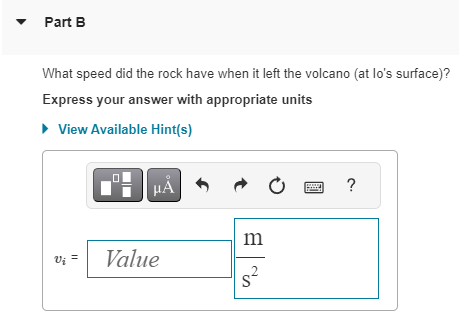
V Part A Somewhat surprisingly, the most volcanically active body in the solar system isn't a planet, but a moon: lo, which orbits Jupiter. On Earth, the energy released in volcanos comes from the Earth's hot core, but on lo, What is the change in gravitational energy a rock of mass 1.86 kg undergoes when the volcano launches it from the surface to the top of the plume? the volcanos are instead caused by the entire moon getting stretched Express your answer with appropriate units and squeezed as it elliptically orbits Jupiter. View Available Hint(s) When the New Horizons spacecraft passed Jupiter on its way to lo, it measured the height of one of its volcanic plumes at 165 km, measured from the surface of the moon. (lo has a radius of 1821 km and a mass of 8.93 x 10²² kg.) ? AU = Value* PartB What speed did the rock have when it left the volcano (at lo's surface)? Express your answer with appropriate units View Available Hint(s) Ef'o
Step by Step Solution
There are 3 Steps involved in it

Get step-by-step solutions from verified subject matter experts
 Study Help