





Question: Value Line provides explicit dividend forecasts over the relative short term, with dividends rising from $.72 in 2012 to $1 in 2015. We can obtain
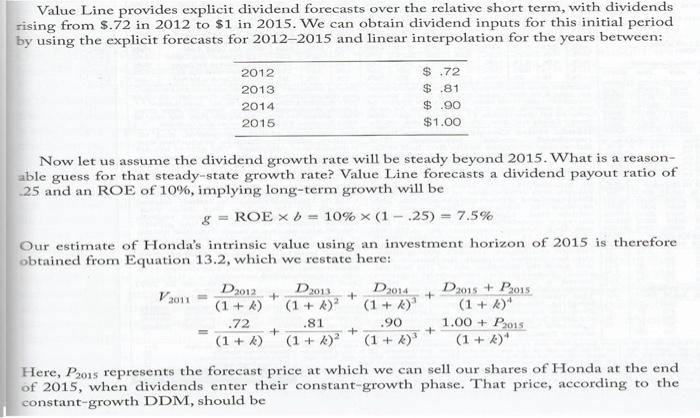
Value Line provides explicit dividend forecasts over the relative short term, with dividends rising from $.72 in 2012 to $1 in 2015. We can obtain dividend inputs for this initial period by using the explicit forecasts for 2012-2015 and linear interpolation for the years between: V2011 Now let us assume the dividend growth rate will be steady beyond 2015. What is a reason- able guess for that steady-state growth rate? Value Line forecasts a dividend payout ratio of 25 and an ROE of 10%, implying long-term growth will be g = ROE b = 10% x (1.25) = 7.5% Our estimate of Honda's intrinsic value using an investment horizon of 2015 is therefore obtained from Equation 13.2, which we restate here: = 2012 2013 2014 2015 = D2012 (1 + k) .72 (1 + k) + + D2013 (1 + k) .81 (1 + k) + + D2014 (1 + k) $.72 $.81 $.90 $1.00 .90 (1 + k) + + D2015 + P2015 (1 + k)4 1.00 + P2015 (1 + k)4 Here, P2015 represents the forecast price at which we can sell our shares of Honda at the end of 2015, when dividends enter their constant-growth phase. That price, according to the constant-growth DDM, should be
 Value Line provides explicit dividend forecasts over the relative short term,

Value Line provides explicit dividend forecasts over the relative short term, with dividends rising from $.72 in 2012 to $1 in 2015 . We can obtain dividend inputs for this initial period by using the explicit forecasts for 2012-2015 and linear interpolation for the years between: Now let us assume the dividend growth rate will be steady beyond 2015. What is a reasonable guess for that steady-state growth rate? Value Line forecasts a dividend payout ratio of 25 and an ROE of 10%, implying long-term growth will be g=ROEb=10%(1.25)=7.5% Our estimate of Honda's intrinsic value using an investment horizon of 2015 is therefore obtained from Equation 13.2, which we restate here: V2011=(1+k)D2012+(1+k)2D2013+(1+k)3D2014+(1+k)4D2015+P2015=(1+k).72+(1+k)2.81+(1+k)3.90+(1+k)41.00+P2015 Here, P2015 represents the forecast price at which we can sell our shares of Honda at the end of 2015 , when dividends enter their constant-growth phase. That price, according to the constant-growth DDM, should be

Step by Step Solution

There are 3 Steps involved in it

1 Expert Approved Answer
Step: 1 Unlock blur-text-image
Question Has Been Solved by an Expert!

Get step-by-step solutions from verified subject matter experts

Step: 2 Unlock
Step: 3 Unlock

Students Have Also Explored These Related Finance Questions!