







Question: ._. vvvvvvv H} ...........v.. u 1. A decrease in the investment rate: Suppose a country enacts a tax policy that discour- ages investment, and the
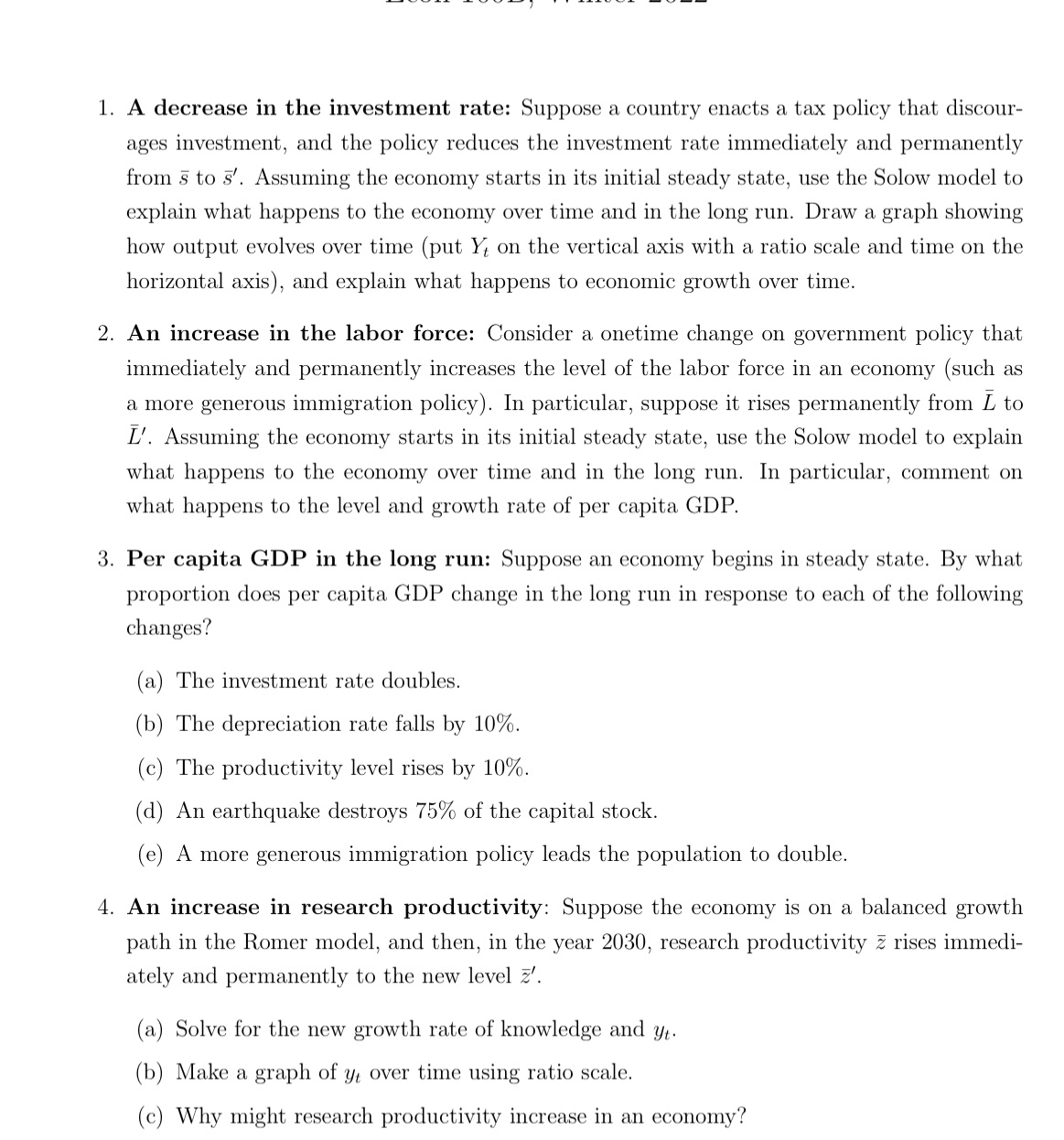
._. vvvvvvv H} ...........v.. u 1. A decrease in the investment rate: Suppose a country enacts a tax policy that discour- ages investment, and the policy reduces the investment rate immediately and permanently from 5 to 5'. Assuming the economy starts in its initial steady state, use the Solow model to explain what happens to the economy over time and in the long run. Draw a graph showing how output evolves over time (put 1'; on the vertical axis with a ratio scale and time on the horizontal axis), and explain what happens to economic growth over time. 2. An increase in the labor force: Consider a onetime change on government policy that immediately and permanently increases the level of the labor force in an economy (such as a more generous immigration policy). In particular, suppose it rises permanently from E to 17. Assuming the economy starts in its initial steady state, use the Solow model to explain what happens to the economy over time and in the long run. In particular, comment on what happens to the level and growth rate of per capita GDP. 3. Per capita GDP in the long run: Suppose an economy begins in steady state. By what proportion does per capita GDP change in the long run in response to each of the following changes? 4. An increase in research productivity: Suppose the economy is on a balanced growth path in the Romer model, and then, in the year 2030, research productivity 2 rises immedi- ately and permanently to the new level '2". (a) Solve for the new growth rate of knowledge and yt. (b) Make a graph of 3;; over time using ratio scale. (0) Why might research productivity increase in an economy
Step by Step Solution
There are 3 Steps involved in it

Get step-by-step solutions from verified subject matter experts
 Study Help