Question: W... (2) WhatsApp T https://www.... Appendix to Smart Cities for Sustainable Development - Reconnaissance Study C.3.15. Case Study 15- Living Lab, Netherlands Smart Cities for
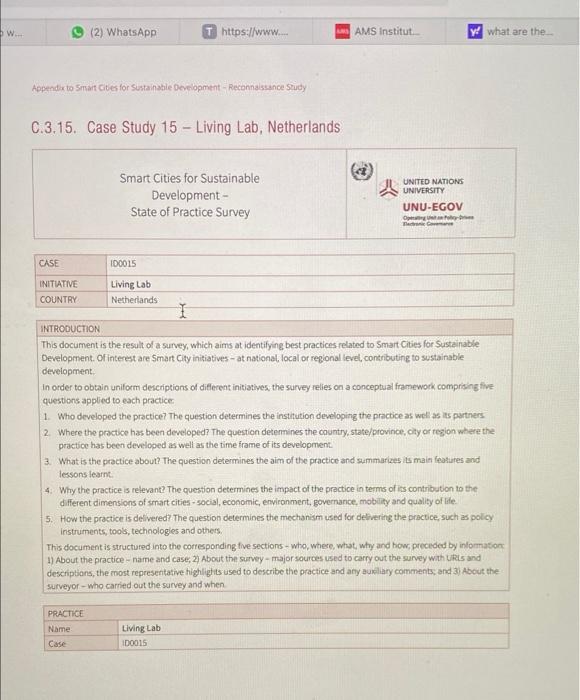
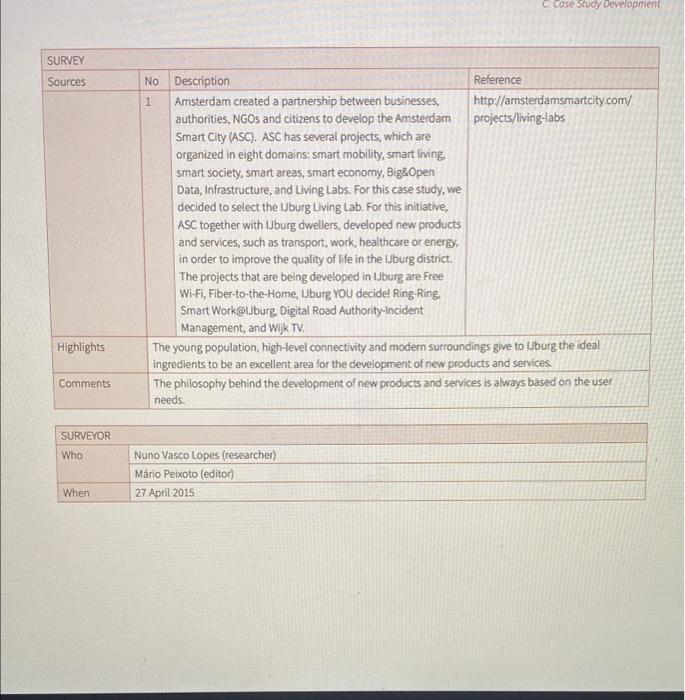
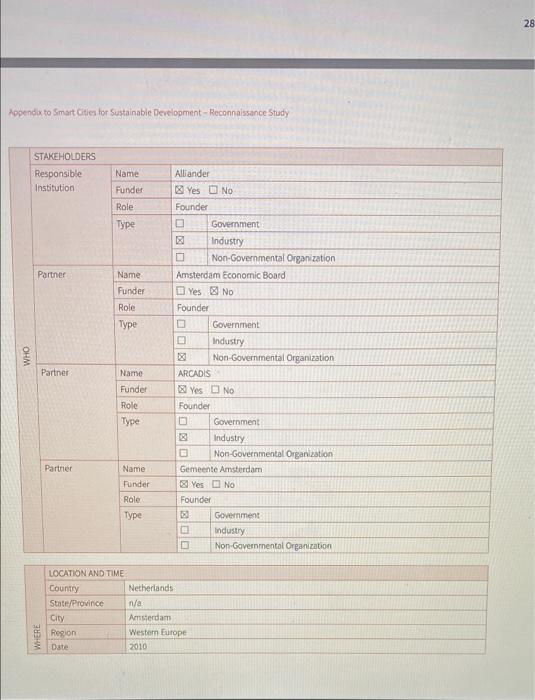
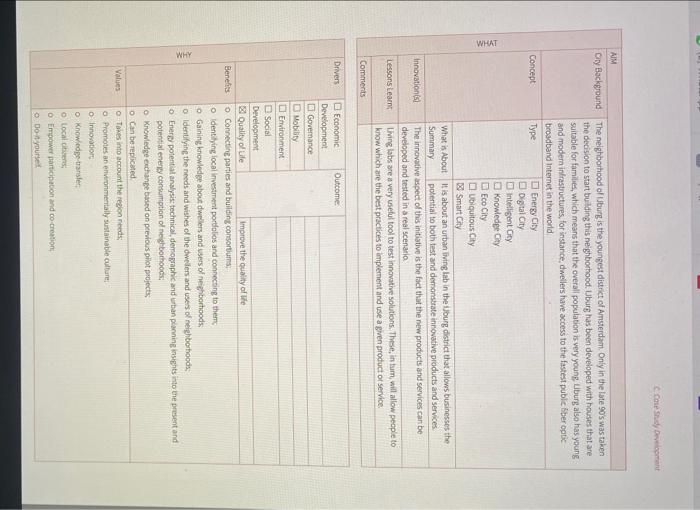
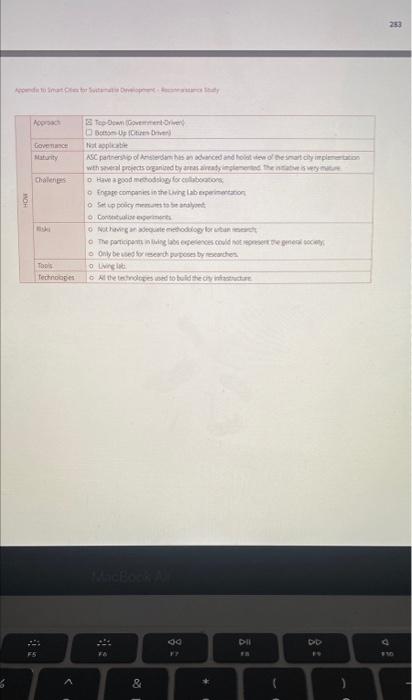
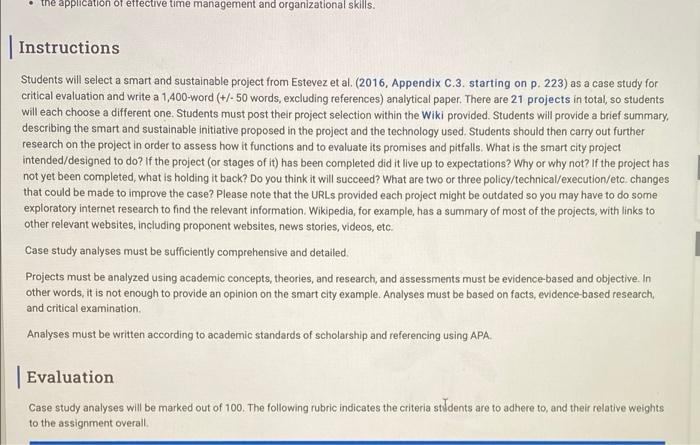
W... (2) WhatsApp T https://www.... Appendix to Smart Cities for Sustainable Development - Reconnaissance Study C.3.15. Case Study 15- Living Lab, Netherlands Smart Cities for Sustainable Development - State of Practice Survey UNITED NATIONS UNIVERSITY UNU-EGOV Operating Fo Blectronic Cove CASE ID0015 INITIATIVE Living Lab COUNTRY Netherlands I INTRODUCTION This document is the result of a survey, which aims at identifying best practices related to Smart Cities for Sustainable Development. Of interest are Smart City initiatives - at national, local or regional level, contributing to sustainable development. in order to obtain uniform descriptions of different initiatives, the survey relies on a conceptual framework comprising five questions applied to each practice 1. Who developed the practice? The question determines the institution developing the practice as well as its partners 2. Where the practice has been developed? The question determines the country, state/province, city or region where the practice has been developed as well as the time frame of its development. 3. What is the practice about? The question determines the aim of the practice and summarizes its main features and lessons learnt. 4: Why the practice is relevant? The question determines the impact of the practice in terms of its contribution to the different dimensions of smart cities-social, economic, environment, governance, mobility and quality of life. 5. How the practice is delivered? The question determines the mechanism used for delivering the practice, such as policy instruments, tools, technologies and others. This document is structured into the corresponding five sections - who, where, what, why and how, preceded by information 1) About the practice - name and case; 2) About the survey-major sources used to carry out the survey with URLs and descriptions, the most representative highlights used to describe the practice and any auxiliary comments; and 3) About the surveyor-who carried out the survey and when PRACTICE Name Living Lab Case ID0015 ADAMS Institut...... what are the... SURVEY Sources Highlights Comments SURVEYOR Who When No Description 1 C Case Study Development Reference http://amsterdamsmartcity.com/ projects/living-labs Amsterdam created a partnership between businesses, authorities, NGOs and citizens to develop the Amsterdam Smart City (ASC). ASC has several projects, which are organized in eight domains: smart mobility, smart living, smart society, smart areas, smart economy, Big&Open Data, Infrastructure, and Living Labs. For this case study, we decided to select the IJburg Living Lab. For this initiative, ASC together with IJburg dwellers, developed new products and services, such as transport, work, healthcare or energy, in order to improve the quality of life in the Uburg district. The projects that are being developed in IJburg are Free Wi-Fi, Fiber-to-the-Home, IJburg YOU decide! Ring-Ring, Smart Work@Jburg, Digital Road Authority-Incident Management, and Wijk TV. The young population, high-level connectivity and modern surroundings give to Uburg the ideal ingredients to be an excellent area for the development of new products and services. The philosophy behind the development of new products and services is always based on the user needs. Nuno Vasco Lopes (researcher) Mrio Peixoto (editor) 27 April 2015 Appendix to Smart Cities for Sustainable Development - Reconnaissance Study STAKEHOLDERS Name Alliander Responsible Institution Funder Role Type Partner WHO WHERE Partner Name Funder Role Type Name Funder Role Type Name Funder Role Type: Partner LOCATION AND TIME Country State/Province City Region Date Yes No- Founder 0 Government Industry 0 Non-Governmental Organization Amsterdam Economic Board Yes No Founder 0 Government 0 Industry Non-Governmental Organization ARCADIS Government Industry Non-Governmental Organization Gemeente Amsterdam Yes No Government Industry D Non-Governmental Organization Founder 0 30 Yes No Founder 800 Netherlands n/a Amsterdam Western Europe 2010 28 WHAT C Case Study Development AIM City Background The neighborhood of IJburg is the youngest district of Amsterdam. Only in the late 90's was taken the decision to start building this neighborhood. Uburg has been developed with houses that are suitable for families, which means that the overall population is very young Liburg also has young and modern infrastructures, for instance, dwellers have access to the fastest public fiber optic broadband Internet in the world. Concept Type Energy City Digital City Intelligent City Knowledge City Eco City Ubiquitous City Smart City What is About It is about an urban living lab in the 1Jburg district that allows businesses the potential to both test and demonstrate innovative products and services. Summary The innovative aspect of this initiative is the fact that the new products and services can be developed and tested in a real scenario Living labs are a very useful tool to test innovative solutions. These, in tum, will allow people to know which are the best practices to implement and use a given product or service. Economic Outcome Development Quality of Life Improve the quality of life o Connecting parties and building consortiums o identifying local investment portfolios and connecting to them, o Gaining knowledge about dwellers and users of neighborhoods o identifying the needs and wishes of the dwellers and users of neighborhoods o Energy potential analysis: technical, demographic and urban planning insights into the present and potential energy consumption of neighborhoods: o Knowledge exchange based on previous pilot projects; o Can be replicated o Takes into account the region needs; o Promotes an environmentally sustainable culture; o Innovation o Knowledge-transfer O Local citizens o Empower participation and co-creation o Do it yourself Innovation(s) Lessons Learnt Comments Drivers WHY Benefits Values Governance Mobility Environment Social Development 3 Approach Tep-Down (Government Ori Bottom Up (Citures Diver Not applicable Governance Maturity ASC partnership of Amsterdam has an advanced and holot view of the smart city implementation with several projects organized by areas already implemented the initiative is very mature Challenges o Have a good methodology for collaborations o Engage companies in the Living lab experimentation o Set up policy memes to be analyt o Contextuali Not having an adequate methodology for urban The participants in living labs experiences could not represent the general society Only be used for research purposes by researches Tools o Living lab Technologies Al the technologes used to build the city instructure 44 Dil FP 02 <. dd the application of effective time management and organizational skills. instructions students will select a smart sustainable project from estevez et al. appendix c.3. starting on p. as case study for critical evaluation write words excluding references analytical paper. there are projects in total so each choose different one. must post their selection within wiki provided. provide brief summary describing initiative proposed technology used. should then carry out further research order to assess how it functions evaluate its promises pitfalls. what is city intended do if stages has been completed did live up expectations why or not yet holding back you think succeed two three policy changes that could be made improve please note urls provided might outdated may have some exploratory internet find relevant information. wikipedia example most with links other websites including proponent news stories videos etc. analyses sufficiently comprehensive detailed. analyzed using academic concepts theories assessments evidence-based objective. enough an opinion example. based facts examination. written according standards scholarship referencing apa. marked following rubric indicates criteria adhere relative weights assignment overall>









 Study Help