







Question: want python code 1. Consider the Lebesgue function Ln(a) = 1936). (1.1) j=0 With l;(x) being the Lagrange polynomials. (a) Write a function to to
want python code
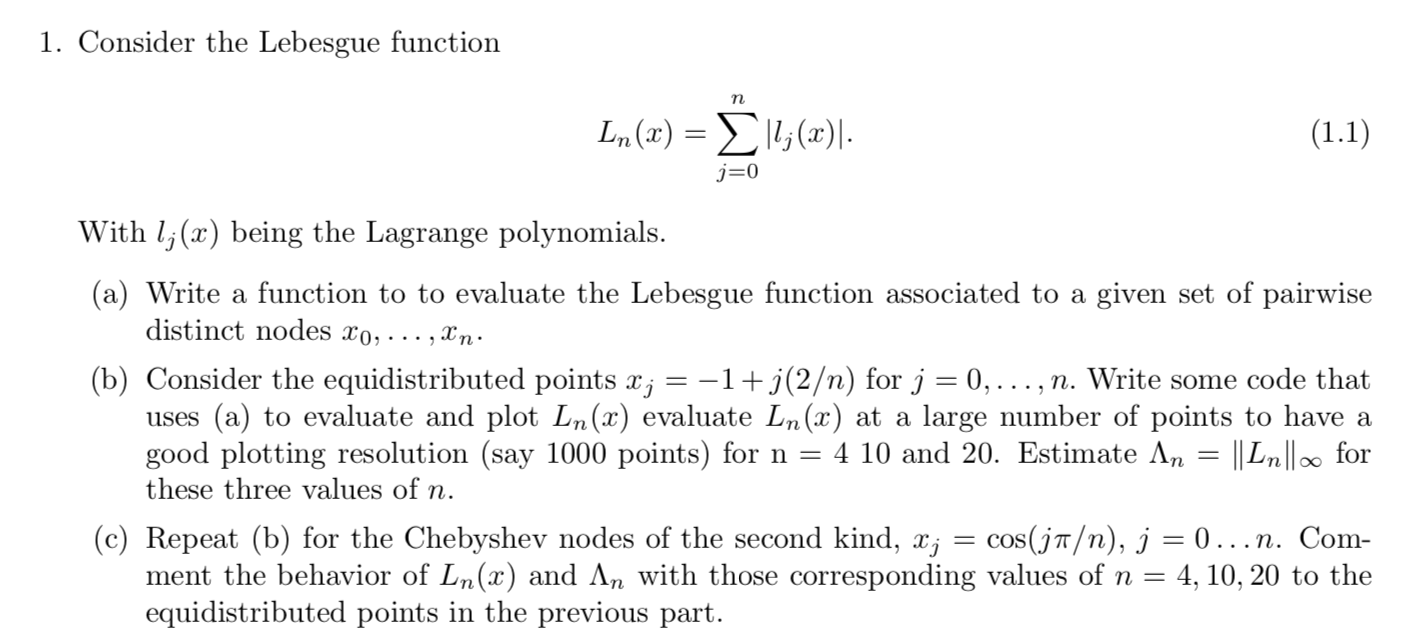
1. Consider the Lebesgue function Ln(a) = 1936). (1.1) j=0 With l;(x) being the Lagrange polynomials. (a) Write a function to to evaluate the Lebesgue function associated to a given set of pairwise distinct nodes xo, ... ,Xn: (b) Consider the equidistributed points x; = -1+;(2) for j = 0,...,n. Write some code that uses (a) to evaluate and plot Ln(x) evaluate Ln(x) at a large number of points to have a good plotting resolution (say 1000 points) for n = 4 10 and 20. Estimate An = ||n||for these three values of n. (c) Repeat (b) for the Chebyshev nodes of the second kind, X; = cos(ja), j = 0...n. Com- ment the behavior of Ln(x) and An with those corresponding values of n = 4, 10, 20 to the equidistributed points in the previous part. 1. Consider the Lebesgue function Ln(a) = 1936). (1.1) j=0 With l;(x) being the Lagrange polynomials. (a) Write a function to to evaluate the Lebesgue function associated to a given set of pairwise distinct nodes xo, ... ,Xn: (b) Consider the equidistributed points x; = -1+;(2) for j = 0,...,n. Write some code that uses (a) to evaluate and plot Ln(x) evaluate Ln(x) at a large number of points to have a good plotting resolution (say 1000 points) for n = 4 10 and 20. Estimate An = ||n||for these three values of n. (c) Repeat (b) for the Chebyshev nodes of the second kind, X; = cos(ja), j = 0...n. Com- ment the behavior of Ln(x) and An with those corresponding values of n = 4, 10, 20 to the equidistributed points in the previous part
Step by Step Solution
There are 3 Steps involved in it

Get step-by-step solutions from verified subject matter experts
 Study Help