







Question: We are designing a protein chip, which includes a capture antibody for analyte A. The antibody has dissociation constant of 10nM. At the detection limit,
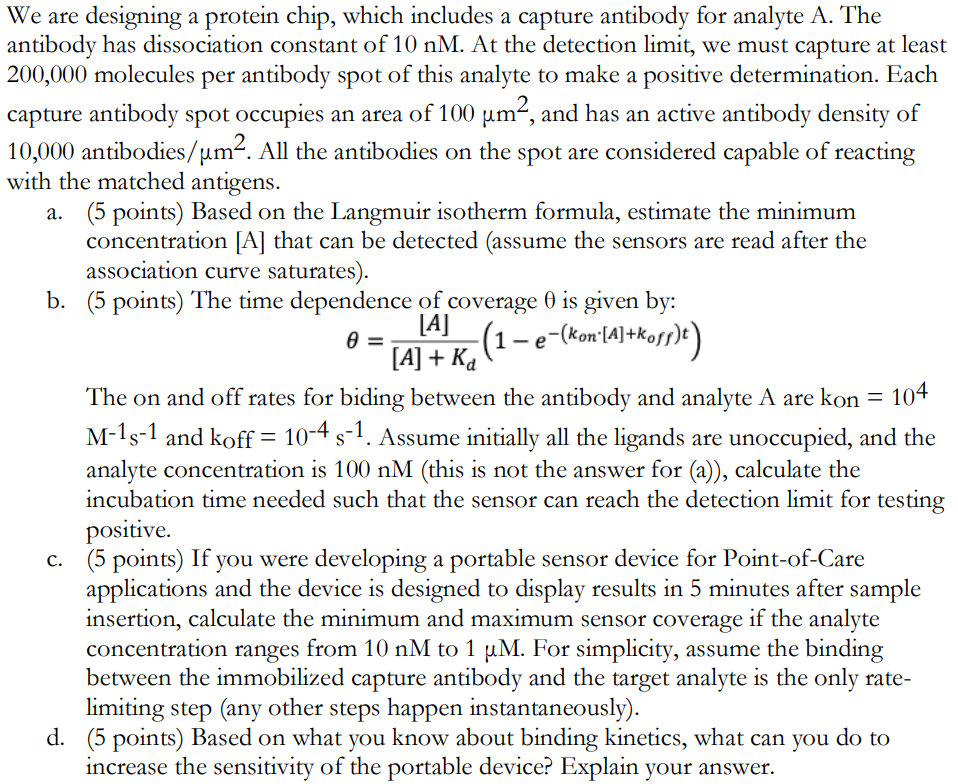
We are designing a protein chip, which includes a capture antibody for analyte A. The antibody has dissociation constant of 10nM. At the detection limit, we must capture at least 200,000 molecules per antibody spot of this analyte to make a positive determination. Each capture antibody spot occupies an area of 100m2, and has an active antibody density of 10,000 antibodies /m2. All the antibodies on the spot are considered capable of reacting with the matched antigens. a. (5 points) Based on the Langmuir isotherm formula, estimate the minimum concentration [A] that can be detected (assume the sensors are read after the association curve saturates). b. (5 points) The time dependence of coverage is given by: =[A]+Kd[A](1e(kon[A]+koff)t) The on and off rates for biding between the antibody and analyte A are kon =104 M1s1 and kOff=104s1. Assume initially all the ligands are unoccupied, and the analyte concentration is 100nM (this is not the answer for (a)), calculate the incubation time needed such that the sensor can reach the detection limit for testing positive. c. (5 points) If you were developing a portable sensor device for Point-of-Care applications and the device is designed to display results in 5 minutes after sample insertion, calculate the minimum and maximum sensor coverage if the analyte concentration ranges from 10nM to 1M. For simplicity, assume the binding between the immobilized capture antibody and the target analyte is the only ratelimiting step (any other steps happen instantaneously). d. (5 points) Based on what you know about binding kinetics, what can you do to increase the sensitivity of the portable device? Explain your
Step by Step Solution
There are 3 Steps involved in it

Get step-by-step solutions from verified subject matter experts
 Study Help