Question: There is a pdf which includes all these questions, so where I can post that pdf for more clearance? plan The future of Beyond Meat
There is a pdf which includes all these questions, so where I can post that pdf for more clearance?
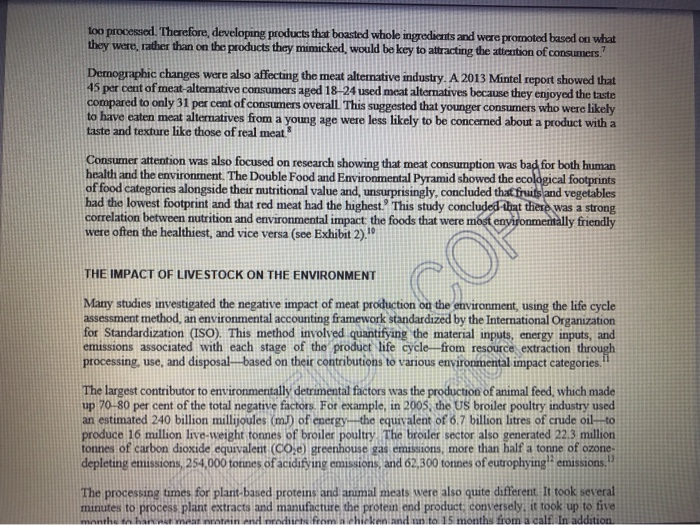
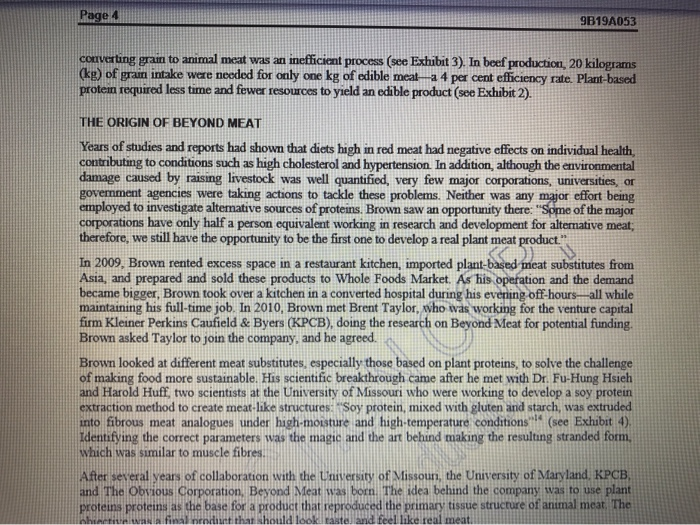
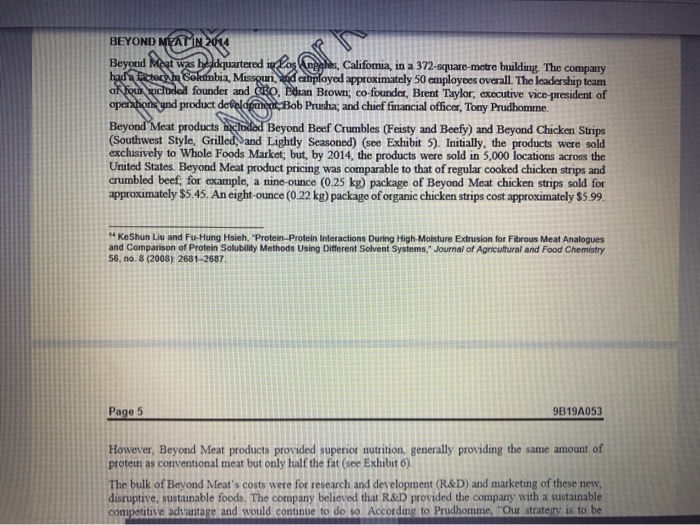
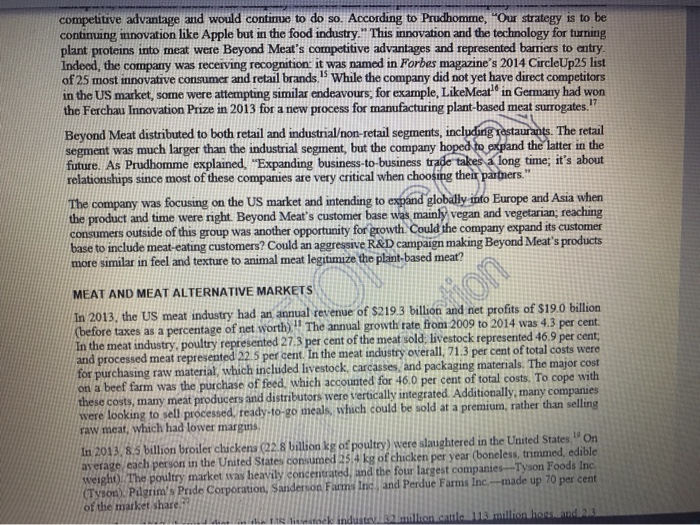
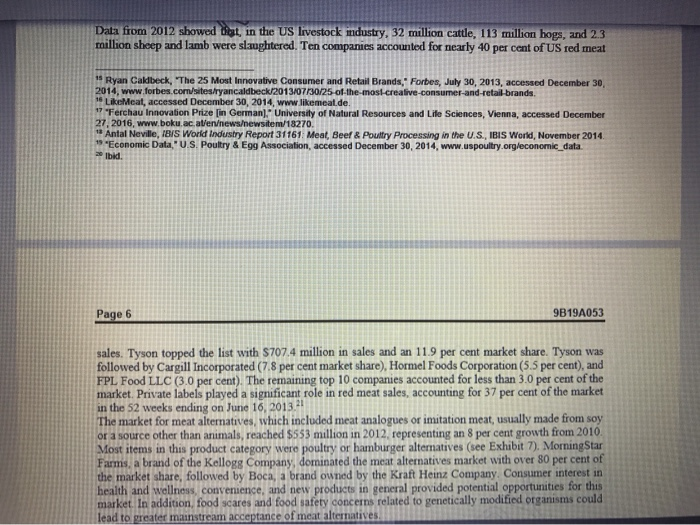
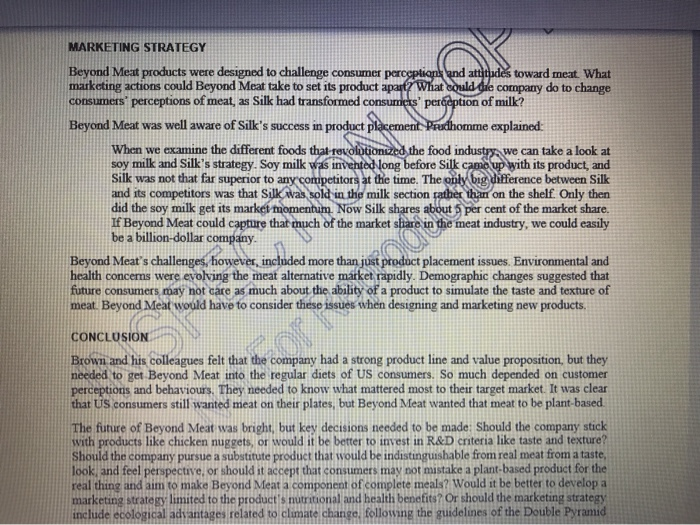
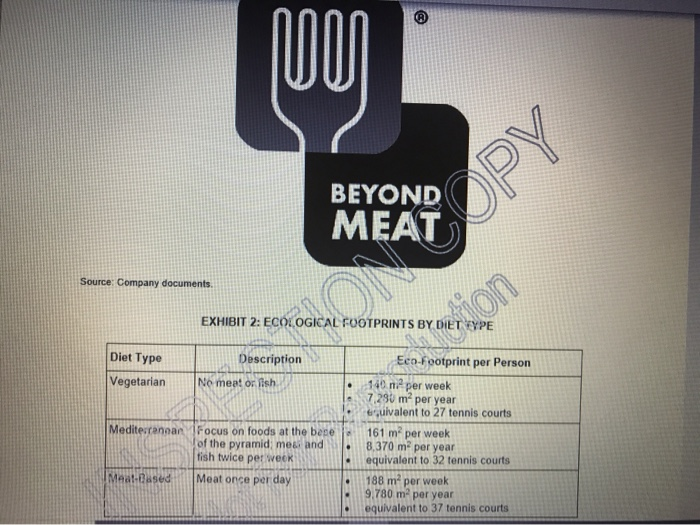
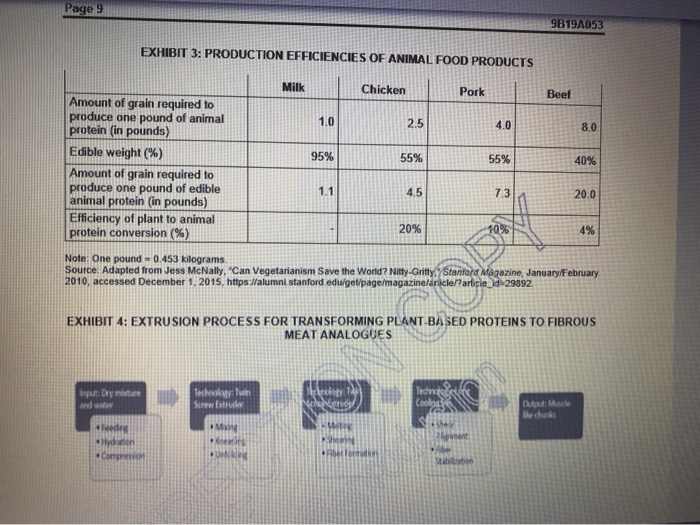
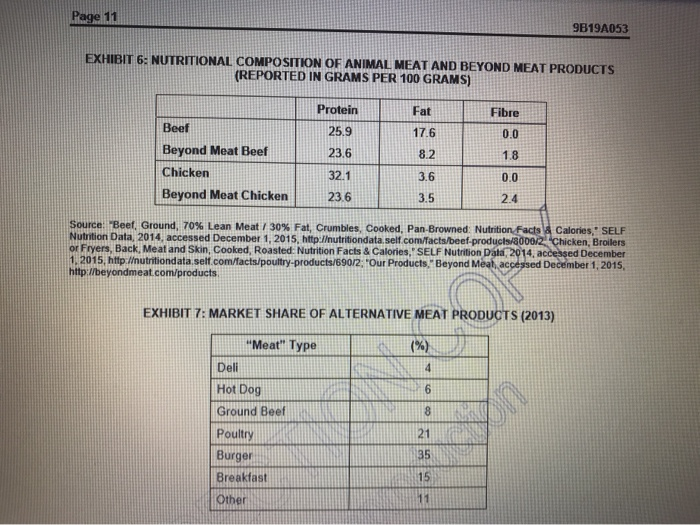
plan The future of Beyond Meat was bright, but key decisions needed to be made: Should the company stick with products like chicken nuggets, or would it be better to invest in R&D criteria like taste and texture? Should the company pursue a substitute product that would be indistinguishable from real meat from a taste, look, and feel perspective, or should it accept that consumers may not mistake a plant-based product for the real thing and aim to make Beyond Meat a component of complete meals? Would it be better to develop a marketing strategy limited to the product's nutritional and health benefits? Or should the marketing strategy include ecological advantages related to climate change, following the guidelines of the Double Pyramid 21 Levesque, op. cit 9B19A053 Page 7 research? Finally, which markets should Beyond Meat target? Would it be better for the company to target vegetarians looking for better plant-based alternatives, or should it target meat eaters who might be convinced to try a different kind of meat? How might changing demographic demands factor into this? University, London, Ontario, Canada, N5G ON1; ( 519.661.3208, (e) cases vey.ca, wyprom. Our goal is to publish materials of the highest quality, sauf any errata to puthishasesivoy.ca Copyright 2019, Avey Business School Foundation Version: 2020-02-28 co aroor It was mid-2014, and as the founder and chief executive Officer (CEOY of Beyond Meat, Ethan Brown, scrolled through the company's Twitter feed, he was pleased to see the stream of photos featuring Beyond Meat in a variety of foods. Beyond Meat could now be found a dishes from chicken noodle soup to creamy pasta. It made him think back to the 2009 dinner that had started it all: Brown had then been working at the fuel cell company Ballard Power Systems Inc (Ballard), and he had been puzzle to note that colleagues at a conference dinner chose a steak entre an energy-intensive food that scemed to be at odds with Ballard's efforts to convert energy more efficiently. Seeing this contrast between mission and behaviour, Brown had asked himself, "How difficult can it be to change what eat for dinner?" Motivated by this question, he founded Beyond Meat in 2009 with the mission to mass-market solutions that perfectly replace animal protein with planit protein. The company had faced all the typical challenges of a star and Brown and his colleagues knew that, in addition to these, their greatest challenge would be to change customer behaviour. Meat held a central role in US culture and society_from summer barbeques and holiday meals to on-the-go foods like hot dogs at baseball games and chicken nuggets at drive throughs. The name and "impossible fork" logo of Beyond Meat were symbols of Brown's intention to challenge this by evolving "meat" to a new level and producing a high- quality meat alternative (see Exhibit 1), Assuming that a meat alternative could be produced and marketed cost-effectively, Beyond Meat would also need to make its plant-based "meat" socially and culturally palatable. This would involve changing US dinner habits- an exercise that would require Beyond Meat to consider how its product compared to animal meat in terms of its look, taste, feel appearance, and nutritional content. It would also involve considering target markets and customer segments, as well as deciding whether to use ecological and or ethical arguments in marketing Brown wanted Beyond Meat to be the game changer in the meat industry, just as soy- and almond-based Silk had changed the milk industry. Packaging its soy milk in a standard gable-top carton had allowed Silk to overcome customer reticence by aligning the product with traditional dairy products. Silk had been able to grow its market share considerably by using packaging and product placement that appealed to consumers looking for a highly similar alternative to regular dairy milk. Now, Silk was the leading soy milk, with $12.5 million in sales for 2014, compared to $4.7 million for its closest competitor. Brown was looking to replicate this success by targeting consumers who were looking for a healthier meat alternative that mimicked the taste o Page 2 9B19A053 and texture of meat in much the same way that Silk soy milk mimicked its dairy counterpart. However, even if Beyond Meat could offer the healthiest and most economical "meat" available, Brown and his colleagues were well aware of the difficulty of changing customer perceptions and behaviours. How could Beyond Meat make its way onto the shopping lists and dinner tables of more US consumers? HUMANS AND MEAT In order to understand the dependency of humans on meat, one must consider both the history and the science of humans and meat consumption. Some scientists believed that there were fundamental links between meat eating and the evolution of human biology and society, for example, humans possessed the enzymes needed to digest meat, and human socialization could be connected to the domestication of animals and co-operative hunting.' Humans had historically relied on meat to provide essential amino acids and micronutrients, using plant foods as supplemental sources of energy. Increasingly consumers were drawing necessary nutrients from a variety of sources, so dependency on meat was decreasing. At the same time, the rise of genetically modified meat, along with ethically controversial means of raising livestock and poultry, were shaking consumers' trust in meat and its origin and makeup. CUSTOMER BEHAVIOUR AND ATTITUDES TOWARD MEAT In 2010, the world's population was projected to increase over the next decade by 11 per cent, or about 766 million people. Moreover, at least 800 million consumers were expected to join the middle class by 2020, driven mainly by emerging market economies such as China and India. Historically, as incomes had risen, people had shifted from grain-based diets to high-value diets that included more meat and fish. This meant not only that more people would be consuming food in general but also that people would be consuming more meat. According to a survey conducted for National Public Radio by Thomson Reuters Corporation and released in 2010,61 per cent of US consumers were concerned about contamination of the food supply, while 51 per cent worried most about meat safety. Another report, by Mintel Group Ltd in 2013, showed that the majority of meat eaters (58 per cent) were concerned about the food safety of red meat and pork. Many customers were looking for food sources that were both ethical and responsible as well as for foods with high nutritional value and these qualities were especially relevant when it came to the meat they consumed. Therefore, many customers were evaluating a range of factors before deciding on the types of meats they would eat. Some chose to increase their consumption of chicken in lieu of red meat. More customers (51 per cent) showed a preference and willingness to pay extra for brands that supported animal welfare by buying products such as inn too processed. Therefore, developing products that boasted whole ingredients and were promoted based on what they were, rather than on the products they mimicked, would be key to attracting the attention of consumers." Demographic changes were also affecting the meat alternative industry. A 2013 Mintel report showed that 45 per cent of meat alterative consumers aged 18-24 used meat alternatives because they enjoyed the taste compared to only 31 per cent of consumers overall This suggested that younger consumers who were likely to have eaten meat alternatives from a young age were less likely to be concemed about a product with a taste and texture like those of real meat 8 Consumer attention was also focused on research showing that meat consumption was bad for both human health and the environment. The Double Food and Environmental Pyramid showed the ecological footprints of food categories alongside their nutritional value and, unsurprisingly, concluded that fruits and vegetables had the lowest footprint and that red meat had the highest. This study concluded that there was a strong correlation between nutrition and environmental impact the foods that were most environmentally friendly were often the healthiest, and vice versa (see Exhibit 2).'' THE IMPACT OF LIVESTOCK ON THE ENVIRONMENT Many studies investigated the negative impact of meat production on the environment, using the life cycle assessment method, an environmental accounting framework standardized by the International Organization for Standardization (ISO). This method involved quantifying the material inputs, energy inputs, and emissions associated with each stage of the product life cycle--from resource extraction through processing, use, and disposal_based on their contributions to various environmental impact categories. The largest contributor to environmentally detrimental factors was the production of animal feed, which made up 70-80 per cent of the total negative factors. For example, in 2005, the US broiler poultry industry used an estimated 240 billion millijoules (mt) of energy the equivalent of 6.7 billion litres of crude oil to produce 16 million live-weight tonnes of broiler poultry The broiler sector also generated 22.3 million tonnes of carbon dioxide equivalent (CO2) greenhouse gas emissions, more than half a tonne of ozone- depleting emissions, 254,000 tonnes of acidifying emissions, and 62,300 tonnes of eutrophying' emissions. The processing times for plant-based proteins and animal meats were also quite different. It took several minutes to process plant extracts and manufacture the protein and product: conversely, it took up to five months maat wmtain and dirt from whicken and nn ta 15 months from a calf. In addition, Page 4 9B19A053 converting grain to animal meat was an inefficient process (see Exhibit 3). In beef production, 20 kilograms (kg) of grain intake were needed for only one kg of edible meat 14 per cent efficiency rate. Plant-based protem required less time and fewer resources to yield an edible product (see Exhibit 2). THE ORIGIN OF BEYOND MEAT Years of studies and reports had shown that diets high in red meat had negative effects on individual health, contributing to conditions such as high cholesterol and hypertension. In addition, although the environmental damage caused by raising livestock was well quantified, very few major corporations, universities, or government agencies were taking actions to tackle these problems. Neither was any major effort being employed to investigate alternative sources of proteins. Brown saw an opportunity there: "Some of the major corporations have only half a person equivalent working in research and development for alternative meat; therefore, we still have the opportunity to be the first one to develop a real plant meat product." In 2009, Brown rented excess space in a restaurant kitchen, imported plant-based meat substitutes from Asia, and prepared and sold these products to Whole Foods Market. As his operation and the demand became bigger, Brown took over a kitchen in a converted hospital during his evening off-hoursall while maintaining his full-time job. In 2010, Brown met Brent Taylor, who was working for the venture capital firm Kleiner Perkins Caufield & Byers (KPCB), doing the research on Beyond Meat for potential funding. Brown asked Taylor to join the company, and he agreed. Brown looked at different meat substitutes, especially those based on plant proteins, to solve the challenge of making food more sustainable. His scientific breakthrough came after he met with Dr. Fu-Hung Hsieh and Harold Huff, two scientists at the University of Missouri who were working to develop a soy protein extraction method to create meat-like structures: "Soy protein, mixed with gluten and starch, was extruded into fibrous meat analogues under high-moisture and high-temperature conditions (see Exhibit 4). Identifying the correct parameters was the magic and the art behind making the resulting stranded form, which was similar to muscle fibres. After several years of collaboration with the University of Missouri, the University of Maryland. KPCB, and The Obvious Corporation, Beyond Meat was born. The idea behind the company was to use plant proteins proteins as the base for a product that reproduced the primary tissue structure of animal meat. The his final nendiitti that should look raste, and feel like real meati BEYOND MEAT IN 2014 Beyond Meat was headquartered in Los Pales, Califomia, in a 372-square-metre building. The company had a factory me Sokmbia, Missouri, employed approximately 50 employees overall. The leadership team of fou included founder and CEO dan Brown, co-founder, Brent Taylor, executive vice-president of operations and product debelopment Bob Prusha, and chief financial officer, Tony Prudhomme. Beyond Meat products mcluded Beyond Beef Crumbles (Feisty and Beefy) and Beyond Chicken Strips (Southwest Style, Grilled, and Lightly Seasoned) (see Exhibit 5). Initially, the products were sold exclusively to Whole Foods Market; but, by 2014, the products were sold in 5,000 locations across the United States. Beyond Meat product pricing was comparable to that of regular cooked chicken strips and crumbled beef, for example, a nine-ounce (0.25 kg) package of Beyond Meat chicken strips sold for approximately $5.45. An eight-ounce (0.22 kg) package of organic chicken strips cost approximately $5.99. "KeShun Liu and Fu-Hung Hsieh, "Protein-Protein Interactions During High-Moisture Extrusion for Fibrous Meat Analogues and Comparison of Protein Solubility Methods Using Different Solvent Systems, Journal of Agricultural and Food Chemistry 56, no. 8 (2008): 2681-2687 Page 5 9B19A053 However, Beyond Meat products provided superior nutrition, generally providing the same amount of protein as conventional meat but only half the fat (see Exhibit 6). The bulk of Beyond Meat's costs were for research and development (R&D) and marketing of these new, disruptive, sustainable foods. The company believed that R&D provided the company with a sustainable competitive advantage and would continue to do so. According to Prudhomme, "Our strategy is to be competitive advantage and would continue to do so. According to Prudhomme, "Our strategy is to be continuing innovation like Apple but in the food industry." This innovation and the technology for turning plant proteins into meat were Beyond Meat's competitive advantages and represented barriers to entry. Indeed, the company was receiving recognition: it was named in Forbes magazine's 2014 CircleUp25 list of 25 most innovative consumer and retail brands. While the company did not yet have direct competitors in the US market, some were attempting similar endeavours, for example, LikeMeat' in Germany had won the Ferchau Innovation Prize in 2013 for a new process for manufacturing plant-based meat surrogates." Beyond Meat distributed to both retail and industrialon-retail segments, including restaurants. The retail segment was much larger than the industrial segment, but the company hoped to expand the latter in the future. As Prudhomme explained, "Expanding business-to-business trade takes a long time; it's about relationships since most of these companies are very critical when choosing their partners." The company was focusing on the US market and intending to expand globally into Europe and Asia when the product and time were right. Beyond Meat's customer base was mainly vegan and vegetarian, reaching consumers outside of this group was another opportunity for growth. Could the company expand its customer base to include meat-eating customers? Could an aggressive R&D campaign making Beyond Meat's products more similar in feel and texture to animal meat legitimize the plant-based meat? von MEAT AND MEAT ALTERNATIVE MARKETS In 2013, the US meat industry had an annual revenue of $219.3 billion and net profits of $19.0 billion (before taxes as a percentage of net worth). The annual growth rate from 2009 to 2014 was 4.3 per cent. In the meat industry, poultry represented 27.3 per cent of the meat sold, livestock represented 46.9 per cent; and processed meat represented 22.5 per cent. In the meat industry overall, 71.3 per cent of total costs were for purchasing raw material, which included livestock carcasses and packaging materials. The major cost on a beef farm was the purchase of feed, which accounted for 46.0 per cent of total costs. To cope with these costs, many meat producers and distributors were vertically integrated. Additionally, many companies were looking to sell processed, ready-to-go meals, which could be sold at a premium, rather than selling raw meat, which had lower margins, In 2013.8.5 billion broiler chickens (22.8 billion kg of poultry) were slaughtered in the United States On average each person in the United States consumed 25,4 kg of chicken per year (boneless, trimmed, edible weight. The poultry market was heavily concentrated, and the four largest companies--Tyson Foods Inc. up 70 (Tyson Pilgrim's Pride Corporation, Sanderson Farms Inc. and Perdue Farms Inc.-made of the market share. tek industriencat million hors and 19 per cent Data from 2012 showed bilat, in the US livestock industry, 32 million cattle, 113 million hogs, and 23 million sheep and lamb were slaughtered. Ten companies accounted for nearly 40 per cent of US red meat 1 Ryan Cakbeck, "The 25 Most Innovative Consumer and Retail Brands, Forbes, July 30, 2013, accessed December 30, 2014, www forbes.com/sites/ryancaldbeck/2013/07/30/25 of the most creative-consumer-and-retail brands. 1 LikeMeat, accessed December 30, 2014, www likemeat.de. 17 Ferchau Innovation Prize (in German). University of Natural Resources and Life Sciences, Vienna, accessed December 27, 2016, www.boku.ac.at/enewsewsitem/18270. 13 Antal Neville, IBIS World Industry Report 31161. Meat, Beef & Poultry Processing in the U.S., IBIS World, November 2014 1 Economic Data, "U.S. Poultry & Egg Association, accessed December 30, 2014, www.uspoultry.org/economic_data. Ibid. Page 6 9B19A053 sales. Tyson topped the list with $707.4 million in sales and an 11.9 per cent market share. Tyson was followed by Cargill Incorporated (7.8 per cent market share), Hormel Foods Corporation (5.5 per cent), and FPL Food LLC (3.0 per cent). The remaining top 10 companies accounted for less than 3.0 per cent of the market. Private labels played a significant role in red meat sales, accounting for 37 per cent of the market in the 52 weeks ending on June 16, 2013.21 The market for meat alternatives, which included meat analogues or imitation meat, usually made from soy or a source other than animals, reached $553 million in 2012, representing an 8 per cent growth from 2010. Most items in this product category were poultry or hamburger alternatives (see Exhibit 7). Morning Star Farms, a brand of the Kellogg Company, dominated the meat alternatives market with over 80 per cent of the market share, followed by Boca, a brand owned by the Kraft Heinz Company. Consumer interest in health and wellness, convenience, and new products in general provided potential opportunities for this market. In addition, food scares and food safety concerns related to genetically modified organisms could lead to greater mainstream acceptance of meat alternatives MARKETING STRATEGY Beyond Meat products were designed to challenge consumer perceptions and attitudes toward meat What marketing actions could Beyond Meat take to set its product apart? What could die company do to change consumers' perceptions of meat, as Silk had transformed consumets' perception of milk? Beyond Meat was well aware of Silk's success in product placement Prudhomme explained When we examine the different foods that revolutionized the food industry, we can take a look at soy milk and Silk's strategy. Soy milk was invented long before Silk came up with its product, and Silk was not that far superior to any competitors at the time. The only big difference between Silk and its competitors was that Silk was sold in the milk section rather than on the shelf. Only then did the soy milk get its market momentum Now Silk shares about 5 per cent of the market share. If Beyond Meat could capture that much of the market shar the meat industry, we could easily be a billion-dollar company. Beyond Meat's challenges, however, included more than just product placement issues. Environmental and health concerns were evolving the meat alternative market rapidly. Demographic changes suggested that future consumers may not care as much about the ability of a product to simulate the taste and texture of meat. Beyond Meat would have to consider these issues when designing and marketing new products. CONCLUSION Brown and his colleagues felt that the company had a strong product line and value proposition, but they needed to get Beyond Meat into the regular diets of US consumers. So much depended on customer perceptions and behaviours. They needed to know what mattered most to their target market. It was clear that US consumers still wanted meat on their plates, but Beyond Meat wanted that meat to be plant-based The future of Beyond Meat was bright, but key decisions needed to be made: Should the company stick with products like chicken nuggets, or would it be better to invest in R&D criteria like taste and texture? Should the company pursue a substitute product that would be indistinguishable from real meat from a taste, look and feel perspective, or should it accept that consumers may not mistake a plant-based product for the real thing and aim to make Beyond Meat a component of complete meals? Would it be better to develop a marketing strategy limited to the product's nutritional and health benefits? Or should the marketing strategy include ecological advantages related to climate change, following the guidelines of the Double Pyramid Page 7 9B19A053 research? Finally, which markets should Beyond Meat target? Would it be better for the company to target vegetarians looking for better plant-based alternatives, or should it target meat eaters who might be convinced to try a different kind of meat? How might changing demographic demands factor into this? 000 BEYOND MEAT Source: Company documents EXHIBIT 2: ECOLOGICAL FOOTPRINTS BY DI OPY a tution Diet Type Description Vegetarian No meat or fish Mediterranean Focus on foods at the bese of the pyramid med and tish twice per week Meat once per day Eco-Footprint per Person 140 n per week 7.290 m2 per year tuivalent to 27 tonnis courts 161 m per week 8,370 m2 per year equivalent to 32 tennis courts 188 m2 per week 9.780 m per year equivalent to 37 tennis courts . Maat-Oased . Page 9 9B19A053 EXHIBIT 3: PRODUCTION EFFICIENCIES OF ANIMAL FOOD PRODUCTS Milk Chicken Pork Beef 1.0 2.5 4.0 8.0 95% 55% 55% 40% Amount of grain required to produce one pound of animal protein (in pounds) Edible weight (%) Amount of grain required to produce one pound of edible animal protein (in pounds) Efficiency of plant to animal protein conversion (%) 1.1 4.5 7.3 20.0 20% 10% 4% Note: One pound -0.453 kilograms Source: Adapted from Jess McNally. "Can Vegetarianism Save the World? Nitty-Gritty, Stanford Magazine, January/February 2010, accessed December 1, 2015, https://alumni stanford.edu/getpage/magazinelar icle/?article_id-29892 EXHIBIT 4: EXTRUSION PROCESS FOR TRANSFORMING PLANT-BASED PROTEINS TO FIBROUS MEAT ANALOGUES Input: Ory mixture and wat Technology: Iwi Screwbud Tech Coco @ out: Munch MM ed Hyder Compe M . UM bel Station Page 11 9819A053 EXHIBIT 6: NUTRITIONAL COMPOSITION OF ANIMAL MEAT AND BEYOND MEAT PRODUCTS (REPORTED IN GRAMS PER 100 GRAMS) Protein Fat Fibre Beef 25.9 17.6 0.0 23,6 8.2 1.8 Beyond Meat Beef Chicken Beyond Meat Chicken 32.1 3.6 0.0 23.6 3.5 2.4 Source: "Beef, Ground, 70% Lean Meat 7 30% Fat, Crumbles, Cooked, Pan-Browned Nutrition Facts & Calories, SELF Nutrition Data, 2014, accessed December 1, 2015, http:/utritiondata.self.com/facts/beef products/8000/2 "Chicken, Broilers or Fryers, Back, Meat and Skin, Cooked, Roasted: Nutrition Facts & Calories, 'SELF Nutrition Data, 2014, accessed December 1.2015, http:/utritiondata self.com/facts/poultry products/690/2"Our Products, Beyond Meat, accessed December 1, 2015, http://beyondmeat.com/products EXHIBIT 7: MARKET SHARE OF ALTERNATIVE MEAT PRODUCTS (2013) "Meat" Type (%) Deli 4 Hot Dog 6 Ground Beef 8 21 Poultry Burger Breakfast 35 15 Other 11









 Study Help