







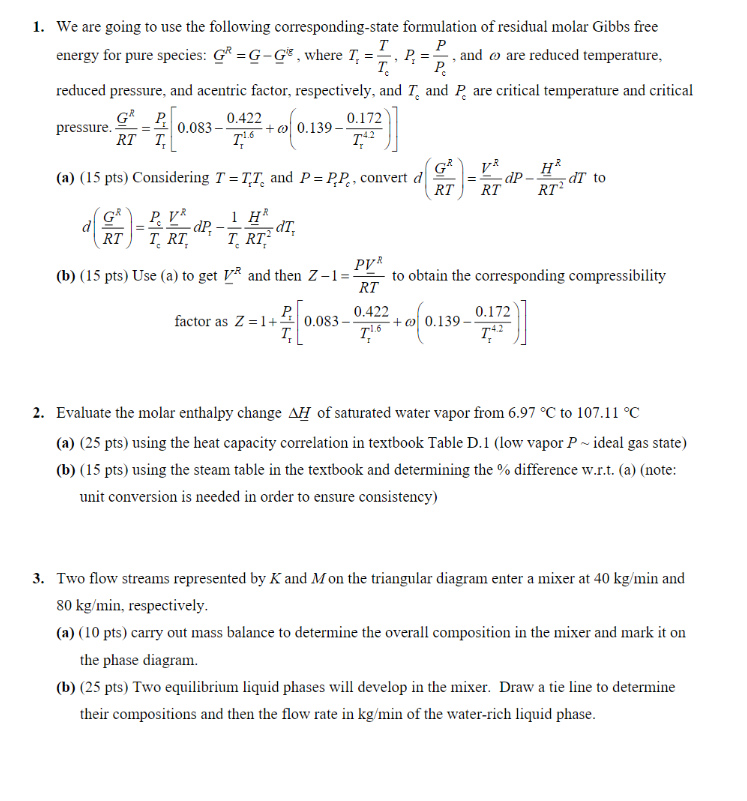
Question: We are going to use the following corresponding - state formulation of residual molar Gibbs free energy for pure species: G ? ? ( R
We are going to use the following correspondingstate formulation of residual molar Gibbs free
energy for pure species: where and are reduced temperature,
reduced pressure, and acentric factor, respectively, and and are critical temperature and critical
pressure.
a pts Considering and convert to
b pts Use a to get and then to obtain the corresponding compressibility
factor as
Evaluate the molar enthalpy change of saturated water vapor from to
a pts using the heat capacity correlation in textbook Table Dlow vapor ideal gas state
b pts using the steam table in the textbook and determining the difference wrtanote:
unit conversion is needed in order to ensure consistency
Two flow streams represented by and on the triangular diagram enter a mixer at and
respectively.
a pts carry out mass balance to determine the overall composition in the mixer and mark it on
the phase diagram.
b pts Two equilibrium liquid phases will develop in the mixer. Draw a tie line to determine
their compositions and then the flow rate in of the waterrich liquid phase.
Step by Step Solution
There are 3 Steps involved in it
1 Expert Approved Answer
Step: 1 Unlock

Question Has Been Solved by an Expert!
Get step-by-step solutions from verified subject matter experts
Step: 2 Unlock
Step: 3 Unlock
 Study Help