







Question: We can model potential flow over a jellybean by using a source ( Q ) , vortex ( ) , and sink ( - Q
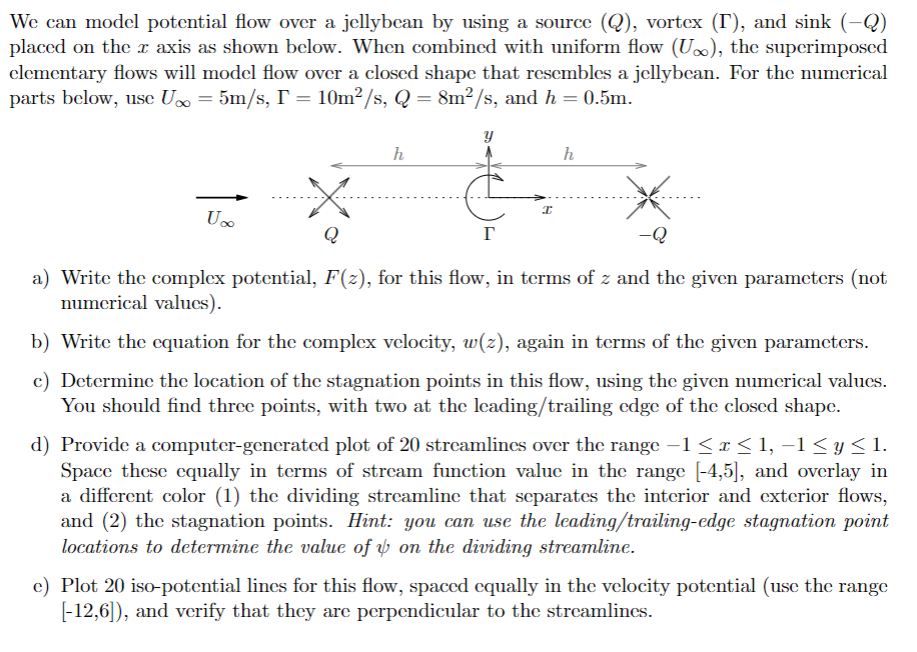
We can model potential flow over a jellybean by using a source vortex and sink
placed on the axis as shown below. When combined with uniform flow the superimposed
elementary flows will model flow over a closed shape that resembles a jellybean. For the numerical
parts below, use and
a Write the complex potential, for this flow, in terms of and the given parameters not
numerical values
b Write the equation for the complex velocity, again in terms of the given parameters.
c Determine the location of the stagnation points in this flow, using the given numerical values.
You should find three points, with two at the leadingtrailing edge of the closed shape.
d Provide a computergenerated plot of streamlines over the range
Space these equally in terms of stream function value in the range and overlay in
a different color the dividing streamline that separates the interior and exterior flows,
and the stagnation points. Hint: you can use the leadingtrailingedge stagnation point
locations to determine the value of on the dividing streamline.
e Plot isopotential lines for this flow, spaced equally in the velocity potential use the range
and verify that they are perpendicular to the streamlines.
Step by Step Solution
There are 3 Steps involved in it
1 Expert Approved Answer
Step: 1 Unlock

Question Has Been Solved by an Expert!
Get step-by-step solutions from verified subject matter experts
Step: 2 Unlock
Step: 3 Unlock
 Study Help