Question: STRUCTURING SYSTEM PROCESS REQUIREMENTS 233 system. Remember, these are to be logical DFDs, no consider improvements independent of technology that can be used to support
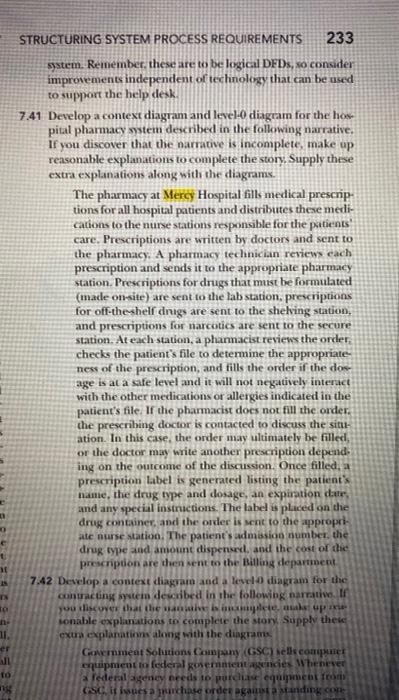
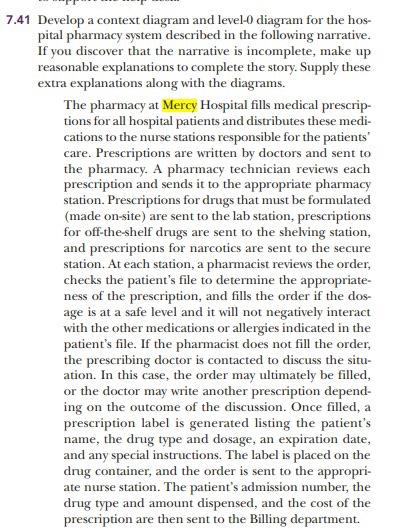
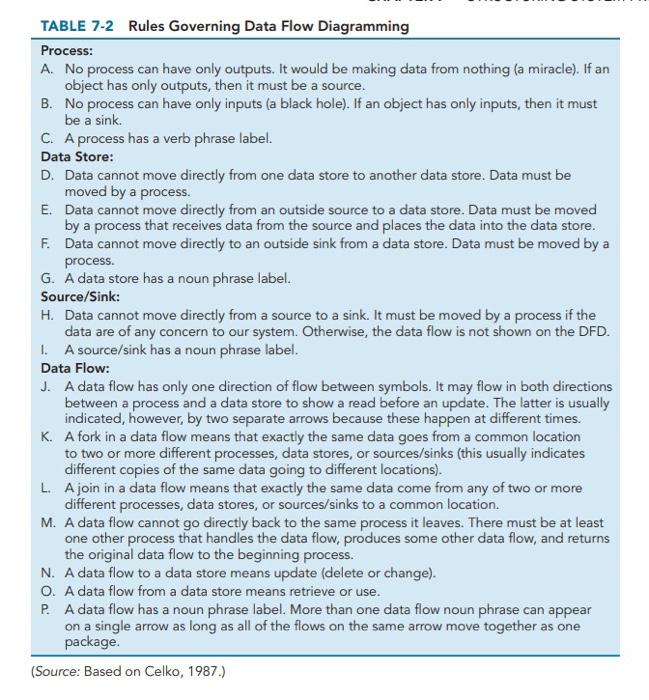
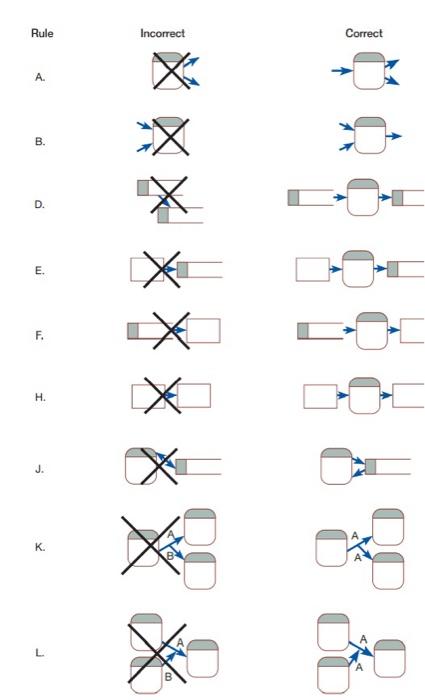
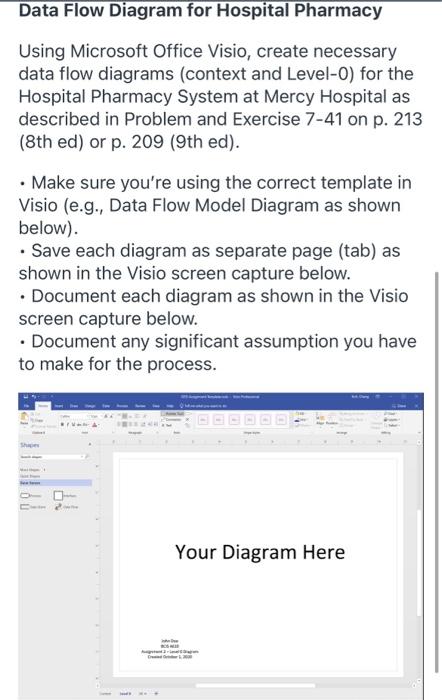
STRUCTURING SYSTEM PROCESS REQUIREMENTS 233 system. Remember, these are to be logical DFDs, no consider improvements independent of technology that can be used to support the help desk. 7.41 Develop a context diagram and level:0 diagram for the how pital pharmacy system described in the following narrative, if you discover that the narrative is incomplete, make up reasonable explanations to complete the story. Supply these extra explanations along with the diagrams. The pharmacy at Mercy Hospital fills medical prescrip tions for all hospital patients and distributes these medi- cations to the nurse stations responsible for the patients! care. Prescriptions are written by doctors and sent to the pharmacy. A pharmacy technician reviews each prescription and sends it to the appropriate pharmacy station. Prescriptions for drugs that must be formulated (made on-site) are sent to the lab station, prescriptions for off-theshelf dnigs are sent to the shelving station, and prescriptions for narcotics are sent to the secure station. At each station, a pharmacist reviews the order checks the patient's file to determine the appropriate ness of the prescription, and fills the order if the dow age is at a safe level and it will not negatively interact with the other medications or allergies indicated in the patient's file. In the pharmacist does not fill the order. the prescribing doctor is contacted to discuss the situ- ation. In this case, the order may ultimately be filled or the doctor may write another prescription depend ing on the outcome of the discussion. Once filled, a prescription label is generated listing the patient's name, the drug type and dosage, an expiration date and any special instructions. The label is placed on the drug container, and the order is sent to the appropria ate nurse station. The patient's admission number, the drug type and amount dispense, and the cost of the prescription are then sent to the Billing department 7.42 Develop a context diagram and a level diagram for the contracting system described in the following narrative. If to you liscover that he wanaonyete sonable explanations to complete the story Supply these Il exura explanation along with the diagrams er Cernmeat Solutions Company GSC) es computer MI cupmiento federal generntences Whenever to & federal agency needs 10 pordiae equipment from 113 GSC it iwues archase order agaitasunding.com IS 7.41 Develop a context diagram and level-O diagram for the hos- pital pharmacy system described in the following narrative. If you discover that the narrative is incomplete, make up reasonable explanations to complete the story. Supply these extra explanations along with the diagrams. The pharmacy at Mercy Hospital fills medical prescrip- tions for all hospital patients and distributes these medi- cations to the nurse stations responsible for the patients' care. Prescriptions are written by doctors and sent to the pharmacy. A pharmacy technician reviews each prescription and sends it to the appropriate pharmacy station. Prescriptions for drugs that must be formulated (made on-site) are sent to the lab station, prescriptions for off-the-shelf drugs are sent to the shelving station, and prescriptions for narcotics are sent to the secure station. At each station, a pharmacist reviews the order, checks the patient's file to determine the appropriate- ness of the prescription, and fills the order if the dos- age is at a safe level and it will not negatively interact with the other medications or allergies indicated in the patient's file. If the pharmacist does not fill the order, the prescribing doctor is contacted to discuss the situ- ation. In this case, the order may ultimately be filled, or the doctor may write another prescription depend- ing on the outcome of the discussion. Once filled, a prescription label is generated listing the patient's name, the drug type and dosage, an expiration date, and any special instructions. The label is placed on the drug container, and the order is sent to the appropri- ate nurse station. The patient's admission number, the drug type and amount dispensed, and the cost of the prescription are then sent to the Billing department. Context Diagram Class Schedule Student Course Request 0 Class Registration System List of Courses Possible Classes Scheduled Classes Department D1 Roster of Classes Level-0 Diagram Course Request From Student To Student 3 Class Receive Check Schedule Course for Request Availability Course Scheduled Request Classes Possible Classes 2 Receive Class Course Lists List of Courses From Department D2 Roster TABLE 7-2 Rules Governing Data Flow Diagramming Process: A. No process can have only outputs. It would be making data from nothing (a miracle). If an object has only outputs, then it must be a source. B. No process can have only inputs (a black hole). If an object has only inputs, then it must be a sink. C. A process has a verb phrase label. Data Store: D. Data cannot move directly from one data store to another data store. Data must be moved by a process. E. Data cannot move directly from an outside source to a data store. Data must be moved by a process that receives data from the source and places the data into the data store. F. Data cannot move directly to an outside sink from a data store. Data must be moved by a process. G. A data store has a noun phrase label. Source/Sink: H. Data cannot move directly from a source to a sink. It must be moved by a process if the data are of any concern to our system. Otherwise, the data flow is not shown on the DFD. 1. A source/sink has a noun phrase label. Data Flow: J. A data flow has only one direction of flow between symbols. It may flow in both directions between a process and a data store to show a read before an update. The latter is usually indicated, however, by two separate arrows because these happen at different times. K. A fork in a data flow means that exactly the same data goes from a common location to two or more different processes, data stores, or sources/sinks (this usually indicates different copies of the same data going to different locations). L. A join in a data flow means that exactly the same data come from any of two or more different processes, data stores, or sources/sinks to a common location. M. A data flow cannot go directly back to the same process it leaves. There must be at least one other process that handles the data flow, produces some other data flow, and returns the original data flow to the beginning process. N. A data flow to a data store means update (delete or change). O. A data flow from a data store means retrieve or use. P. A data flow has a noun phrase label. More than one data flow noun phrase can appear on a single arrow as long as all of the flows on the same arrow move together as one package (Source: Based on Celko, 1987.) Data Flow Diagram for Hospital Pharmacy Using Microsoft Office Visio, create necessary data flow diagrams (context and Level-0) for the Hospital Pharmacy System at Mercy Hospital as described in Problem and Exercise 7-41 on p. 213 (8th ed) or p. 209 (9th ed). Make sure you're using the correct template in Visio (e.g., Data Flow Model Diagram as shown below). Save each diagram as separate page (tab) as shown in the Visio screen capture below. Document each diagram as shown in the Visio screen capture below. . Document any significant assumption you have to make for the process. Your Diagram Here










 Study Help