







Question: We define a probability measure P by specifying that P({a}) = P((6)) = ;, P({c)) = , P({d)) = We next define two random variables,
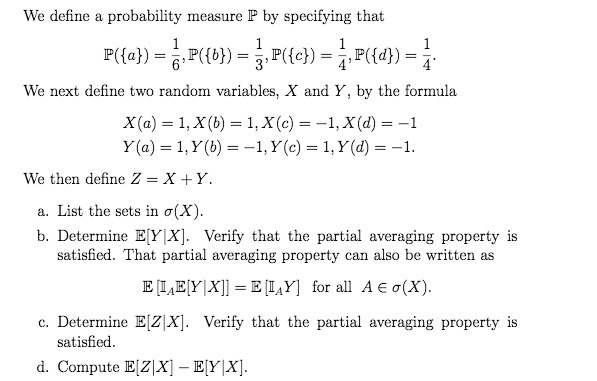
We define a probability measure P by specifying that P({a}) = P((6)) = ;, P({c)) = , P({d)) = We next define two random variables, X and Y, by the formula X(a) = 1, X(b) = 1, X(c) = -1, X(d) =-1 Y(a) = 1, Y(b) = -1, Y(c) = 1, Y(d) = -1. We then define Z = X + Y. a. List the sets in o(X). b. Determine E[Y X]. Verify that the partial averaging property is satisfied. That partial averaging property can also be written as E [IE[Y X]] = E[IAY] for all Aco( X). c. Determine E[Z X]. Verify that the partial averaging property is satisfied. d. Compute E[Z X] - E[YIX]
Step by Step Solution
There are 3 Steps involved in it
1 Expert Approved Answer
Step: 1 Unlock

Question Has Been Solved by an Expert!
Get step-by-step solutions from verified subject matter experts
Step: 2 Unlock
Step: 3 Unlock
 Study Help