



Question: We don't forget the framework of Question 2, but we now assume that the correlation is uniform (?i,j = ? if i 6= j) and
We don't forget the framework of Question 2, but we now assume that the correlation is uniform (?i,j = ? if i 6= j) and the volatilities are the identical r) of portfolio x is propor- tional to the common Sharpe ratio of the belongings r) = w 1 n Xn i=1 SRi ! (c) We set ? = 50%. How many assets can we want to reap a Sharpe ratio large than 25% in comparison to the common Sharpe ratio of the property? (d) Same query if ? = 80%. (e) Comment on these results. Four. We recollect a fund of hedge price range manager, whose objective is to reap a performance of Libor + 400 bps with a volatility of four%. We assume that the management and performance costs of the FoF are 1% in keeping with year and 10% above Libor.
We recollect the overall framework with n risky assets whose vector of predicted returns is and the covariance matrix of asset returns is ? while the return of the hazard-free asset is r. We observe ?x the portfolio invested in the n + 1 property. We have: x? = x xr with x the weight vector of unstable belongings and xr the burden of the hazard-free asset. We impose the subsequent constraint: Xn i=1 x?i = Xn i=1 xi = 1 (a) Define ? and ? the vector of anticipated returns and the covariance ? matrix of asset returns associated with the n + 1 assets. (b) By using the Markowitz ?-trouble, retrieve the Separation Theo- rem of Tobin. B.1.3 Sharpe ratio 1. We remember volatile property with returns R1 and R2. We expect that: R = R1 R2 ? N 1 2 , ? 2 1 ??1?2 ??1?2 ? 2 2 (a) Let r be the go back of the risk-unfastened asset. Define the Sharpe ratio SRi of each asset i. (b) Let x = (x1, x2) be a portfolio composed of the 2 volatile belongings. Give the expression of the Sharpe ratio SR (x expect that x1 + x2 = 1 and the second asset corresponds to the danger-loose asset. Show that we've got: SR (x zero 2. We don't forget an similarly weighted portfolio with n assets2 . Let R = (R1, . . . , Rn) be the vector of asset returns. We expect that R ? N (, ?) with = (1, . . . , n), ? = (?i,j ) and3 ?i,j = ?i,j?i?j . We take a look at the case while the asset returns are not correlated (?i,j = 0 if i 6= j). (a) Give the expression of the Sharpe ratio of the portfolio x = (x1, . . . , xn).
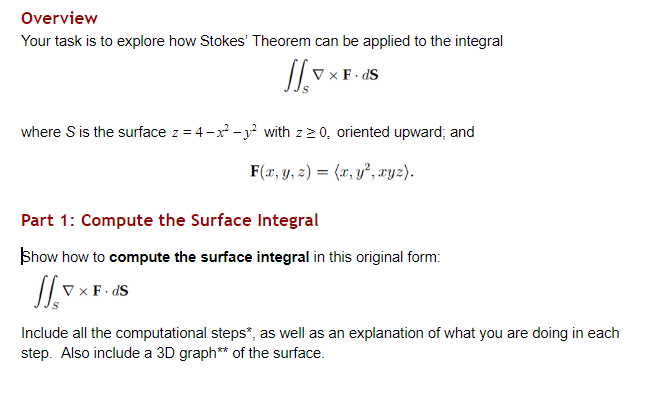
Overview Your task is to explore how Stokes' Theorem can be applied to the integral V F. dS where S is the surface z=4-x-12 with z0, oriented upward; and F(x, y, z) = (x, y, xyz). Part 1: Compute the Surface Integral Show how to compute the surface integral in this original form: Vx F-dS Include all the computational steps*, as well as an explanation of what you are doing in each step. Also include a 3D graph** of the surface.
Step by Step Solution
There are 3 Steps involved in it

Get step-by-step solutions from verified subject matter experts