







Question: We studied a number of multiple access protocols in this course, including (1) TDMA, (2) CSMA, (3) Slotted Aloha and (4) Token passing. Suppose
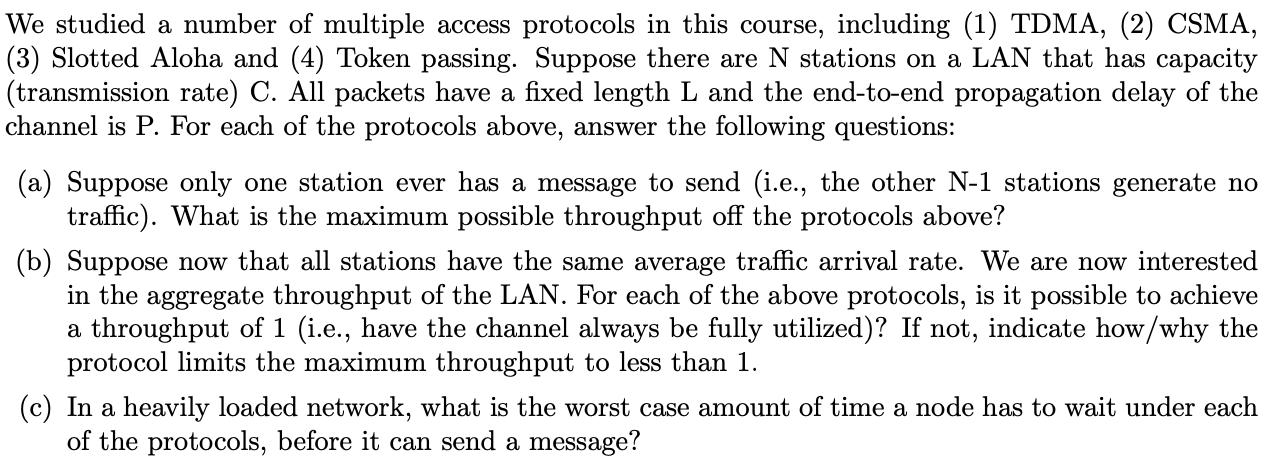
We studied a number of multiple access protocols in this course, including (1) TDMA, (2) CSMA, (3) Slotted Aloha and (4) Token passing. Suppose there are N stations on a LAN that has capacity (transmission rate) C. All packets have a fixed length L and the end-to-end propagation delay of the channel is P. For each of the protocols above, answer the following questions: (a) Suppose only one station ever has a message to send (i.e., the other N-1 stations generate no traffic). What is the maximum possible throughput off the protocols above? (b) Suppose now that all stations have the same average traffic arrival rate. We are now interested in the aggregate throughput of the LAN. For each of the above protocols, is it possible to achieve a throughput of 1 (i.e., have the channel always be fully utilized)? If not, indicate how/why the protocol limits the maximum throughput to less than 1. (c) In a heavily loaded network, what is the worst case amount of time a node has to wait under each of the protocols, before it can send a message?
Step by Step Solution
There are 3 Steps involved in it

Get step-by-step solutions from verified subject matter experts
 Study Help