







Question: We would like to sample 3 signals simultaneously with a multiplexer and to convert the signals to binary form by using one A/D converter.
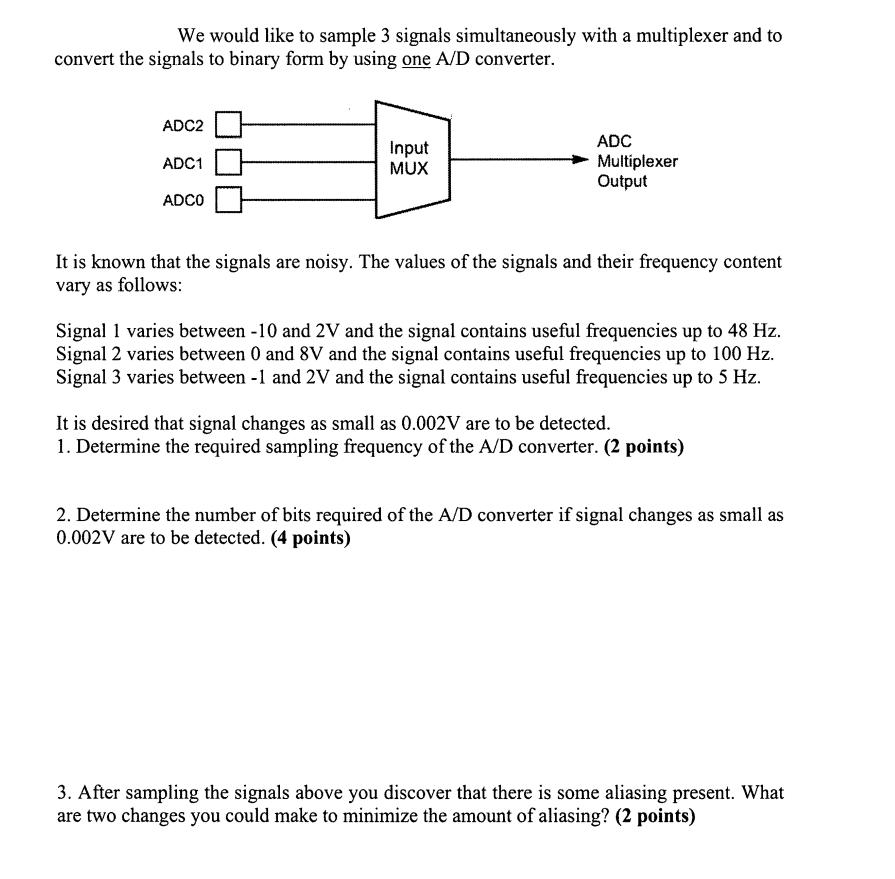
We would like to sample 3 signals simultaneously with a multiplexer and to convert the signals to binary form by using one A/D converter. ADC2 ADC1 ADCO Input MUX ADC Multiplexer Output It is known that the signals are noisy. The values of the signals and their frequency content vary as follows: Signal 1 varies between -10 and 2V and the signal contains useful frequencies up to 48 Hz. Signal 2 varies between 0 and 8V and the signal contains useful frequencies up to 100 Hz. Signal 3 varies between -1 and 2V and the signal contains useful frequencies up to 5 Hz. It is desired that signal changes as small as 0.002V are to be detected. 1. Determine the required sampling frequency of the A/D converter. (2 points) 2. Determine the number of bits required of the A/D converter if signal changes as small as 0.002V are to be detected. (4 points) 3. After sampling the signals above you discover that there is some aliasing present. What are two changes you could make to minimize the amount of aliasing? (2 points)
Step by Step Solution
3.40 Rating (166 Votes )
There are 3 Steps involved in it
To determine the required sampling frequency of the AD converter we need to consider the NyquistShannon sampling theorem which states that the samplin... View full answer

Get step-by-step solutions from verified subject matter experts
 Study Help