







Question: Week 1 4 - Problems to solve B 1 8 &B 1 9 ( Radiation and Antenna ) Problem 1 In this week lecture, we
Week Problems to solve B&BRadiation and Antenna
Problem
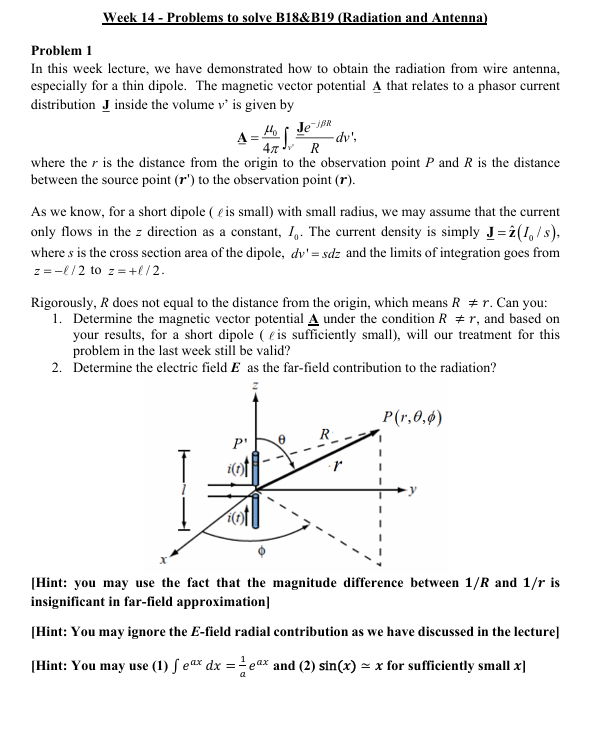
In this week lecture, we have demonstrated how to obtain the radiation from wire antenna, especially for a thin dipole. The magnetic vector potential that relates to a phasor current distribution inside the volume is given by
where the is the distance from the origin to the observation point and is the distance between the source point to the observation point
As we know, for a short dipole is small with small radius, we may assume that the current only flows in the direction as a constant, The current density is simply hat where is the cross section area of the dipole, and the limits of integration goes from to
Rigorously, does not equal to the distance from the origin, which means Can you:
Determine the magnetic vector potential under the condition and based on your results, for a short dipole is sufficiently small will our treatment for this problem in the last week still be valid?
Determine the electric field as the farfield contribution to the radiation?
Hint: you may use the fact that the magnitude difference between and is insignificant in farfield approximation
Hint: You may ignore the field radial contribution as we have discussed in the lecture
Hint: You may use and for sufficiently small
Step by Step Solution
There are 3 Steps involved in it
1 Expert Approved Answer
Step: 1 Unlock

Question Has Been Solved by an Expert!
Get step-by-step solutions from verified subject matter experts
Step: 2 Unlock
Step: 3 Unlock
 Study Help