







Question: Week 10 Discussion Board This week, we covered the basic elements that facilitate change in consumers' beliefs, attitudes, and behaviors. These elements can help us
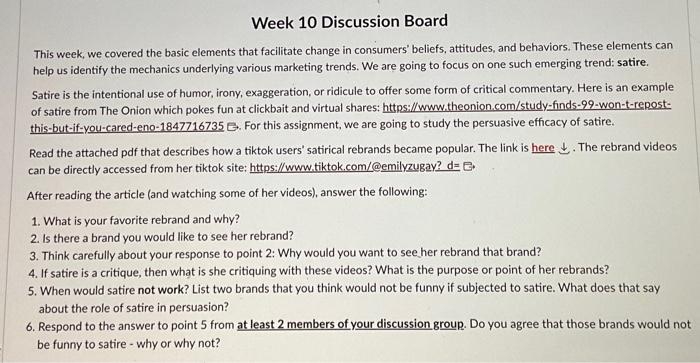
Week 10 Discussion Board This week, we covered the basic elements that facilitate change in consumers' beliefs, attitudes, and behaviors. These elements can help us identify the mechanics underlying various marketing trends. We are going to focus on one such emerging trend: satire. Satire is the intentional use of humor, irony, exaggeration, or ridicule to offer some form of critical commentary. Here is an example of satire from The Onion which pokes fun at clickbait and virtual shares: htt ss://ww. theonion.com/study-finds-99-won-t-repostthis-but-if-you-cared-eno-1847716735 G. For this assignment, we are going to study the persuasive efficacy of satire. Read the attached pdf that describes how a tiktok users' satirical rebrands became popular. The link is here . The rebrand videos can be directly accessed from her tiktok site: https://www.tiktok.com/@emilyzugay? d=. After reading the article (and watching some of her videos), answer the following: 1. What is your favorite rebrand and why? 2. Is there a brand you would like to see her rebrand? 3. Think carefully about your response to point 2: Why would you want to see her rebrand that brand? 4. If satire is a critique, then what is she critiquing with these videos? What is the purpose or point of her rebrands? 5. When would satire not work? List two brands that you think would not be funny if subjected to satire. What does that say about the role of satire in persuasion? 6. Respond to the answer to point 5 from at least 2 members of your discussion group. Do you agree that those brands would not be funny to satire - why or why not
Step by Step Solution
There are 3 Steps involved in it

Get step-by-step solutions from verified subject matter experts
 Study Help