Question: Week 2 Tutorial INTRODUCTION TO STRATEGIC MANAGEMENT ACCOUNTING Read the Case Wal-Mart' and answer the questions given at the end of the case. WAL-MART STORES,
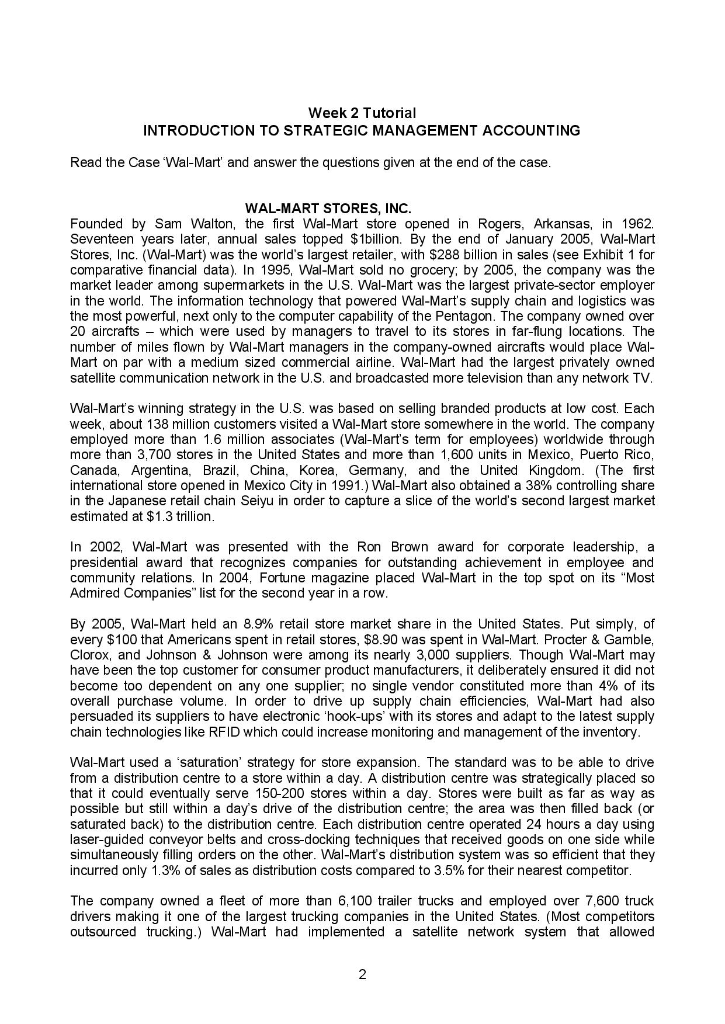
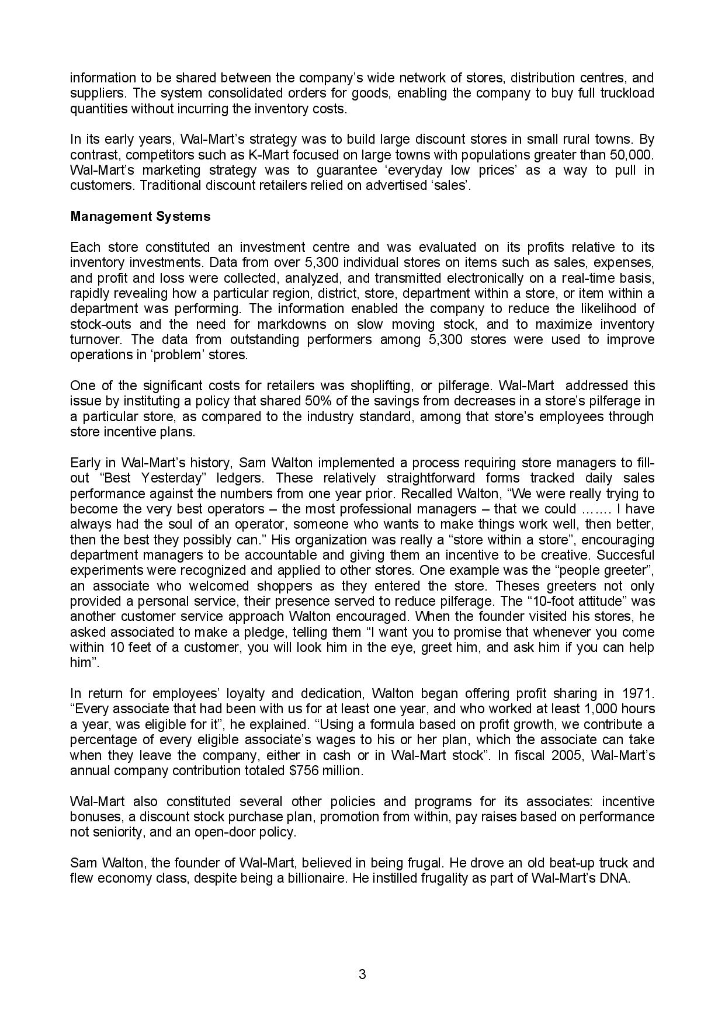
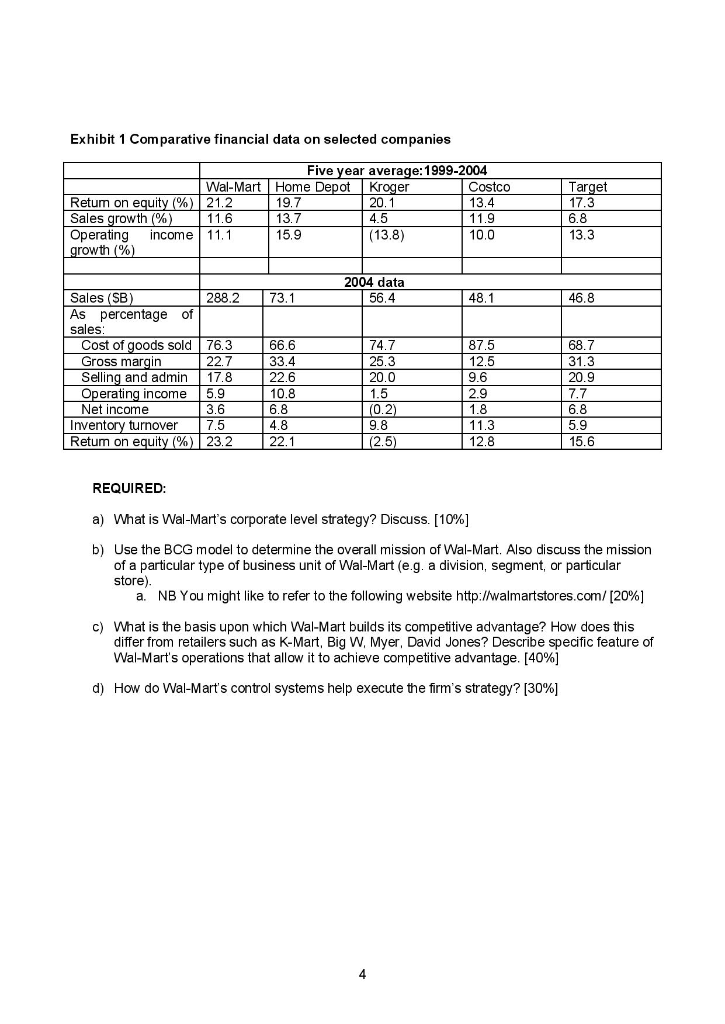
Week 2 Tutorial INTRODUCTION TO STRATEGIC MANAGEMENT ACCOUNTING Read the Case Wal-Mart' and answer the questions given at the end of the case. WAL-MART STORES, INC. Founded by Sam Walton, the first Wal-Mart store opened in Rogers, Arkansas, in 1962 Seventeen years later, annual sales topped $1billion. By the end of January 2005, Wal-Mart Stores, Inc. (Wal-Mart) was the world's largest retailer, with $288 billion in sales (see Exhibit 1 for comparative financial data). In 1995, Wal-Mart sold no grocery; by 2005, the company was the market leader among supermarkets in the U.S. Wal-Mart was the largest private-sector employer in the world. The information technology that powered Wal-Mart's supply chain and logistics was the most powerful, next only to the computer capability of the Pentagon. The company owned over 20 aircrafts - which were used by managers to travel to its stores in far-flung locations. The number of miles flown by Wal-Mart managers in the company-owned aircrafts would place Wal- Mart on par with a medium sized commercial airline. Wal-Mart had the largest privately owned satellite communication network in the U.S. and broadcasted more television than any network TV. Wal-Mart's winning strategy in the U.S. was based on selling branded products at low cost. Each week, about 138 million customers visited a Wal-Mart store somewhere in the world. The company employed more than 1.6 million associates (Wal-Mart's term for employees) worldwide through more than 3,700 stores in the United States and more than 1,600 units in Mexico, Puerto Rico, Canada, Argentina, Brazil, China, Korea, Germany, and the United Kingdom. (The first international store opened in Mexico City in 1991.) Wal-Mart also obtained a 38% controlling share in the Japanese retail chain Seiyu in order to capture a slice of the world's second largest market estimated at $1.3 trillion. In 2002, Wal-Mart was presented with the Ron Brown award for corporate leadership, a presidential award that recognizes companies for outstanding achievement in employee and community relations. In 2004, Fortune magazine placed Wal-Mart in the top spot on its "Most Admired Companies" list for the second year in a row. By 2005, Wal-Mart held an 8.9% retail store market share in the United States. Put simply, of every $100 that Americans spent in retail stores, $8.90 was spent in Wal-Mart. Procter & Gamble, Clorox, and Johnson & Johnson were among its nearly 3,000 suppliers. Though Wal-Mart may have been the top customer for consumer product manufacturers, it deliberately ensured it did not become too dependent on any one supplier, no single vendor constituted more than 4% of its overall purchase volume. In order to drive up supply chain efficiencies, Wal-Mart had also persuaded its suppliers to have electronic 'hook-ups' with its stores and adapt to the latest supply chain technologies like RFID which could increase monitoring and management of the inventory. Wal-Mart used a 'saturation strategy for store expansion. The standard was to be able to drive from a distribution centre to a store within a day. A distribution centre was strategically placed so that it could eventually serve 150-200 stores within a day. Stores were built as far as way as possible but still within a day's drive of the distribution centre; the area was then filled back (or saturated back) to the distribution centre. Each distribution centre operated 24 hours a day using laser-guided conveyor belts and cross-docking techniques that received goods on one side while simultaneously filling orders on the other. Wal-Mart's distribution system was so efficient that they incurred only 1.3% of sales as distribution costs compared to 3.5% for their nearest competitor. The company owned a fleet of more than 6,100 trailer trucks and employed over 7.600 truck drivers making it one of the largest trucking companies in the United States. (Most competitors outsourced trucking.) Wal-Mart had implemented a satellite network system that allowed information to be shared between the company's wide network of stores, distribution centres, and suppliers. The system consolidated orders for goods, enabling the company to buy full truckload quantities without incurring the inventory costs. In its early years, Wal-Mart's strategy was to build large discount stores in small rural towns. By contrast, competitors such as K-Mart focused on large towns with populations greater than 50,000. Wal-Mart's marketing strategy was to guarantee 'everyday low prices' as a way to pull in customers. Traditional discount retailers relied on advertised 'sales' Management Systems Each store constituted an investment centre and was evaluated on its profits relative to its inventory investments. Data from over 5,300 individual stores on items such as sales, expenses, and profit and loss were collected, analyzed, and transmitted electronically on a real-time basis, rapidly revealing how a particular region, district, store, department within a store, or item within a department was performing. The information enabled the company to reduce the likelihood of stock-outs and the need for markdowns on slow moving stock, and to maximize inventory turnover. The data from outstanding performers among 5,300 stores were used to improve operations in 'problem' stores. One of the significant costs for retailers was shoplifting, or pilferage. Wal-Mart addressed this issue by instituting a policy that shared 50% of the savings from decreases in a store's pilferage in a particular store, as compared to the industry standard, among that store's employees through store incentive plans. Early in Wal-Mart's history, Sam Walton implemented a process requiring store managers to fill- out "Best Yesterday" ledgers. These relatively straightforward forms tracked daily sales performance against the numbers from one year prior. Recalled Walton, "We were really trying to become the very best operators - the most professional managers - that we could ....... I have always had the soul of an operator, someone who wants to make things work well, then better, then the best they possibly can." His organization was really a "store within a store", encouraging department managers to be accountable and giving them an incentive to be creative. Succesful experiments were recognized and applied to other stores. One example was the "people greeter", an associate who welcomed shoppers as they entered the store. Theses greeters not only provided a personal service, their presence served to reduce pilferage. The "10-foot attitude" was another customer service approach Walton encouraged. When the founder visited his stores, he asked associated to make a pledge, telling them "I want you to promise that whenever you come within 10 feet of a customer, you will look him in the eye, greet him, and ask him if you can help him". In return for employees' loyalty and dedication, Walton began offering profit sharing in 1971. "Every associate that had been with us for at least one year, and who worked at least 1,000 hours a year, was eligible for it", he explained. "Using a formula based on profit growth, we contribute a percentage of every eligible associate's wages to his or her plan, which the associate can take when they leave the company, either in cash or in Wal-Mart stock". In fiscal 2005, Wal-Mart's annual company contribution totaled S756 million. Wal-Mart also constituted several other policies and programs for its associates: incentive bonuses, a discount stock purchase plan, promotion from within, pay raises based on performance not seniority, and an open-door policy. Sam Walton, the founder of Wal-Mart, believed in being frugal. He drove an old beat-up truck and flew economy class, despite being a billionaire. He instilled frugality as part of Wal-Mart's DNA. Exhibit 1 Comparative financial data on selected companies Five year average: 1999-2004 Wal-Mart Home Depot Kroger Costco Retum on equity (%) 21.2 19.7 20.1 13.4 Sales growth (%) 11.6 4.5 11.9 Operating income 11.1 15.9 (13.8) 10.0 growth (%) Target 17.3 6.8 13.3 - 13.7 73.1 2004 data 56.4 48.1 46.8 875 12.5 Sales (SB) 288.2 As percentage of sales: Cost of goods sold 76.3 Gross margin 22.7 Selling and admin 17.8 Operating income 5.9 Net income 3.6 Inventory turnover 7.5 Retum on equity (%) 23.2 1 66.6 33.4 22.6 10.8 6.8 4.8 22.1 74.7 25.3 20.0 1.5 (0.2) 9.8 (2.5) 29 68.7 31.3 20.9 7.7 6.8 5.9 15.6 18 11.3 12.8 REQUIRED: a) What is Wal-Mart's corporate level strategy? Discuss. (10%) b) Use the BCG model to determine the overall mission of Wal-Mart. Also discuss the mission of a particular type of business unit of Wal-Mart (e.g. a division, segment, or particular store) a. NB You might like to refer to the following website http://walmartstores.com/ (20%) c) What is the basis upon which Wal-Mart builds its competitive advantage? How does this differ from retailers such as K-Mart, Big W, Myer, David Jones? Describe specific feature of Wal-Mart's operations that allow it to achieve competitive advantage. [40%] d) How do Wal-Mart's control systems help execute the firm's strategy? (30%)









 Study Help