





Question: Week 5 Assignment 2 What are the chances? - Template Use a six-sided die and what you have learned so far in your course to
Week 5 Assignment 2 What are the chances? -
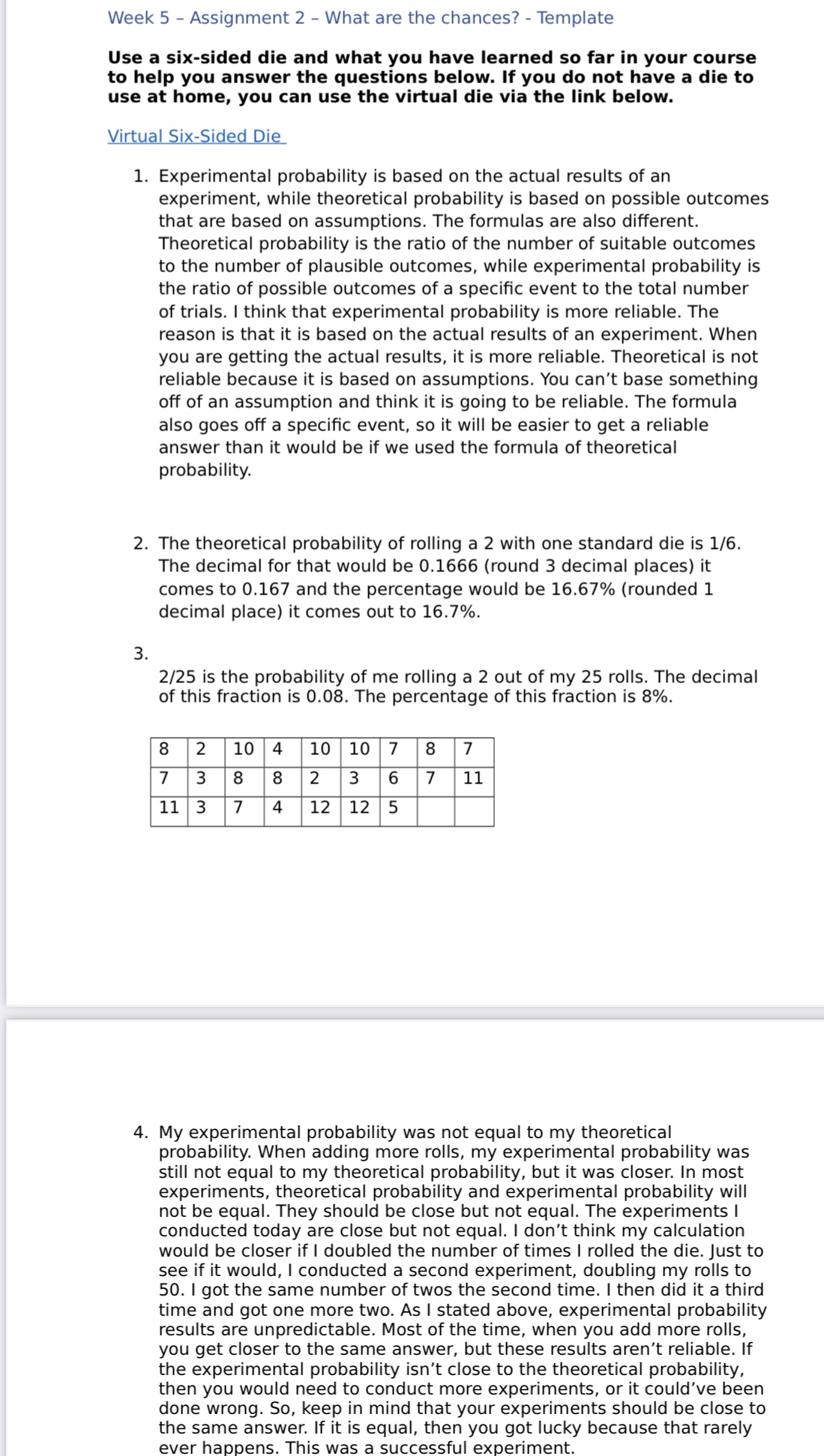
Week 5 Assignment 2 What are the chances? - Template Use a six-sided die and what you have learned so far in your course to help you answer the questions below. If you do not have a die to use at home, you can use the virtual die via the link below. Virtual Sixisided Die 1. Experimental probability is based on the actual results of an experiment, while theoretical probability is based on possible outcomes that are based on assumptions. The formulas are also different. Theoretical probability is the ratio of the number of suitable outcomes to the number of plausible outcomes, while experimental probability is the ratio of possible outcomes of a specific event to the total number of trials. I think that experimental probability is more reliable. The reason is that it is based on the actual results of an experiment. When you are getting the actual results, it is more reliable. Theoretical is not reliable because it is based on assumptions. You can't base something off of an assumption and think it is going to be reliable. The formula also goes off a specific event, so it will be easier to get a reliable answer than it would be if we used the formula of theoretical probability. 2. The theoretical probability of rolling a 2 with one standard die is 1/6. The decimal for that would be 0.1666 (round 3 decimal places) it comes to 0.167 and the percentage would be 16.67% (rounded 1 decimal place) it comes out to 16.7%. 2/25 is the probability of me rolling a 2 out of my 25 rolls. The decimal of this fraction is 0.08. The percentage of this fraction is 8%. 821041010787 7388236711 III-III...- 4. My experimental probability was not equal to my theoretical probability. When adding more rolls, my experimental probability was still not equal to my theoretical probability, but it was closer. In most experiments, theoretical probability and experimental probability will not be equal. They should be close but not equal. The experiments 1 conducted today are close but not equal. I don't think my calculation would be closer if I doubled the number of times I rolled the die. Just to see if it would. I conducted a second experiment, doubling my rolls to 50. I got the same number of twos the second time. I then did it a third time and got one more two. As I stated above, experimental probability results are unpredictable. Most of the time. when you add more rolls, you get closer to the same answer, but these results aren't reliable. if the experimental probability isn't close to the theoretical probability, then you would need to conduct more experiments, or it could've been done wrong. So, keep in mind that your experiments should be close to the same answer. if it is equal, then you got lucky because that rarely ever happens. This was a successful experiment

Step by Step Solution

There are 3 Steps involved in it

1 Expert Approved Answer
Step: 1 Unlock blur-text-image

Question Has Been Solved by an Expert!

Get step-by-step solutions from verified subject matter experts

Step: 2 Unlock
Step: 3 Unlock

Students Have Also Explored These Related Mathematics Questions!