



Question: We're going to explore the series from part 1(a) bit more. (a) First, we're going to attempt to express the expression inside the sum as
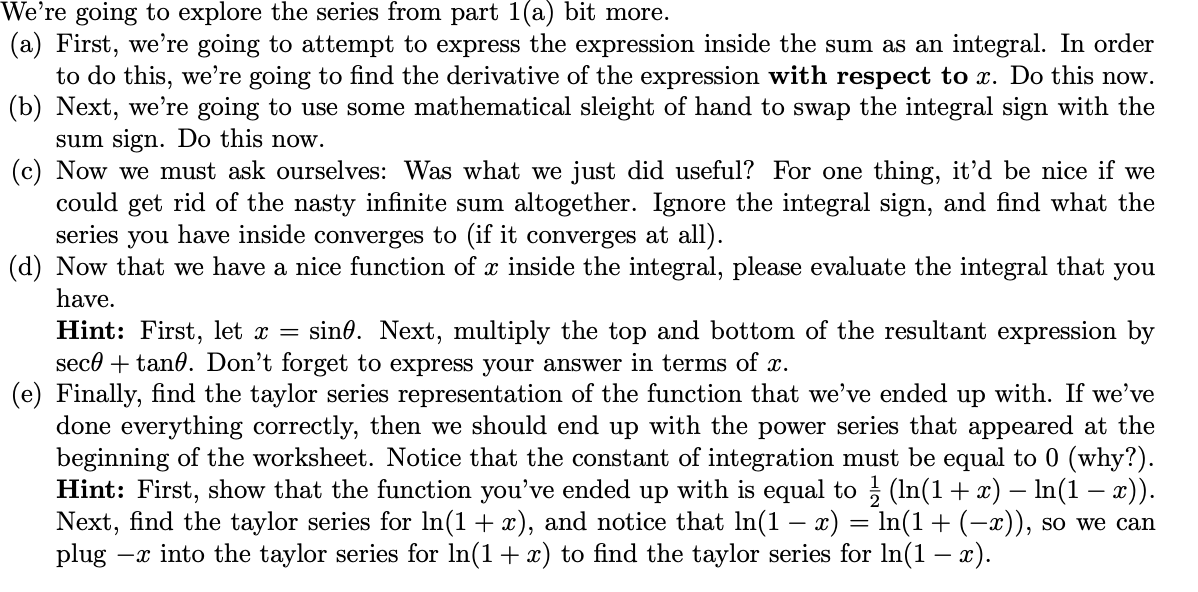
We're going to explore the series from part 1(a) bit more. (a) First, we're going to attempt to express the expression inside the sum as an integral. In order to do this, we're going to find the derivative of the expression with respect to x. Do this now. (b) Next, we're going to use some mathematical sleight of hand to swap the integral sign with the sum sign. Do this now. (c) Now we must ask ourselves: Was what we just did useful? For one thing, it'd be nice if we could get rid of the nasty infinite sum altogether. Ignore the integral sign, and find what the series you have inside converges to (if it converges at all). (d) Now that we have a nice function of a inside the integral, please evaluate the integral that you have. Hint: First, let x = sind. Next, multiply the top and bottom of the resultant expression by seco + tand. Don't forget to express your answer in terms of x. (e) Finally, find the taylor series representation of the function that we've ended up with. If we've done everything correctly, then we should end up with the power series that appeared at the beginning of the worksheet. Notice that the constant of integration must be equal to 0 (why?). Hint: First, show that the function you've ended up with is equal to ? (In(1 + x) - In(1 - x)). Next, find the taylor series for In(1 + x), and notice that In(1 - x) = In(1 + (-x)), so we can plug -x into the taylor series for In(1 + x) to find the taylor series for In (1 - x)
Step by Step Solution
There are 3 Steps involved in it

Get step-by-step solutions from verified subject matter experts