







Question: We've seen the union L_1 L_2, which includes any strings in L_1, L_2, or both, and we've seen the intersection L_1 L_2, which includes only
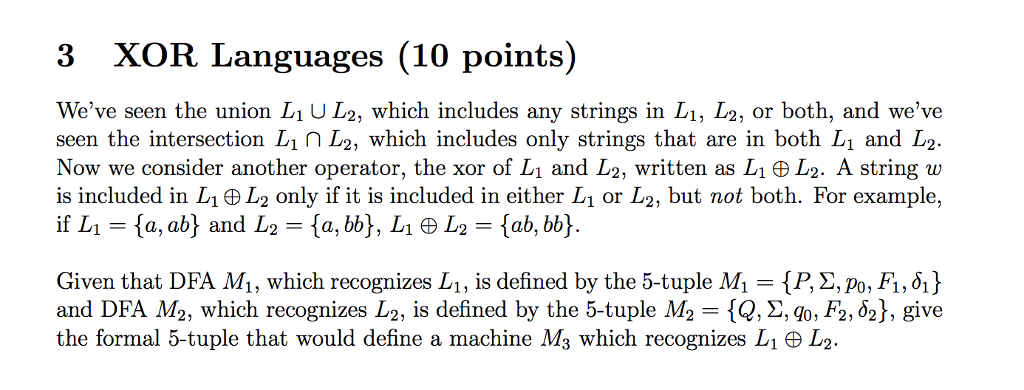
We've seen the union L_1 L_2, which includes any strings in L_1, L_2, or both, and we've seen the intersection L_1 L_2, which includes only strings that are in both L_1 and L_2. Now we consider another operator, the xor of L_1 and L_2, written as L_1 L_2. A string omega is included in L_1 L_2 only if it is included in either L_1 or L_2, but not both. For example, if L_1 = {a, ab} and L_2 = {a, bb}, L_1 L_2 = {ab, bb}. Given that DFA M_1; which recognizes L_1, is defined by the 5-tuple M_1 = {P, sigma, p_0, F_1, delta_1} and DFA M_2, which recognizes L_2, is defined by the 5-tuple M_2 = {Q, sigma, q_0, F_2, delta_2], give the formal 5-tuple that would define a machine M_3 which recognizes L_1 L_2
Step by Step Solution
There are 3 Steps involved in it

Get step-by-step solutions from verified subject matter experts
 Study Help