







Question: What about you? How do you sit in class? Does Cud-dy's description of students' classroom body language seem to apply to you? Specifically, what might
- What about you? How do you sit in class? Does Cud-dy's description of students' classroom body language seem to apply to you? Specifically, what might you do to improve your classroom body language? How about your body language in other situations?
- Review the section in the text on "Individual Barriers" to communication. How might Cuddy's analysis of the impressions that we make on people help in understanding these barriers? More specifically, how might that analysis be used in helping to overcome them? Now ask yourself which of these barriers seem to affect your own communication habits. How might Cuddy's analysis help you to understand and deal with the barriers to your own communication habits?
- Here's a list of Cuddy's four ideal types in the warmth/ competence matrix, along with examples of people who, according to her research, tend to fall into each category:
- Warm/competent-fathers
- Warm/incompetent-working mothers
- Cold/competent-Asian students
- Cold/incompetent-economically disadvantaged people
Bearing in mind that these examples reflect generalized perceptions of people, explain why each group falls into its respective category. Add another group to each category. Explain the role played by stereotyping in assigning people to each category. Finally, to what extent do you yourself tend to succumb to these generalizations?
- As we've seen, Cuddy has observed "a gender grade gap" in her MBA classes at Harvard, in which classroom participation accounts for a significant portion of students' grades. "It's competitive-you really have to get in there," she says, and women aren't quite as successful at contributing to discussions as men. Men, she reports, volunteer to answer questions by shooting their arms in the air while women tend toward a polite bent-elbow wave. Women often touch their faces and necks while talking and tend to sit withtightly crossed ankles. "These postures," says Cuddy,"are associated with powerlessness and intimidation and keep people from expressing who they really are."Cuddy's research also reveals that nonwhite males are often subject to the same disadvantages and exhibit similar behaviors when participating in classroom discussion. Why does this "gender gap" exist in the classroom?
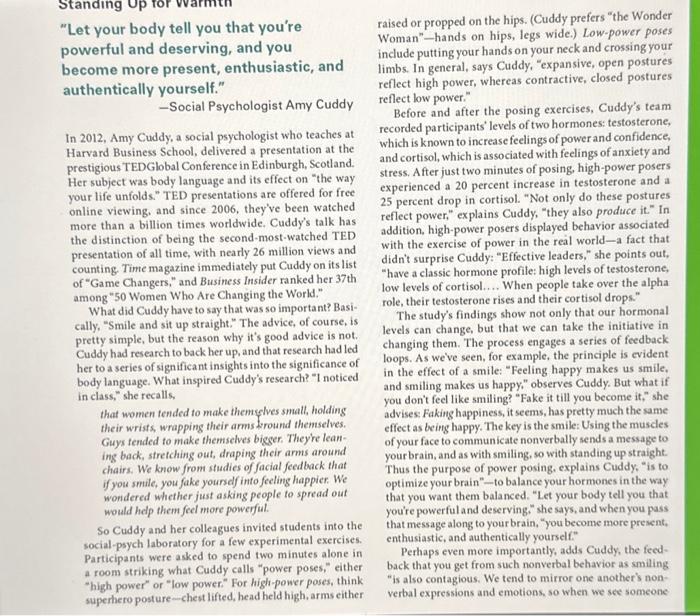
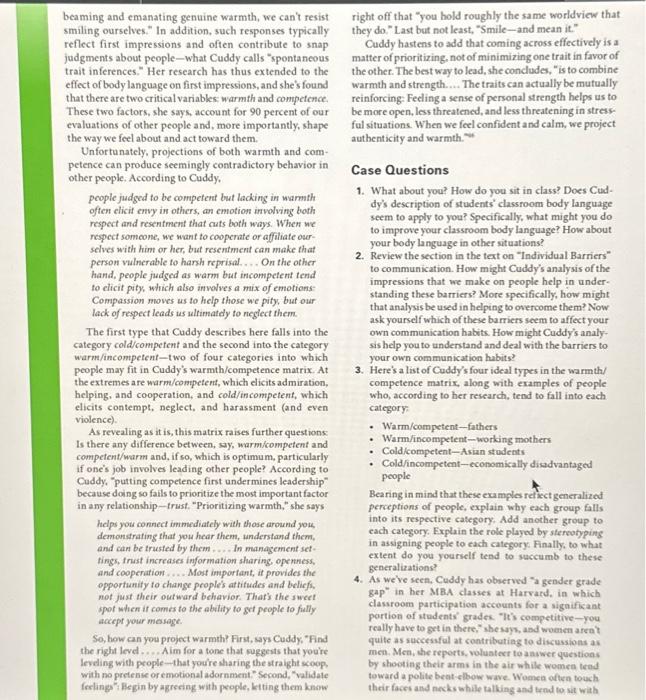
"Let your body tell you that you're_ raised or propped on the hips. (Cuddy prefers "the Wonder powerful and deserving, and you Woman"-hands on hips, legs wide.) Low-power poses become more present, enthusiastic, and include putting your hands on your neck and crossing your -Social Psychologist Amy Cuddy reflect low power, whereas contractive, closed postures In 2012, Amy Cuddy, a social psychologist who teaches at Beforeandaftertheposingexercises,Cuddysteamrecordedparticipantslevelsoftwohormenes: Harvard Business School, delivered a presentation at the which is known to increasefeel two hormones: testosterone. prestigious TEDGlobal Conference in Edinburgh, Scotland. and cortisol, which is associated wit Her subject was body language and its effect on "the way stress. After just two minutes of your life unfolds." TED presentations are offered for free experienced a 20 percent in online viewing, and since 2006, they've been watched 25 percent drop in cortiso. "S the distinction of being the second-most-watched TED addition, high-power posers presentation of all time, with nearly 26 million views and with the exercise of powe itslist didn't surprise Cuddy: "E "have a classic hormone 37 th low levels of cortisol... " Are Changing the World." Basi- role, their testosterone rises a pretty simple, but the reason why it's good advice is not. levels can change, but that we can take the initiative in Cuddy had research to back her up, and that research had led changing them. The process engages a series of feedback her to a series of significant insights into the significance of loops. As weve seen, for example, the principle is evident body language. What inspired Cuddy's research? "I noticed in the effect of a smile: "Feeling happy makes us smile. and smiling makes us happy," observes Cuddy. But what if that women tended to make themeelves small, holding You don't feel like smiling? "Fake it till you become it," she their writs, wrapping their arms tround themselves. advises, Faking happiness, it seems, has pretty much the same effect as being happy. The key is the smile: Using the muscles ing back, stretching out, draping their arms around of your face to communicate nonverbally sends a message to chairs. We know from studies frial feedback that your brain, and as with smiling, so with standing up straight. W Thus the purpose of power posing, explains Cuddy, "is to wondered wou fake yoursdf into feeling happiead out optimize your brain"-to balance your hormones in the way thether just asking people to spien want them balanced. "Let your body tell you that so Cuddy and her colleagues invited students into the youre powerful and deserving," she says, and when you pass social-psych laboratory for a few experimental exercises. enthusiastic, and authentically yourself" Participants were asked to spend two minutes alone in Perhaps even more importantly, adds Cuddy, the feeda room striking what Cuddy calls "power poses," either back that you get from such nonverbal behavior as smiling "high power" or "low power"" For high-power poses, think "is also contagious. We tend to mirror one another's nonsuperhero posture-chest lifted, head held high, arms either verbal expressions and emotions, so when we see someone beaming and emanating genuine warmth, we can't resist right off that "you hold roughly the same worldview that smiling ourselves." In addition, such responses typically they do, "Last but not least, "Smile-and mean it." reflect first impressions and often contribute to snap Cuddy hastens to add that coming across effectively is a judgments about people-what Cuddy calls "spontaneous matter of prioritizing, not of minimizing one trait in favor of trait inferences," Her research has thus extended to the the other. The best way to lead, she concludes, "is to combine effect of body language on first impressions, and she's found warmth and strength... The traits can actually be mutually that there are two critical variables warmth and competence. reinforcing: Feeling a sense of personal strength helps us to These two factors, she says, account for 90 percent of our be more open, less threatened, and less threatening in stressevaluations of other people and, more importantly, shape ful situations. When we feel confident and calm, we project the way we feel about and act toward them. authenticity and warmth. ? Unfortunately, projections of both warmth and competence can produce seemingly contradictory behavior in Case Questions other people. According to Cuddy. prople judged to be competent but lading in wamth 1. What about you? How do you sit in class? Does Cuddy's description of students' classroom body language often elikit envy in others, an emotion involving both respect and resentment that cuts both ways. When we seem to apply to you? Specifically, what might you do nespect someone, we want to coopenate or affiliate ourto improve your classroom body language? How about selves with him or her, but resentment can make that your body language in other situations? 2. Review the section in the teat on "Individual Barriers" person vulnerable to harsh reprisal. ... On the other hand, people judged as wam but incompetent tend to communication. How might Cuddy's analysis of the to clicit puty, which also involves a mix of emotionsimpressions that we make on people help in understanding these barriers? More specifically, how might Compassion moves us to help those we pity, but our lack of respect leads us ultimatdy to neglect them. that analysis be used in helping to overcome them? Now ask yourself which of these barriers seem to affect your The first type that Cuddy describes here falls into the own communication habits. How might Cuddy's analy. warm/incompetent-two of four categories into which your own communication hubits? people may fit in Cuddy's warmth/competence matrix. At 3. Here's a list of Cuddy's four ideal types in the warmth/ the extremes are warm/competent, which elicits admiration, competence matrix, along with eramples of people helping, and cooperation, and cold/incompetent, which who, according to her research, tend to fall into each elicits contempt, neglect, and harassment (and even category: violence). As reveal ing as it is, this matrix raises further questions: - Warm/competent-fathers Is there any difference between, say, warmkompetent and - Warm/incompetent-working mothers competent/warm and, if so, which is optimum, particularly - Coldicompetent-Asian students if one's job involves leading other people? According to - Cold/incompetent-economically disadvantaged Cuddy, "putting competence firt undermines leadership" people because doing so fails to prioritize the most important factor Bearing in mind that these examples retiect generalized in any relationship-trust. "Prioritizing warmth," she says perceptions of people, explain why each group falls helps you connect immediately with those around you into its respective category, Add another group to demonstrating that you hear them, understand them, each category, Explain the role played by stereotyping and can be trusted by them .... In management set. _ in assigning people to each category. Finally, to what tinges, trust increases information sharing, openness extent do you yourself tend to succumb to these and cooperation ..... Most important, it provides the generalizations? opportunity to change proples attitudes and belicfi, 4. As we 'e seen, Cuddy has oberved "a gender grade not just their outward behavior. That's the sweet gap in her MBA classes at Harvard. in which spot when ir comes to the ability to get people to fully classoom participation accounts for a significant acesp your mosige. portion of stadents' grades. "It's competitive-you Se really have to get in there," shesus, and women aren? So,bw can you projct warmehr First, sys Cuody." Find quite as successfal at contributiag to discussions as the right level.... A im for a tone that suggests that youre men. Men, she reports, voluatecr to aawwer questions leviling with prople - that youre sharing the straight woop, by shooting their arms in the air while womca tead with no pretense or emotional adornment" Second, "validale toward a polite beat elbow wave. Womea often touch ferling"t Begin by agreeing with prople, kiting them know their faces and necks while talking and tend to sat with
Step by Step Solution
There are 3 Steps involved in it

Get step-by-step solutions from verified subject matter experts
 Study Help