







Question: 12 What about you? How do you sit in class? Does Cud-dy's description of students' classroom body language seem to apply to you? Specifically,
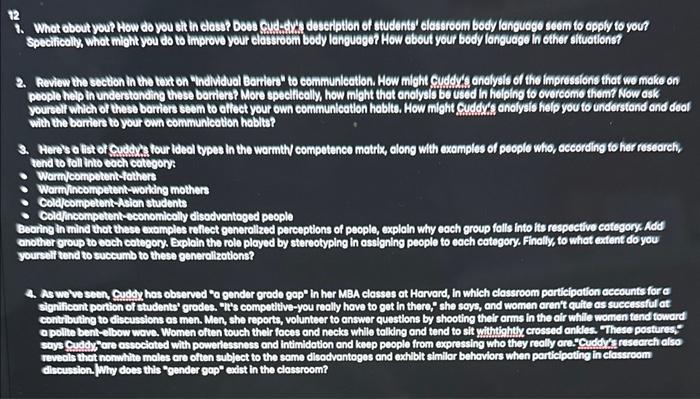
12 What about you? How do you sit in class? Does Cud-dy's description of students' classroom body language seem to apply to you? Specifically, what might you do to improve your classroom body language? How about your body language in other situations? 2. Review the section in the text on "Individual Barriers" to communication. How might Cuddy's analysis of the impressions that we make on people help in understanding these barriers? More specifically, how might that analysis be used in helping to overcome them? Now ask yourself which of these barriers seem to affect your own communication habits. How might Cuddy's analysis help you to understand and deal with the barriers to your own communication habits? 3. Here's a list of Cuddy four ideal types in the warmth/ competence matrix, along with examples of people who, according to her research, tend to fall into each category: Warm/competent-fathers Warm/incompetent-working mothers Cold/competent-Asian students Cold/incompetent-economically disadvantaged people Bearing in mind that these examples reflect generalized perceptions of people, explain why each group falls into its respective category. Add another group to each category. Explain the role played by stereotyping in assigning people to each category. Finally, to what extent do you yourself tend to succumb to these generalizations? 4. As we've seen, Cuddy has observed "a gender grade gap" in her MBA classes at Harvard, in which classroom participation accounts for a significant portion of students' grades. "It's competitive-you really have to get in there," she says, and women aren't quite as successful at contributing to discussions as men. Men, she reports, volunteer to answer questions by shooting their arms in the air while women tend toward a polite bent-elbow wave. Women often touch their faces and necks while talking and tend to sit withtightly, crossed ankles. "These postures," says Cuddy, "are associated with powerlessness and intimidation and keep people from expressing who they really are."Cuddy's research also reveals that nonwhite males are often subject to the same disadvantages and exhibit similar behaviors when participating in classroom discussion. Why does this "gender gap" exist in the classroom?
Step by Step Solution
There are 3 Steps involved in it

Get step-by-step solutions from verified subject matter experts
 Study Help