



Question: what are the balanced equations for A,B, C and D Part A. The Preparation of (PPhy) NiI 2 . Heat an oil bath to 120C.
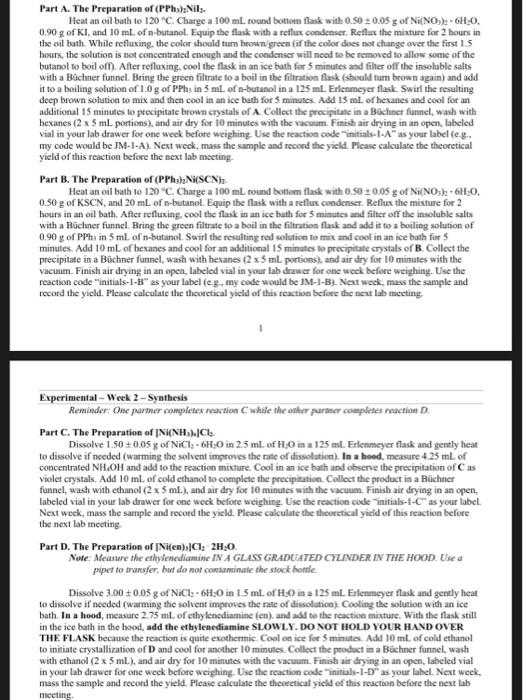
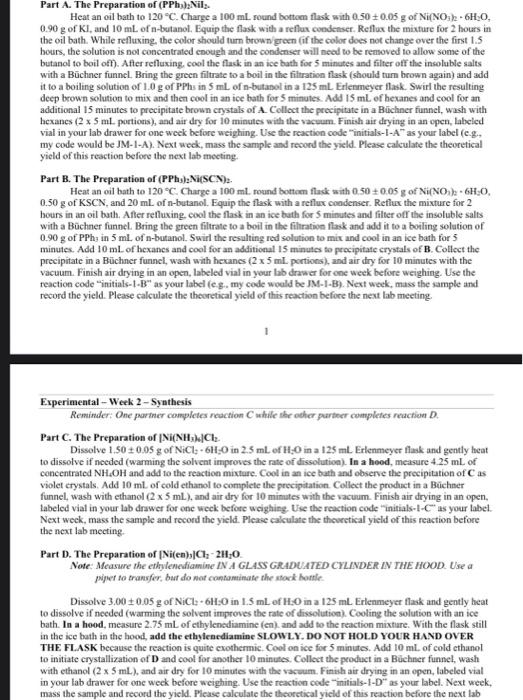
Part A. The Preparation of (PPhy) NiI 2 . Heat an oil bath to 120C. Charge a 100mL. found bothem flask with 0.500.05g of Ni(NO3)L2=6H2O.. 0.90g of Kl, and 10mL. of n-butanol. Equip the flask with a reflur condenser. Reflax the miature for 2 hours in the oil bath. While refluxing, the color should turn brown/green (if the color does not change over the first 1.5 hours, the solution is not concentrated enough and the condenser will need to be removed to allow some of the butanol to boil off. After refluxing, cool the flask in an ice bath for 5 minutes and filter off the insoluble salts with a Bchner funnel. Bring the green filtrate to a boil in the filtration flisk (should turn brown again) and add it to a boiling solution of 1.0g of PPhs in 5ml. of n-butanol in a 125mL. Frlenmeyer flask. Swirl the resulting deep brown solution to mix and then cool in an ice bath for 5 minutes. Add 15mL of hexanes and cool for an additional 15 minules to precipitate brown crystals of A. Cellect the procipitate in a Buchner funnel, wash with bexanes (25mL portions ), and air dry for 10 minties with the vacuum. Finish air drying in an open, labeled vial in your lab drawer for one week before weighing. Use the reaction code "initials-1. A as your label (e.g., my code would be JM-1-A). Next week, mass the sample and record the yield. Please calculate the theoretical yield of this reaction before the next lab mecting. Part B. The Preparation of (PPh)2Ni(SCV)2. Heat an oil bath to 120C. Charge a 100mL round botiom flask with 0.500.05g of Ni(NO3)=6H2O. 0.50g of KSCN, and 20mL of n-butanol. Equip the flask with a reflux condenser. Reflux the mivture for 2 hours in an oil bath. After refluxing. cool the flask in an ice bath for 5 mitutes and filter off the insoluble salts with a Bchner funnel. Bring the green filtrate to a boil in the filtration flusk and add it to a boiling solution of 0.90g of PPh in 5mL. of n-butanol. Swirl the resulting red solutice to mix and cool in an ice bath for 5 minutes. Add 10mL of hexanes and cool for an additional 15 minutes to precipitate crystals of B. Collect the precipitate in a Buichner funnel, wash with hexanes (2x5mL portions), and air dry for 10 minutes with the vacuum. Finish air drying in an open, labeled vial in your lab drawer for one week before weighing. Use the reaction code "initials-1-B" as your label (e.g., my code would be JM-1-B). Next weck, mass the sample and record the yicld. Please calculate the theoretical yicld of this reaction before the neat lab mecting. Experimental - Week 2 - Synthesis Reminder: One partner comyeletes reaction C while the odher purater completes reaction D. Part C. The Preparation of [Ni(NH3), ]Cl2. Dissolve 1.500.05g of NiCly - 6H,O in 2.5mL. of HzO in a 125mL. Erlenneyer flask and gently heat to dissolve if needed (warming the rolvent improves the rate of dissolation). In a hoed, measure 4.25mL. of concentrated NH4OH and add to the reaction misture. Cool in an ice bath and observe the precipitation of C as violet erystals. Add 10mL. of cold cthanol to complete the precipitation. Collect the product in a Bchner funnel, wash with ethanol ( 25mL.), and air dry for 10 minutes with the vacuum. Finish air drying in an cpen, labeled vial in your lab drawer for one weck before weighing. Use the reaction code "initials- IC " as your label. Next weck, mass the sample and record the yicld. Please calculate the theoretical yicid of this reaction before the next lab mecting. Part D. The Preparation of Ni(en),3]Cl22H2O Note: Mearare the ethylenediamine IN A GLASS GRADUATED CYUNDER IN THE HOOD. Ure a pipet to transfer, but do not conaminate the stock botrle. Dissolve 3.000.05g of NiCl6H:O in 1.5mL of H20 in a 125mL. Erlenmeyer flask and gently heat to dissolve if needed (warming the solvent impeoves the rate of dissolution). Cooting the solution with an ice bath. In a hood, measure 2.75mL. of cthylenediamine (en), and adl to the reaction mixture. With the flask still in the ice bath in the hood, add the ethylenediamine SLOWLY. DO NOT HOLD YOUR HAND OVER THE. FL.ASK because the reaction is quite exothermic. Cool on ice for 5 minutes. Add 10mL. of cold ethanol to initiate crystallization of D and cool for another 10 minutes. Colloct the peodoct in a Bchner funnel, wash with ethanol (25mL.), and air dry for 10 minutes with the vacuum. Finish air drying in an epen, labeled vial in your lab drawer for one week before weighing. Use the reaction code "initials-1-1" as your label. Nedt week, mass the sample and recoed the yield. Please calculate the theoetical yield of this reaction before the next lab Part A. The Preparation of (PPh)2 Nill 2 Heat an oil bath to 120C. Charge a 100ml. round bottom flask with 0.500.05g of Ni(NO3)26H2O,, 0.90g of KI, and 10mL of n-butanol. Equip the flask with a reflux condenser. Reflux the mixture for 2 hours in the oil bath. While refluxing, the color should turn brown green (if the color does not change over the first 1.5 bours, the solution is not concentrated enough and the condenser will need to be reasoved to allow sone of the butanol to boil off). After refluxing, cool the flask in an ise bath for 5 minutes and filter off the insoluble salts with a Bchner funnel. Bring the green filtrate to a boil in the filtration flask (should turn brown again) and add it to a boiling solution of 1.0g of PPhs in 5mL of n-butasol in a 125mL. Erlenmeyer flask. Swirl the resulting deep brown solution to mix and then cool in an ice bath for 5 minutes. Add 15mL of hexanes and cool for an additional 15 minutes to precipitate brown crystals of A. Colloct the precipitate in a Bchner funnel, wash with hexanes (25ml. portions), and air dry for 10 minutes with the vacsum. Finish air drying in an open, labeled vial in your lab drawer for one week before weighing. Use the reaction code "initials- A - as your label (c.g., my code would be JM-1-A). Next weck, mass the sample and resord the yield. Please calculate the theoretical yield of this reaction before the next lab mecting. Part B. The Preparation of (PPhs)zNi(SCN)2. Heat an oil bath to 120C. Charge a 100ml. round bottam flask with 0.500.05g of Ni(NO1)=6H3O3 0.50g of KSCN , and 20mL of n-butanol. Equip the flask with a reflux condenser. Reflux the mixture for 2 bours in an oil bath. After refluxing, cool the flask in an ice buth for 5 minutes and filter off the insoluble salts with a Bchner funneL. Bring the green filtrate to a boil in the filiration flask and add it to a boiling solation of 0.90g of PPhy in 5mL. of n-butanol. Swirl the resulting red solution to mix and cool in an ice bath for 5 minutes. Add 10mL of hexancs and cool for an additional 15 minutes to precipitate crystals of B. Collect the precipitate in a Bchner funnel, wash with hexanes ( 25mL. portions), and air dry for 10 minutes with the vacuum. Finish air drying in an open, labeled vial in your lab drawer for one week before weighing. Use the reaction code "initials-1-B" as your label (eg., my code would be JM-1-B). Next weck, mass the sample and record the yield. Please calculate the theoretical yield of this reaction before the next lab meeting. Experimental - Week 2 - Synthesis Reminder: One partiner completes reaction C while ste edter partecr completes reaction D. Part C. The Preparation of [Ni(NH3)]3]Cl. Dissolve 1.500.05g of NiCl+6H,O in 2.5mL of H:O in a 125mL. Erlenmeyer flask and gently heat to dissolve if needed (warming the solvent improves the fate of dissolution). In a hoed, measure 4.25mL of concentrated NH4OH and add to the reaction mixture. Cool in an iee bath and observe the precipitation of C as violet erystals. Add 10ml of cold ethanol to consiete the precipitation. Collect the product in a Buichner funnel, wash with ethanol (25mL), and air dry for 10 minutes with the vacuum. Finish air drying in an open, labeled vial in your lab drawer for one week before weighing. Use the reaction code "initials-1-C- as your label. Next week, mass the sample and record the yield. Please cakculate the thevrctical yield of this reaction before the next lab mecting. Part D. The Preparation of [Ni(en),Cl22H2O. Note: Measure the ethylenediamine IN A GLASS GRADUATED CYLAVDER IN THE HIOOD. Use a pipert to transfer, bat do not conkominate the stock hontie. Dissolve 3.000.05 g of NiCl+6H.O in 1.5mL of H0 in a 125mL Erlenmeyer flask and gently heat to dissolve if needed (warming the solvent improves the rate of dissolution). Cooling the solution with an ice bath. In a hood, measure 2.75mL of ethylenediamine (en). and add to the reaction mixtare. With the flask still in the ice bath in the hood, add the ethylcaediamine SLOWLY. DO NOT HOL.D YOUR HAND OVER THE FI.ASK because the reaction is quite exothermic. Cool on ice for 5 minutes. Add 10mL, of cold ethanol to initiate crystallization of D and cool for another 10 minutes. Collect the peoduct in a Bchner funnel, wash with ethanol ( 25mL), and air dry for 10 minutes with the vaceum. Finish air drying in an open, labeled vial in your lab drawer for one week before weighing. Use the reaction cede "initials-1-D as your label. Next week, mass the sample and record the yield. Please calculate the theoretical yicld of this reaction before the next lab Part A. The Preparation of (PPhy) NiI 2 . Heat an oil bath to 120C. Charge a 100mL. found bothem flask with 0.500.05g of Ni(NO3)L2=6H2O.. 0.90g of Kl, and 10mL. of n-butanol. Equip the flask with a reflur condenser. Reflax the miature for 2 hours in the oil bath. While refluxing, the color should turn brown/green (if the color does not change over the first 1.5 hours, the solution is not concentrated enough and the condenser will need to be removed to allow some of the butanol to boil off. After refluxing, cool the flask in an ice bath for 5 minutes and filter off the insoluble salts with a Bchner funnel. Bring the green filtrate to a boil in the filtration flisk (should turn brown again) and add it to a boiling solution of 1.0g of PPhs in 5ml. of n-butanol in a 125mL. Frlenmeyer flask. Swirl the resulting deep brown solution to mix and then cool in an ice bath for 5 minutes. Add 15mL of hexanes and cool for an additional 15 minules to precipitate brown crystals of A. Cellect the procipitate in a Buchner funnel, wash with bexanes (25mL portions ), and air dry for 10 minties with the vacuum. Finish air drying in an open, labeled vial in your lab drawer for one week before weighing. Use the reaction code "initials-1. A as your label (e.g., my code would be JM-1-A). Next week, mass the sample and record the yield. Please calculate the theoretical yield of this reaction before the next lab mecting. Part B. The Preparation of (PPh)2Ni(SCV)2. Heat an oil bath to 120C. Charge a 100mL round botiom flask with 0.500.05g of Ni(NO3)=6H2O. 0.50g of KSCN, and 20mL of n-butanol. Equip the flask with a reflux condenser. Reflux the mivture for 2 hours in an oil bath. After refluxing. cool the flask in an ice bath for 5 mitutes and filter off the insoluble salts with a Bchner funnel. Bring the green filtrate to a boil in the filtration flusk and add it to a boiling solution of 0.90g of PPh in 5mL. of n-butanol. Swirl the resulting red solutice to mix and cool in an ice bath for 5 minutes. Add 10mL of hexanes and cool for an additional 15 minutes to precipitate crystals of B. Collect the precipitate in a Buichner funnel, wash with hexanes (2x5mL portions), and air dry for 10 minutes with the vacuum. Finish air drying in an open, labeled vial in your lab drawer for one week before weighing. Use the reaction code "initials-1-B" as your label (e.g., my code would be JM-1-B). Next weck, mass the sample and record the yicld. Please calculate the theoretical yicld of this reaction before the neat lab mecting. Experimental - Week 2 - Synthesis Reminder: One partner comyeletes reaction C while the odher purater completes reaction D. Part C. The Preparation of [Ni(NH3), ]Cl2. Dissolve 1.500.05g of NiCly - 6H,O in 2.5mL. of HzO in a 125mL. Erlenneyer flask and gently heat to dissolve if needed (warming the rolvent improves the rate of dissolation). In a hoed, measure 4.25mL. of concentrated NH4OH and add to the reaction misture. Cool in an ice bath and observe the precipitation of C as violet erystals. Add 10mL. of cold cthanol to complete the precipitation. Collect the product in a Bchner funnel, wash with ethanol ( 25mL.), and air dry for 10 minutes with the vacuum. Finish air drying in an cpen, labeled vial in your lab drawer for one weck before weighing. Use the reaction code "initials- IC " as your label. Next weck, mass the sample and record the yicld. Please calculate the theoretical yicid of this reaction before the next lab mecting. Part D. The Preparation of Ni(en),3]Cl22H2O Note: Mearare the ethylenediamine IN A GLASS GRADUATED CYUNDER IN THE HOOD. Ure a pipet to transfer, but do not conaminate the stock botrle. Dissolve 3.000.05g of NiCl6H:O in 1.5mL of H20 in a 125mL. Erlenmeyer flask and gently heat to dissolve if needed (warming the solvent impeoves the rate of dissolution). Cooting the solution with an ice bath. In a hood, measure 2.75mL. of cthylenediamine (en), and adl to the reaction mixture. With the flask still in the ice bath in the hood, add the ethylenediamine SLOWLY. DO NOT HOLD YOUR HAND OVER THE. FL.ASK because the reaction is quite exothermic. Cool on ice for 5 minutes. Add 10mL. of cold ethanol to initiate crystallization of D and cool for another 10 minutes. Colloct the peodoct in a Bchner funnel, wash with ethanol (25mL.), and air dry for 10 minutes with the vacuum. Finish air drying in an epen, labeled vial in your lab drawer for one week before weighing. Use the reaction code "initials-1-1" as your label. Nedt week, mass the sample and recoed the yield. Please calculate the theoetical yield of this reaction before the next lab Part A. The Preparation of (PPh)2 Nill 2 Heat an oil bath to 120C. Charge a 100ml. round bottom flask with 0.500.05g of Ni(NO3)26H2O,, 0.90g of KI, and 10mL of n-butanol. Equip the flask with a reflux condenser. Reflux the mixture for 2 hours in the oil bath. While refluxing, the color should turn brown green (if the color does not change over the first 1.5 bours, the solution is not concentrated enough and the condenser will need to be reasoved to allow sone of the butanol to boil off). After refluxing, cool the flask in an ise bath for 5 minutes and filter off the insoluble salts with a Bchner funnel. Bring the green filtrate to a boil in the filtration flask (should turn brown again) and add it to a boiling solution of 1.0g of PPhs in 5mL of n-butasol in a 125mL. Erlenmeyer flask. Swirl the resulting deep brown solution to mix and then cool in an ice bath for 5 minutes. Add 15mL of hexanes and cool for an additional 15 minutes to precipitate brown crystals of A. Colloct the precipitate in a Bchner funnel, wash with hexanes (25ml. portions), and air dry for 10 minutes with the vacsum. Finish air drying in an open, labeled vial in your lab drawer for one week before weighing. Use the reaction code "initials- A - as your label (c.g., my code would be JM-1-A). Next weck, mass the sample and resord the yield. Please calculate the theoretical yield of this reaction before the next lab mecting. Part B. The Preparation of (PPhs)zNi(SCN)2. Heat an oil bath to 120C. Charge a 100ml. round bottam flask with 0.500.05g of Ni(NO1)=6H3O3 0.50g of KSCN , and 20mL of n-butanol. Equip the flask with a reflux condenser. Reflux the mixture for 2 bours in an oil bath. After refluxing, cool the flask in an ice buth for 5 minutes and filter off the insoluble salts with a Bchner funneL. Bring the green filtrate to a boil in the filiration flask and add it to a boiling solation of 0.90g of PPhy in 5mL. of n-butanol. Swirl the resulting red solution to mix and cool in an ice bath for 5 minutes. Add 10mL of hexancs and cool for an additional 15 minutes to precipitate crystals of B. Collect the precipitate in a Bchner funnel, wash with hexanes ( 25mL. portions), and air dry for 10 minutes with the vacuum. Finish air drying in an open, labeled vial in your lab drawer for one week before weighing. Use the reaction code "initials-1-B" as your label (eg., my code would be JM-1-B). Next weck, mass the sample and record the yield. Please calculate the theoretical yield of this reaction before the next lab meeting. Experimental - Week 2 - Synthesis Reminder: One partiner completes reaction C while ste edter partecr completes reaction D. Part C. The Preparation of [Ni(NH3)]3]Cl. Dissolve 1.500.05g of NiCl+6H,O in 2.5mL of H:O in a 125mL. Erlenmeyer flask and gently heat to dissolve if needed (warming the solvent improves the fate of dissolution). In a hoed, measure 4.25mL of concentrated NH4OH and add to the reaction mixture. Cool in an iee bath and observe the precipitation of C as violet erystals. Add 10ml of cold ethanol to consiete the precipitation. Collect the product in a Buichner funnel, wash with ethanol (25mL), and air dry for 10 minutes with the vacuum. Finish air drying in an open, labeled vial in your lab drawer for one week before weighing. Use the reaction code "initials-1-C- as your label. Next week, mass the sample and record the yield. Please cakculate the thevrctical yield of this reaction before the next lab mecting. Part D. The Preparation of [Ni(en),Cl22H2O. Note: Measure the ethylenediamine IN A GLASS GRADUATED CYLAVDER IN THE HIOOD. Use a pipert to transfer, bat do not conkominate the stock hontie. Dissolve 3.000.05 g of NiCl+6H.O in 1.5mL of H0 in a 125mL Erlenmeyer flask and gently heat to dissolve if needed (warming the solvent improves the rate of dissolution). Cooling the solution with an ice bath. In a hood, measure 2.75mL of ethylenediamine (en). and add to the reaction mixtare. With the flask still in the ice bath in the hood, add the ethylcaediamine SLOWLY. DO NOT HOL.D YOUR HAND OVER THE FI.ASK because the reaction is quite exothermic. Cool on ice for 5 minutes. Add 10mL, of cold ethanol to initiate crystallization of D and cool for another 10 minutes. Collect the peoduct in a Bchner funnel, wash with ethanol ( 25mL), and air dry for 10 minutes with the vaceum. Finish air drying in an open, labeled vial in your lab drawer for one week before weighing. Use the reaction cede "initials-1-D as your label. Next week, mass the sample and record the yield. Please calculate the theoretical yicld of this reaction before the next lab
Step by Step Solution
There are 3 Steps involved in it

Get step-by-step solutions from verified subject matter experts