







Question: what are the steps to solve this explain 9.2 Demand Paging 407 With an average page-fault service time of 8 milliseconds and a memory access
what are the steps to solve this explain
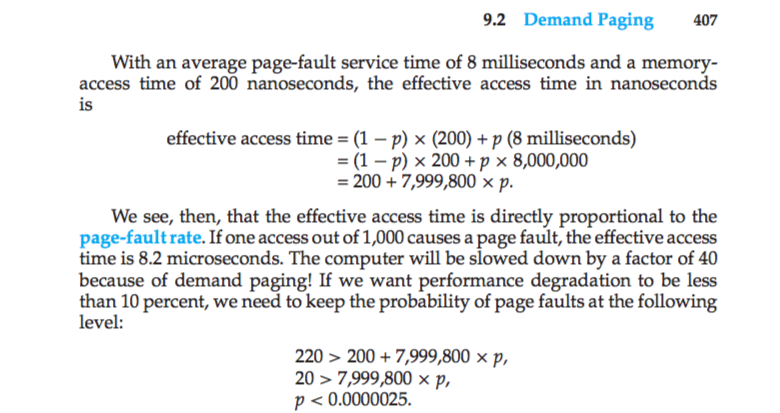
9.2 Demand Paging 407 With an average page-fault service time of 8 milliseconds and a memory access time of 200 nanoseconds, the effective access time in nanoseconds is effective access time-(1 -p) x (200) p (8 milliseconds) = (1-p) x 200 + p 8,000,000 200+7,999,800 x p. We see, then, that the effective access time is directly proportional to the page-fault rate. If one access out of 1,000 causes a page fault, the effective access time is 8.2 microseconds. The computer will be slowed down by a factor of 40 because of demand paging! If we want performance degradation to be less than 10 percent, we need to keep the probability of page faults at the following level: 220> 200+7,999,800 x p, 20 > 7,999,800 P, p0.0000025
Step by Step Solution
There are 3 Steps involved in it

Get step-by-step solutions from verified subject matter experts
 Study Help