



Question: What can you do when the a priori method produces a large number of rules, much more than expected? Use the editor to format your
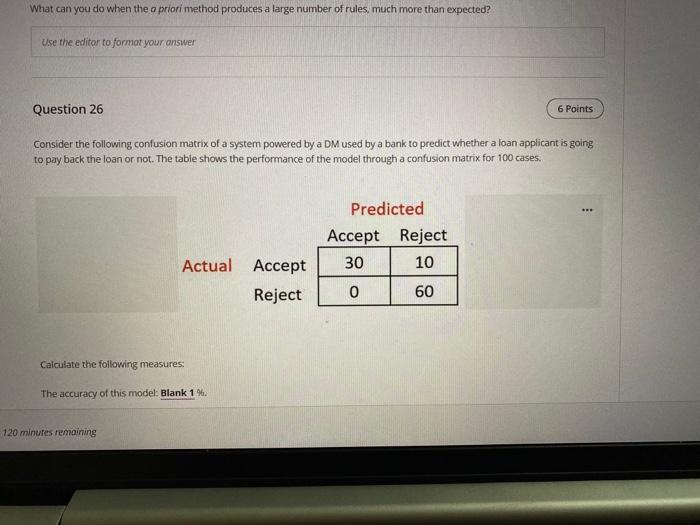
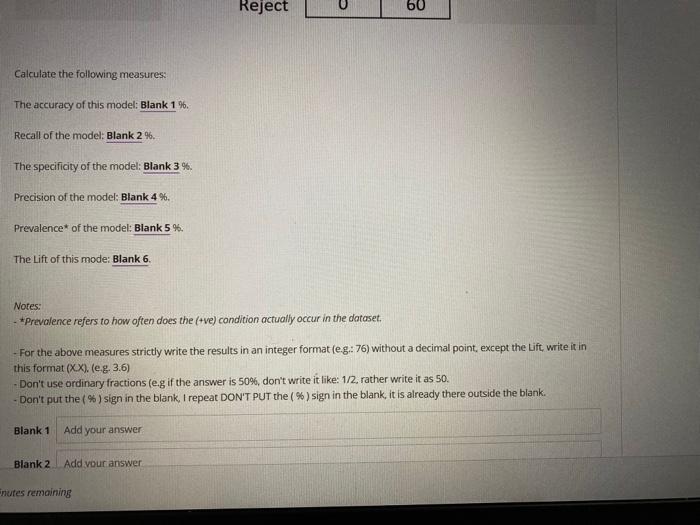
What can you do when the a priori method produces a large number of rules, much more than expected? Use the editor to format your answer Question 26 6 Points Consider the following confusion matrix of a system powered by a DM used by a bank to predict whether a loan applicant is going to pay back the loan or not. The table shows the performance of the model through a confusion matrix for 100 cases. 8. Predicted Accept Reject 30 10 0 60 Actual Accept Reject Calculate the following measures. The accuracy of this model: Blank 1 % 120 minutes remaining Reject 60 Calculate the following measures: The accuracy of this model: Blank 1 %. Recall of the model: Blank 2 %. The specificity of the model: Blank 3 %. Precision of the model: Blank 4%. Prevalence of the model: Blank 5 %. The Lift of this mode: Blank 6. Notes: - *Prevalence refers to how often does the (+ve) condition actually occur in the dataset. - For the above measures strictly write the results in an integer format (eg.: 76) without a decimal point, except the Lift, write it in this format (xx). (e.g. 3.6) - Don't use ordinary fractions (e.g if the answer is 50%, don't write it like: 1/2. rather write it as 50. - Don't put the (%) sign in the blank, I repeat DON'T PUT the (%) sign in the blank, it is already there outside the blank. Blank 1 Add your answer Blank 2. Add your answer nutes remaining
Step by Step Solution
There are 3 Steps involved in it

Get step-by-step solutions from verified subject matter experts