Question: What could be the main options for dealing with the company's exposure? Under what circumstances would the company suffer the greatest loss if its exposure

- What could be the main options for dealing with the company's exposure?
- Under what circumstances would the company suffer the greatest loss if its exposure were left completely uncovered?
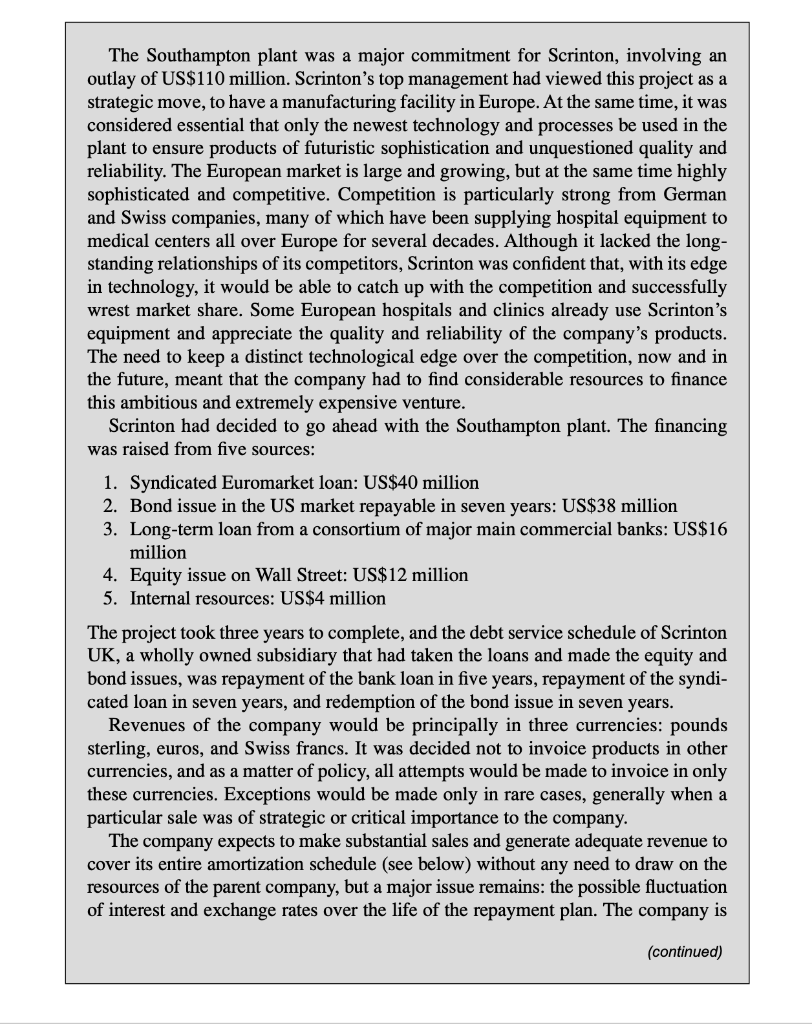
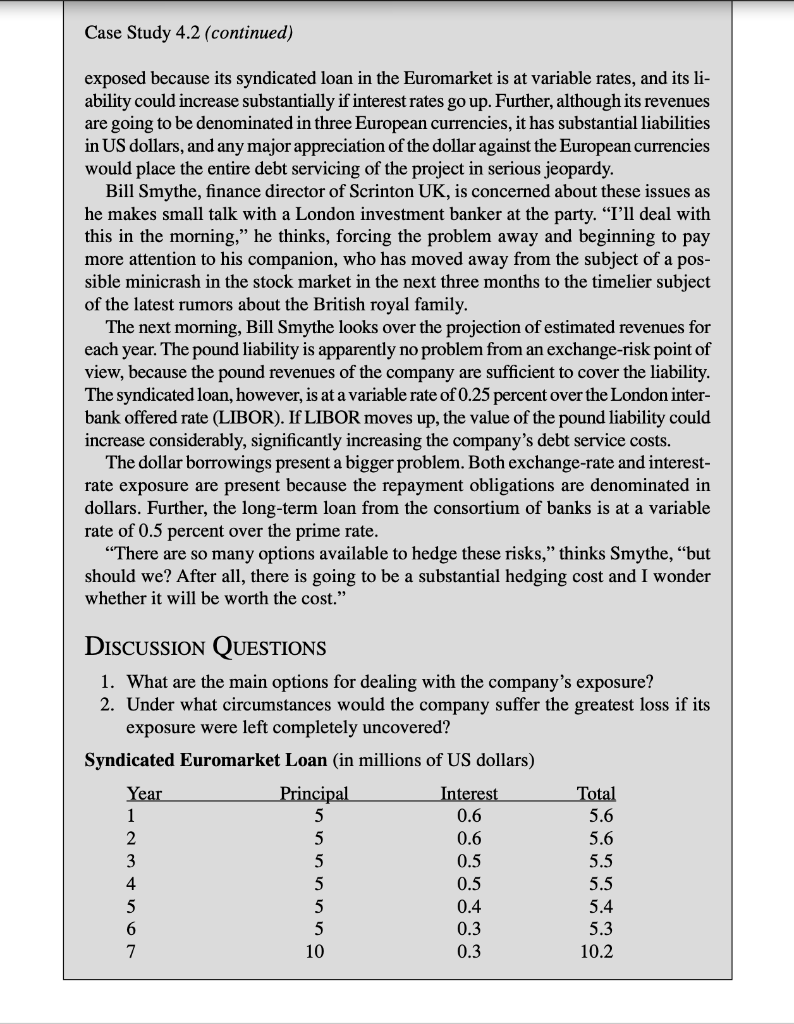
CASE STUDY 4.2 SCRINTON TECHNOLOGIES The party at the banquet hall of Grosvenor House Hotel in London is a glitter- ing affair. Dozens of top bankers, CEOs of industrial companies, and important government officials are attending the formal celebration marking the commis- sioning of Scrinton Technologies' new plant in Southampton, England, which will be manufacturing a small range of state-of-the-art medical diagnostic equipment, including computer-enhanced imagery and high-tech scanning systems. Scrinton is a world leader in diagnostic equipment, and the new plant represents the most advanced manufacturing facility of its type in the world. Only Scrinton's own plant in Sacramento, California, approaches this facility in technical sophistication and advanced production equipment and processes. The Southampton plant was a major commitment for Scrinton, involving an outlay of US$110 million. Scrinton's top management had viewed this project as a strategic move, to have a manufacturing facility in Europe. At the same time, it was considered essential that only the newest technology and processes be used in the plant to ensure products of futuristic sophistication and unquestioned quality and reliability. The European market is large and growing, but at the same time highly sophisticated and competitive. Competition is particularly strong from German and Swiss companies, many of which have been supplying hospital equipment to medical centers all over Europe for several decades. Although it lacked the long- standing relationships of its competitors, Scrinton was confident that, with its edge in technology, it would be able to catch up with the competition and successfully wrest market share. Some European hospitals and clinics already use Scrinton's equipment and appreciate the quality and reliability of the company's products. The need to keep a distinct technological edge over the competition, now and in the future, meant that the company had to find considerable resources to finance this ambitious and extremely expensive venture. Scrinton had decided to go ahead with the Southampton plant. The financing was raised from five sources: 1. Syndicated Euromarket loan: US$40 million 2. Bond issue in the US market repayable in seven years: US$38 million 3. Long-term loan from a consortium of major main commercial banks: US$16 million 4. Equity issue on Wall Street: US$12 million 5. Internal resources: US$4 million The project took three years to complete, and the debt service schedule of Scrinton UK, a wholly owned subsidiary that had taken the loans and made the equity and bond issues, was repayment of the bank loan in five years, repayment of the syndi- cated loan in seven years, and redemption of the bond issue in seven years. Revenues of the company would be principally in three currencies: pounds sterling, euros, and Swiss francs. It was decided not to invoice products in other currencies, and as a matter of policy, all attempts would be made to invoice in only these currencies. Exceptions would be made only in rare cases, generally when a particular sale was of strategic or critical importance to the company. The company expects to make substantial sales and generate adequate revenue to cover its entire amortization schedule (see below) without any need to draw on the resources of the parent company, but a major issue remains: the possible fluctuation of interest and exchange rates over the life of the repayment plan. The company is (continued) Case Study 4.2 (continued) exposed because its syndicated loan in the Euromarket is at variable rates, and its li- ability could increase substantially if interest rates go up. Further, although its revenues are going to be denominated in three European currencies, it has substantial liabilities in US dollars, and any major appreciation of the dollar against the European currencies would place the entire debt servicing of the project in serious jeopardy. Bill Smythe, finance director of Scrinton UK, is concerned about these issues as he makes small talk with a London investment banker at the party. I'll deal with this in the morning," he thinks, forcing the problem away and beginning to pay more attention to his companion, who has moved away from the subject of a pos- sible minicrash in the stock market in the next three months to the timelier subject of the latest rumors about the British royal family. The next morning, Bill Smythe looks over the projection of estimated revenues for each year. The pound liability is apparently no problem from an exchange-risk point of view, because the pound revenues of the company are sufficient to cover the liability. The syndicated loan, however, is at a variable rate of 0.25 percent over the London inter- bank offered rate (LIBOR). If LIBOR moves up, the value of the pound liability could increase considerably, significantly increasing the company's debt service costs. The dollar borrowings present a bigger problem. Both exchange-rate and interest- rate exposure are present because the repayment obligations are denominated in dollars. Further, the long-term loan from the consortium of banks is at a variable rate of 0.5 percent over the prime rate. There are so many options available to hedge these risks, thinks Smythe, but should we? After all, there is going to be a substantial hedging cost and I wonder whether it will be worth the cost." DISCUSSION QUESTIONS 1. What are the main options for dealing with the company's exposure? 2. Under what circumstances would the company suffer the greatest loss if its exposure were left completely uncovered? Syndicated Euromarket Loan (in millions of US dollars) Year Principal Interest Total 1 5 0.6 5.6 2 5 0.6 5.6 3 5 0.5 4 5 0.5 5.5 5 5 0.4 5.4 5 0.3 5.3 7 10 0.3 10.2 5.5




