







Question: What does it mean for scientific knowledge to be simultaneously, reliable and tentative?understanding of the nature of science. Science is characterized by the systematic gathering
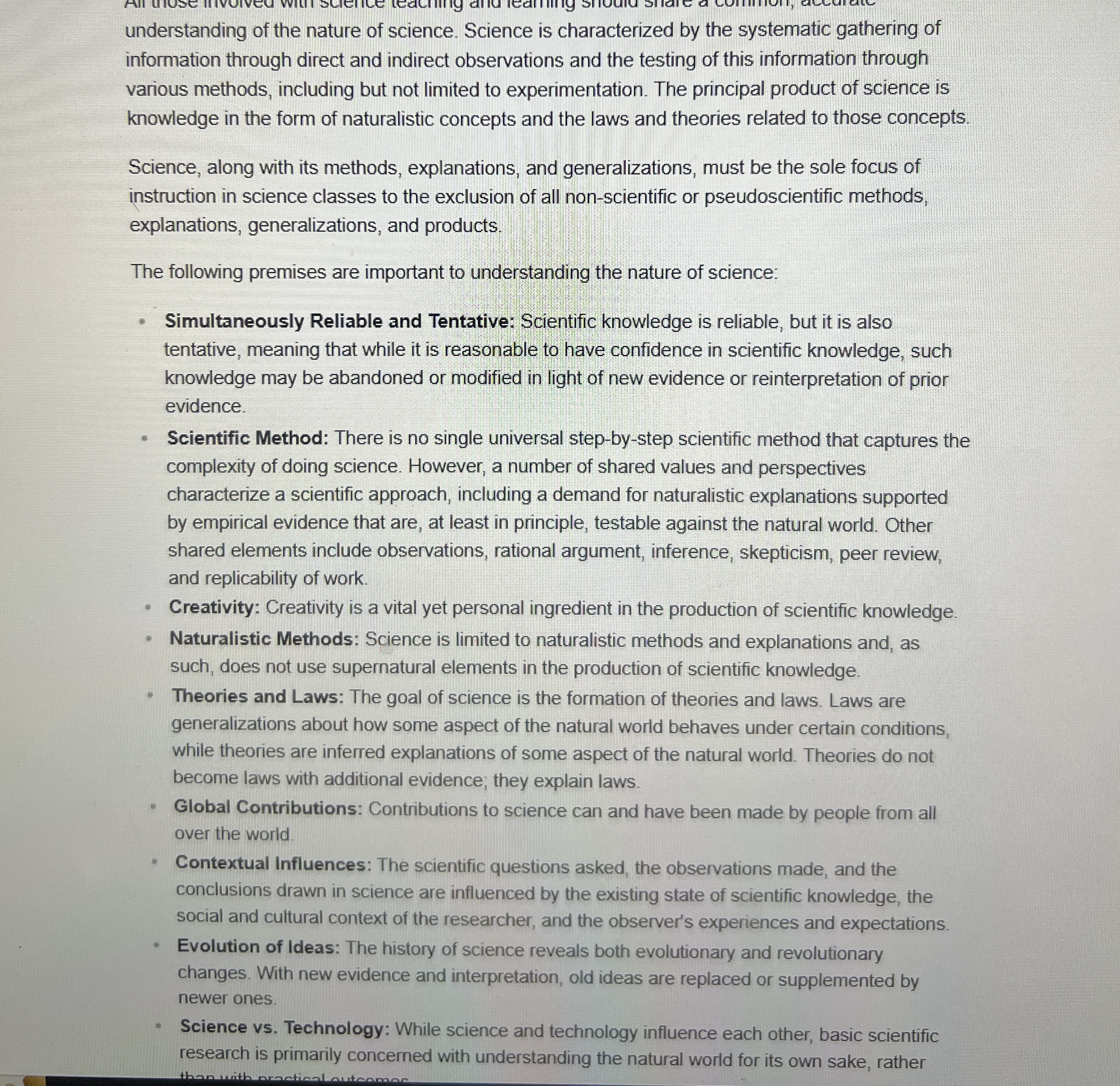
What does it mean for scientific knowledge to be simultaneously, reliable and tentative?understanding of the nature of science. Science is characterized by the systematic gathering of information through direct and indirect observations and the testing of this information through various methods, including but not limited to experimentation. The principal product of science is knowledge in the form of naturalistic concepts and the laws and theories related to those concepts.
Science, along with its methods, explanations, and generalizations, must be the sole focus of instruction in science classes to the exclusion of all nonscientific or pseudoscientific methods, explanations, generalizations, and products.
The following premises are important to understanding the nature of science:
Simultaneously Reliable and Tentative: Scientific knowledge is reliable, but it is also tentative, meaning that while it is reasonable to have confidence in scientific knowledge, such knowledge may be abandoned or modified in light of new evidence or reinterpretation of prior evidence.
Scientific Method: There is no single universal stepbystep scientific method that captures the complexity of doing science. However, a number of shared values and perspectives characterize a scientific approach, including a demand for naturalistic explanations supported by empirical evidence that are, at least in principle, testable against the natural world. Other shared elements include observations, rational argument, inference, skepticism, peer review, and replicability of work.
Creativity: Creativity is a vital yet personal ingredient in the production of scientific knowledge.
Naturalistic Methods: Science is limited to naturalistic methods and explanations and, as such, does not use supernatural elements in the production of scientific knowledge.
Theories and Laws: The goal of science is the formation of theories and laws. Laws are generalizations about how some aspect of the natural world behaves under certain conditions, while theories are inferred explanations of some aspect of the natural world. Theories do not become laws with additional evidence; they explain laws.
Global Contributions: Contributions to science can and have been made by people from all over the world.
Contextual Influences: The scientific questions asked, the observations made, and the conclusions drawn in science are influenced by the existing state of scientific knowledge, the social and cultural context of the researcher, and the observer's experiences and expectations.
Evolution of Ideas: The history of science reveals both evolutionary and revolutionary changes. With new evidence and interpretation, old ideas are replaced or supplemented by newer ones.
Science vs Technology: While science and technology influence each other, basic scientific research is primarily concerned with understanding the natural world for its own sake, rather
Step by Step Solution
There are 3 Steps involved in it
1 Expert Approved Answer
Step: 1 Unlock

Question Has Been Solved by an Expert!
Get step-by-step solutions from verified subject matter experts
Step: 2 Unlock
Step: 3 Unlock
 Study Help