



Question: What does the this suggest about smartphones vs. tablets for mobile shopping? In your estimation is this expectation likely to pan out? Please answer in
What does the this suggest about smartphones vs. tablets for mobile shopping? In your estimation is this expectation likely to pan out?
Please answer in paragraph form. Thank you
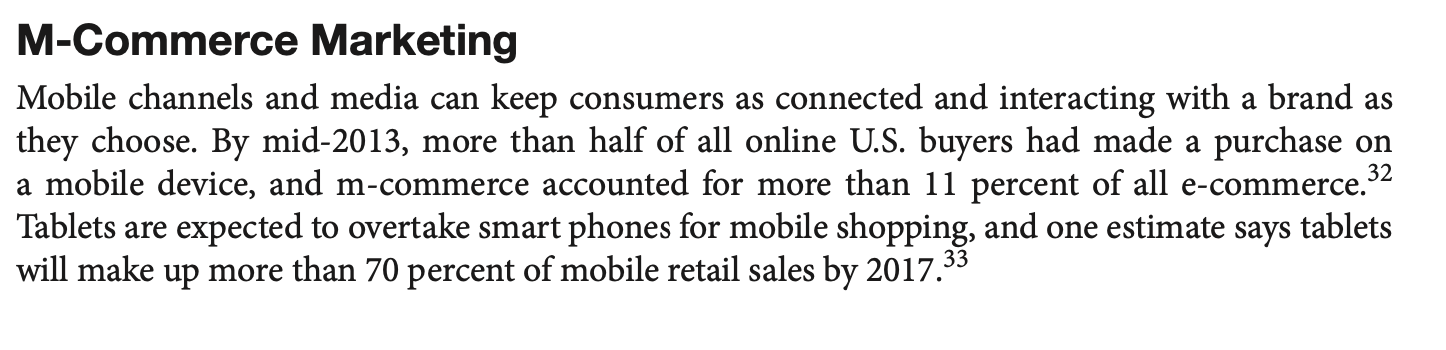
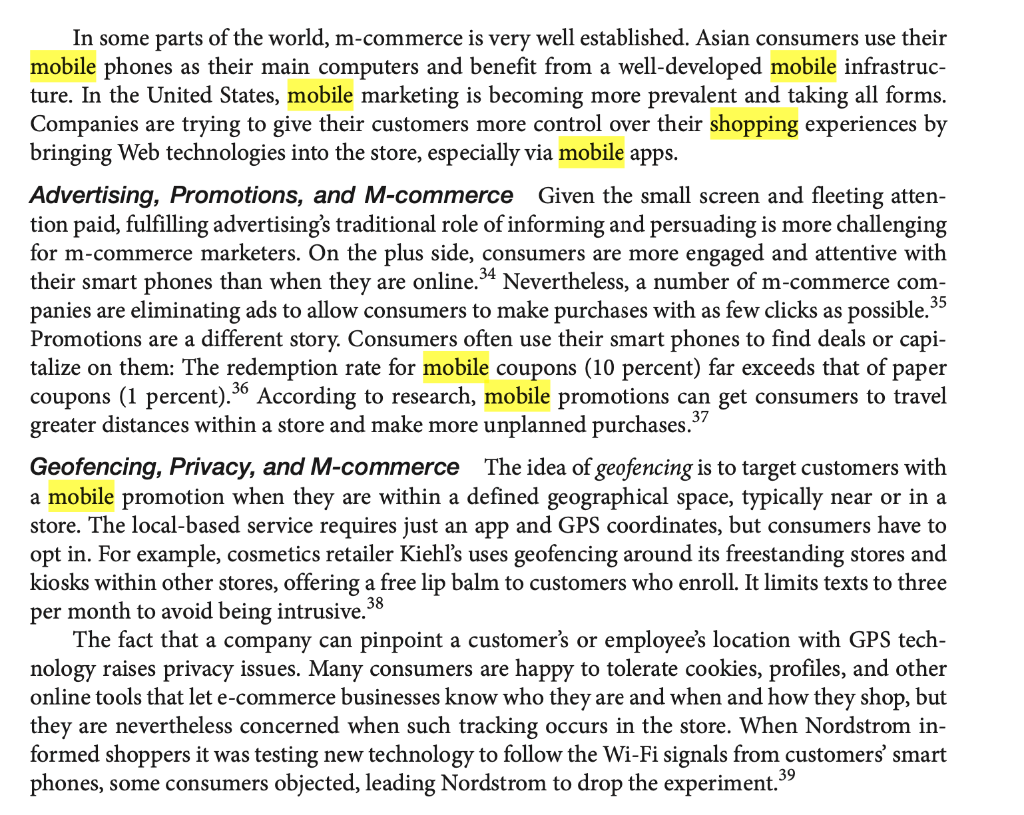
M-Commerce Marketing Mobile channels and media can keep consumers as connected and interacting with a brand as they choose. By mid-2013, more than half of all online U.S. buyers had made a purchase on a mobile device, and m-commerce accounted for more than 11 percent of all e-commerce.32 Tablets are expected to overtake smart phones for mobile shopping, and one estimate says tablets will make up more than 70 percent of mobile retail sales by 2017.33 In some parts of the world, m-commerce is very well established. Asian consumers use their mobile phones as their main computers and benefit from a well-developed mobile infrastruc- ture. In the United States, mobile marketing is becoming more prevalent and taking all forms. Companies are trying to give their customers more control over their shopping experiences by bringing Web technologies into the store, especially via mobile apps. Advertising, Promotions, and M-commerce Given the small screen and fleeting atten- tion paid, fulfilling advertising's traditional role of informing and persuading is more challenging for m-commerce marketers. On the plus side, consumers are more engaged and attentive with their smart phones than when they are online. 94 Nevertheless, a number of m-commerce com- panies are eliminating ads to allow consumers to make purchases with as few clicks as possible.95 Promotions are a different story. Consumers often use their smart phones to find deals or capi- talize on them: The redemption rate for mobile coupons (10 percent) far exceeds that of paper coupons (1 percent). 56 According to research, mobile promotions can get consumers to travel greater distances within a store and make more unplanned purchases." Geofencing, Privacy, and M-commerce The idea of geofencing is to target customers with a mobile promotion when they are within a defined geographical space, typically near or in a store. The local-based service requires just an app and GPS coordinates, but consumers have to opt in. For example, cosmetics retailer Kiehl's uses geofencing around its freestanding stores and kiosks within other stores, offering a free lip balm to customers who enroll. It limits texts to three per month to avoid being intrusive. 58 The fact that a company can pinpoint a customer's or employee's location with GPS tech- nology raises privacy issues. Many consumers are happy to tolerate cookies, profiles, and other online tools that let e-commerce businesses know who they are and when and how they shop, but they are nevertheless concerned when such tracking occurs in the store. When Nordstrom in- formed shoppers it was testing new technology to follow the Wi-Fi signals from customers' smart phones, some consumers objected, leading Nordstrom to drop the experimentStep by Step Solution
There are 3 Steps involved in it
1 Expert Approved Answer
Step: 1 Unlock

Question Has Been Solved by an Expert!
Get step-by-step solutions from verified subject matter experts
Step: 2 Unlock
Step: 3 Unlock