Question: what elements would be required in a canadian national or provincial exporting strategy ? 500 words Canadian Wine Industry The Canada-US free trade agreement was
what elements would be required in a canadian national or provincial exporting strategy ? 500 words
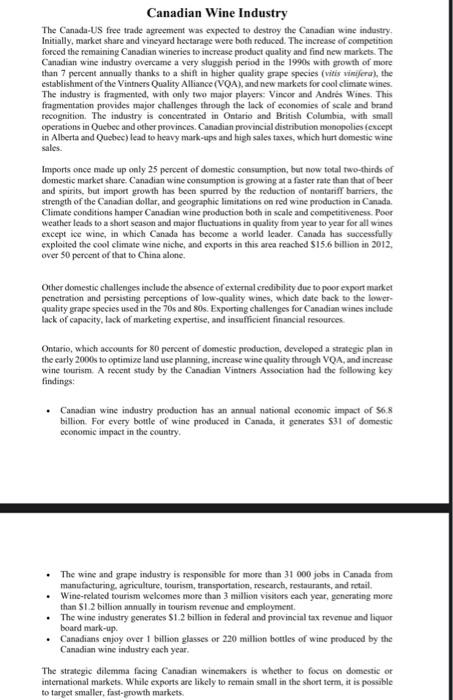
Canadian Wine Industry The Canada-US free trade agreement was expected to destroy the Canadian wine industry, Initially, market share and vineyard hectarage were both reduced. The increase of competition forced the remaining Canadian wineries to increase product quality and find new markets. The Canadian wine industry overcame a very sluggish period in the 1990s with growth of more than 7 percent annually thanks to a shift in higher quality grape species (vitis vinifera), the establishment of the Vintners Quality Alliance (VOA), and new markets for cool climate wines The industry is fragmented, with only two major players: Vincor and Andres Wines. This fragmentation provides major challenges through the lack of economies of scale and brand recognition. The industry is concentrated in Ontario and British Columbia, with small operations in Quebee and other provinces. Canadian provincial distribution monopolies (except in Alberta and Quebec) lead to heavy mark-ups and high sales taxes, which hur domestic wine sales. Imports once made up only 25 percent of domestic consumption, but now total two-thirds of domestic market share. Canadian wine consumption is growing at a faster rate than that of beer and spirits, but import growth has been spurred by the reduction of nontariff barriers, the strength of the Canadian dollar, and geographic limitations on red wine production in Canada. Climate conditions hamper Canadian wine production both in scale and competitiveness. Poor weather leads to a short season and major fluctuations in quality from year to year for all wines except ice wine, in which Canada has become a world leader. Canada has successfully exploited the cool climate wine niche, and exports in this area reached $15.6 billion in 2012, over 50 percent of that to China alone. Other domestic challenges include the absence of external credibility due to poor export market penetration and persisting perceptions of low-quality wines, which date back to the lower quality grape species used in the 70s and 80s. Exporting challenges for Canadian wines include lack of capacity, lack of marketing expertise, and insufficient financial resources Ontario, which accounts for 80 percent of domestic production, developed a strategic plan in the carly 2000s to optimize land use planning, increase wine quality through VQA, and increase wine tourism. A recent study by the Canadian Vintners Association had the following key findings: Canadian wine industry production has an annual national cconomic impact of 56.8 billion. For every bottle of wine produced in Canada, it generates $31 of domestic economic impact in the country. The wine and grape industry is responsible for more than 31 000 jobs in Canada from manufacturing, agriculture, tourism, transportation, research, restaurants, and retail Wine-related tourism welcomes more than 3 million visitors each year, generating more than $1.2 billion annually in tourism revenue and employment The wine industry generates $1.2 billion in federal and provincial tax revenue and liquor board mark-up Canadians enjoy over 1 billion glasses or 220 million bottles of winc produced by the Canadian wine industry cach year, The strategic dilemma facing Canadian winemakers is whether to focus on domestic or intemational markets. While exports are likely to remain small in the short term, it is possible to target smaller, fast-growth markets









 Study Help